11 Indian-Bound Ships Transit Hormuz After Sealing of US-Iran Peace MoU

India says 11 vessels transited Strait of Hormuz after US-Iran MoU.
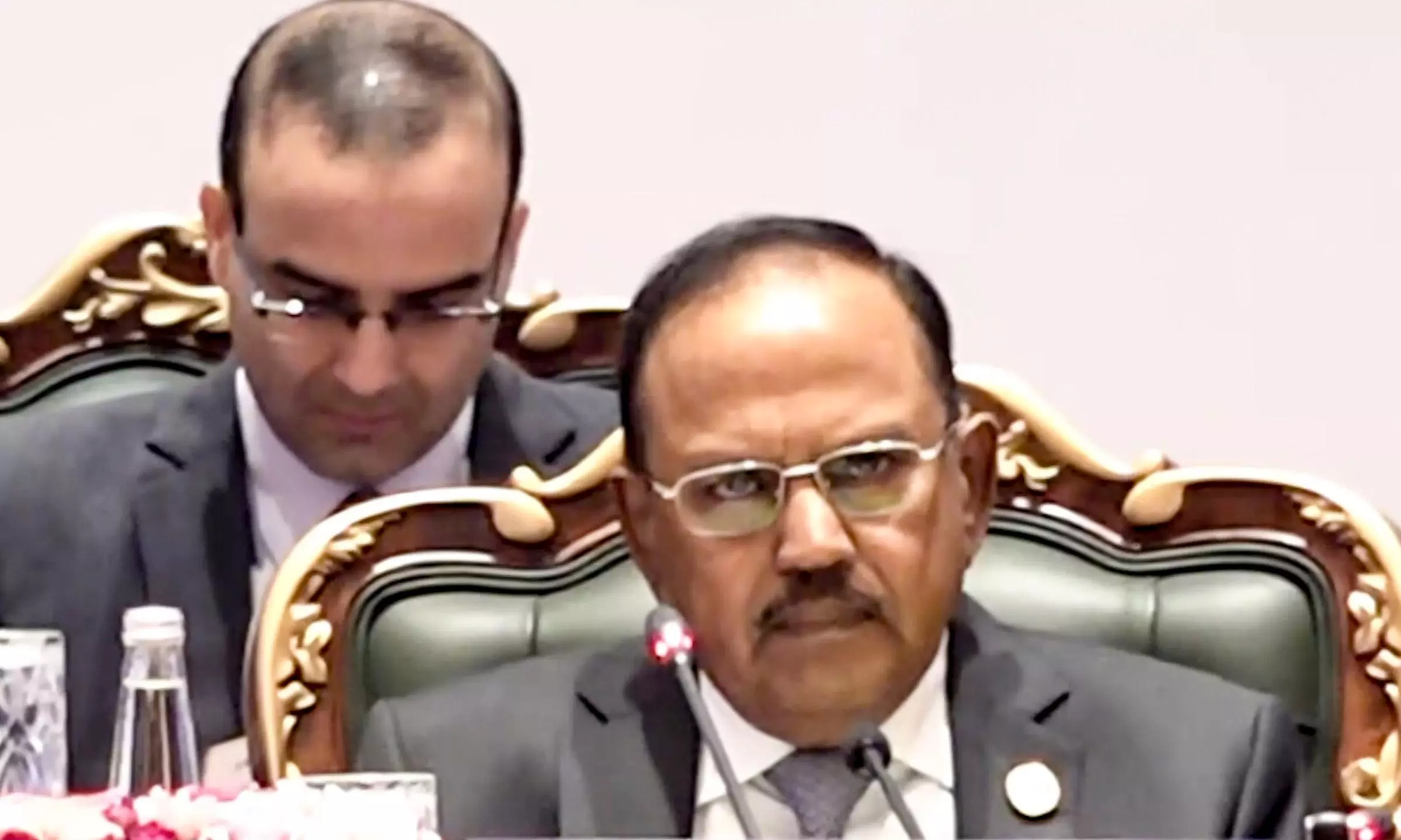
New Delhi: Even as National Security Adviser (NSA) Ajit Doval on Tuesday welcomed the MoU inked between the United States and Iran, New Delhi on Tuesday evening said that “since the signing on June 17 of the MoU, 11 India-bound vessels have transited through the Strait of Hormuz that include three Indian-flagged crude oil tankers, each carrying over 2,85,000 MT crude oil.
At the BRICS NSAs’ meeting, Doval was quoted as saying, “We have got cautious optimism, and we hope that it will work. It will help energy security. The opening of the Strait of Hormuz is a very welcome development. It will remove supply chain bottlenecks and (address) shortages in sectors like fertilisers and chemicals.”
In the evening, at his weekly briefing, MEA spokesperson Randhir Jaiswal said 10 India-flagged vessels were in the Persian Gulf region, and two more had recently arrived there.
The MEA spokesperson said the NSA had earlier on Monday met Iranian deputy secretary for defence Ghadir Nezamipour — who is representing his country at the BRICS NSAs meeting — and had “reviewed the ongoing situation in West Asia” besides discussing cooperation within the BRICS grouping and also discussing bilateral ties.
Doval also met Russian Security Council secretary Sergei Shoigu on Tuesday evening on the sidelines of the 16th BRICS NSAs Meeting during which they “discussed their ongoing cooperation under the BRICS framework, including some proposals put forward by Russia and also reviewed progress on their bilateral cooperation in different spheres, in keeping with the India-Russia Special and Privileged Strategic Partnership”.
In a statement later on the deliberations at the 16th BRICS NSA meeting that was held on Tuesday in the Capital, the MEA said that they exchanged views on security challenges confronting the world and deliberated on challenges related to energy security, food security, supply chain security, emerging technologies utilized by terrorist networks, cyber security and climate-induced instability. The MEA added that they “reaffirmed their commitment to combating terrorism in all its forms and manifestations” and also jointly called on Prime Minister Narendra Modi after their deliberations. India will host the BRICS Leaders’ Summit in the Capital in September this year.
Earlier in the day, at the start of the meeting, Doval was quoted as stating: “We need to be cognizant of the new security threats and challenges. Non-traditional threats have transcended national borders and have developed defeat systems against conventional responses. Innovative disruptive technologies, more camouflaged variants of terrorism, cyber threats, in a world are getting increasingly digitised.”
“They all constitute an important threat for us. Today, we will be navigating some of these non-traditional security challenges in our collective deliberations here. We will also discuss the outcomes of the two BRICS joint working groups on counter-terrorism and on the security in the use of information and communication technologies. I look forward to your valuable interventions,” Dival said.
He added, “We are meeting at a very tumultuous time. The world is beleaguered by military conflicts and complex security problems. It is facing geopolitical uncertainties, economic strains, and disruptive technology. Not only that the threats are compounding, but the instruments and institutional mechanisms are increasingly finding themselves to be inadequate to resolve or mitigate these conflicts. Multilateralism is on the decline.”
The 11-member-nation BRICS grouping comprises Brazil, Russia, India, China and South Africa, besides relatively new members Egypt, Ethiopia, Iran, Indonesia, United Arab Emirates (UAE) and Saudi Arabia, who joined the grouping in the past two years. Asked about media reports that India may supply the BrahMos supersonic cruise missiles to the UAE on its request, the MEA Spokesperson meanwhile pointed to the strong ties between India and the UAE that include the defence sector.
