Lunar Eclipse Enthrals Some, Disappoints Many In AP

The skies remained overcast from the afternoon, forcing many to miss the rare sight
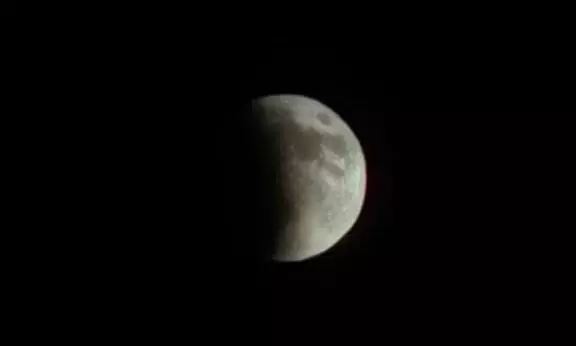
Visakhapatnam: Science enthusiasts, students, and curious citizens across Andhra Pradesh eagerly awaited the celestial spectacle of a total lunar eclipse on Sunday night, only to face disappointment in many regions as heavy rainfall and thick clouds obscured the view. The eclipse, which lasted more than five hours from start to finish, included a striking “blood moon” phase visible for about 82 minutes. Unlike solar eclipses, lunar eclipses can be safely viewed with the naked eye, binoculars, or telescopes.
In Visakhapatnam, the skies remained overcast from the afternoon, forcing many to miss the rare sight. Traditionally, residents observed the eclipse through telescopes set up at RK Beach by private agencies, but the viewing point remained closed this year. The StarDust Astronomy Club, which once offered telescopic views in Vizag, shifted its activities to Hyderabad. “I got more than 15 calls today about watching the Blood Moon from RK Beach, but it was not happening this time,” a club representative said. The group instead arranged eclipse viewings at Durgam Cheruvu in Hyderabad and Anantagiri Hills in Vikarabad.
Local science enthusiasts expressed regret at the lack of organized events. G.V.S. Prabhakar recalled past efforts by Gnana Vignana Vedika and the Physics Department of Andhra University. However, with the winding up of the Space Physics department after the retirement of senior professors, such initiatives have dwindled. Students now look forward to the upcoming Hybrid Planetarium atop Kailasagiri Hills, being developed by the VMRDA.
In sharp contrast, the skies in Anantapur district remained clear, offering uninterrupted views of the eclipse from start to finish. Residents were able to witness the celestial event with the naked eye, from its initial phase to the closing moments. The clarity of the night sky made Anantapur one of the few bright spots in the state for eclipse watchers.
In Tirupati, reactions were mixed. While some youngsters and students gathered on terraces to capture the “blood moon” with mobile phones, many families chose to remain indoors, guided by long-held superstitions about eclipses. Pregnant women were particularly restricted from venturing outside. By 9.30 pm, the normally bustling streets of the pilgrim city fell silent, as shops closed early and traffic thinned. For the younger crowd, however, the eclipse was an occasion to celebrate science over superstition.
In Vijayawada, cloudy skies with nearly 92 per cent average cover dashed the hopes of hundreds who gathered at Gandhi Hill, where the Vijayawada Skywatchers and Jana Vignana Vedika had made elaborate arrangements. Amateur astronomer A. Radhakrishna said, “The weather was a big barrier to viewing the lunar eclipse. We were waiting for a chance to view it if the sky cleared.” Organisers Pothina Uma and Velaga Srinivas expressed disappointment after putting in significant effort to prepare the site, which offered one of the best vantage points in the city.
Elsewhere, in Kakinada, Gnana Vignana Vedika president Alapati Srinivasa Rao said no special arrangements were made since the eclipse could be observed with the naked eye, though he promised telescopes for the next solar eclipse. In Nellore, the District Science Centre had planned a programme for students, but it was cancelled as the celestial event was scheduled close to midnight, making it difficult for children to attend. Reports indicated no official viewing arrangements were made in the city.
Traditional practices continued alongside scientific curiosity. Temples across districts remained closed after morning rituals, in keeping with customs during eclipses. Priests also issued astrological advisories; for instance, people born under Kumbha Rasi were warned against watching the eclipse as it coincided with Sathabhisha Nakshatram.
Despite the setbacks caused by weather and superstition, the rare lunar eclipse rekindled public interest in astronomy across the region, with many hoping for clearer skies and better arrangements during the next celestial event.
