A Carpet of Dreams: How Bhadohi Wove a Guinness World Record

12 Oct 2025 3:02 PM IST12 Oct 2025 3:02 PM IST
From Bhadohi to Kazakhstan, a thousand artisans came together during a pandemic to create the world’s largest hand-tufted carpet—a masterpiece that now lies in Astana Grand Mosque, etching India’s craftsmanship into global history.
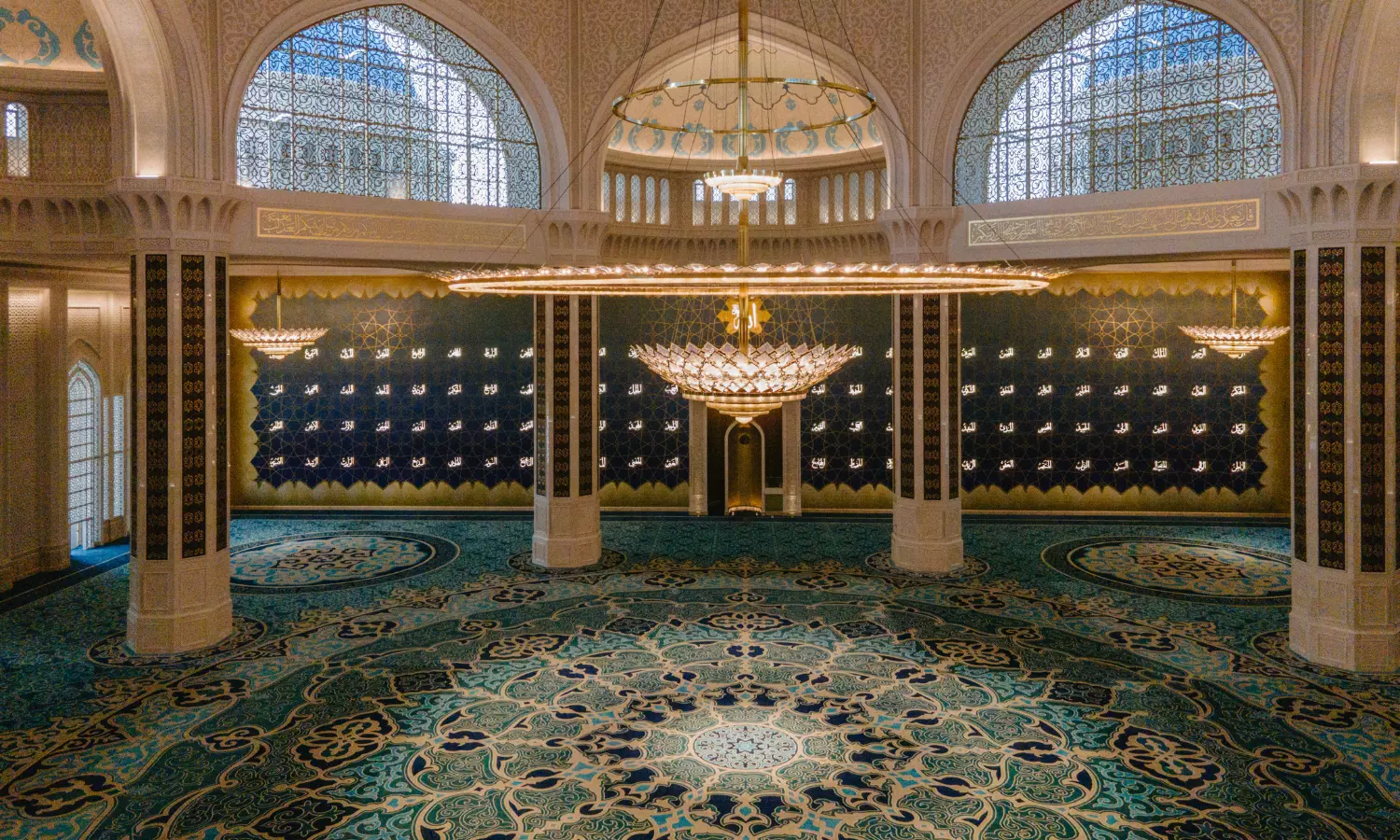
Photo by arrangement
For over a century, Patodia Contract has carried forward a tradition of carpet-making that began under the British in the 1880s. From the halls of the White House to the world’s grandest mosque, the company’s work speaks of timeless skill and innovation. At the heart of it all is Ravi Patodia, who shares how a record-breaking dream became a hand-tufted reality.
Ravi Patodia (Photo by arrangement)
Your company has a legacy of 144 years — how has the philosophy of craftsmanship evolved from the days of your forefathers to today’s global luxury markets?
The company was founded by the British in 1880, and at that time, they were the largest carpet makers in India. They continued until 1960, when my father came from Calcutta to Bhadohi to take charge of the company as a manager. He worked there for 10 years, and in 1970, I came from Calcutta after completing my graduation. That was when we started our independent business.
Since then, we have followed the same standards and ethics of carpet making that the British maintained. They upheld very high standards in terms of quality, business ethics, and discipline and that has become part of our culture. We started our carpet learning with the British, and today we continue to carry forward that legacy of craftsmanship, quality, innovation, and creativity.
You can imagine the scale of excellence from the fact that, about 50 years ago, we had carpeted the White House in the U.S. That itself speaks of our quality and excellence. We have continued to do similar high-standard work ever since. My family, my father, myself, and now the next generation has been in this business for over 55 years, executing complex, customized, and large-scale projects for five-star hotels in India and abroad.
People come to us when they have something complex to execute, be it a challenging shape, design, texture, or look because they know we have the capability. This world record project too is part of that journey. The design features a beautiful Arabic pattern, with colours and motifs that authentically reflect Arabic art and culture. They wanted it executed with great precision, and that was our effort and we succeeded.
Your carpets have adorned spaces as iconic as the White House and Burj Al Arab — what does it take for a design to meet such exacting standards of beauty and precision?
That comes from expertise something not everyone possesses. We have earned it over years of experience and hard work. We have a team that understands how to translate the expectations and inspirations of designers into reality. This is our USP.
In many cases, buyers who have their own design teams invite our designers to interact with theirs. Together, they interpret how a concept can be transformed into a carpet design. Achieving that standard of quality is not always about replication sometimes, the customer gives us inspiration instead.
It could be the waves of the sea, the leaves of a plant, or even an abstract form, and they may say, “We need something like this in black and white.” Understanding that vision and converting it into a carpet is the true expertise of our designers. We also contribute our imaginative skills to help them achieve that and that’s what sets us apart.
How do you balance artistic ambition with social and environmental responsibility?
This is very important to us. We have been in international trade for over 140 years as a company, and my family has been part of it for the last 55 years. In export, there are many compliances and standards you must maintain.
In the last 25 years especially, environmental standards like ISO 9001, ISO 14001 and SA 8000 certifications have become essential and we have all of them. We strictly follow these standards in terms of social responsibility, staff welfare, and environmental care.
For instance, we have a government-approved system for discharging water from our dyeing plant. We operate an ETP (Effluent Treatment Plant), and water is released only after 100% compliance with purification norms. We do this not because of compulsion, but because we feel deeply responsible towards society and the environment.
How did the idea of creating the world’s largest hand-tufted carpet first come about? Was it ambition, a challenge, or pure passion?
It began when we received an enquiry for this project from one of our overseas contacts, someone who knew our capability. It was a global tender, with many countries participating.
We had executed large projects before, but never something of this scale. So, we had several discussions within our production team to understand how we would manage it. It was a highly complex and demanding task and our reputation was at stake if anything went wrong.
After detailed internal planning, we decided to go ahead. There was tough international competition, but we won the project because we were the only company that could offer an end-to-end solution from manufacturing the carpet to shipping it to Kazakhstan, and finally installing it in the mosque.
Other bidders did not have installation capabilities, which became our trump card. That one-stop solution helped us secure the contract. Executing it to perfection, especially joining the massive sections seamlessly was a huge challenge, but we succeeded.
The project was executed during the pandemic — what kept your team motivated through such uncertain times?
It’s quite an interesting story. During the pandemic, when everyone was at home and out of work, we saw this as a good opportunity for our workers to give them a job in a safe environment.
We took 100% precautions. Everyone works with masks and proper distancing. We have the infrastructure to provide ample space, so no one was exposed to health risks. Most of our workers were local, which helped too.
Although managing operations during that time was extremely difficult, I truly believe God was watching over us. This carpet was being made for a mosque, and I feel divine blessings were with us throughout.
Logistics was another huge challenge there was a global container shortage. We had to ship the carpet in nine 40-foot containers, so we double-booked containers to ensure we didn’t face delays. For every shipment, we booked two containers; once one was confirmed, we cancelled the backup. It was a difficult time, but in the end, everything worked out perfectly.
Could you tell us more about the design inspiration?
The design inspiration was provided by the client, and it aligns with the ornamentation of the mosque. If you look at the video, you’ll see how the walls, pillars, domes, and interiors all coordinate beautifully with the carpet design.
It’s a Persian-style design, inspired by ancient Arabic mosques and there’s a strong visual and cultural continuity between the architecture and the carpet.
From Bhadohi to Kazakhstan — what does this achievement say about Indian craftsmanship on the global stage?
It speaks volumes about Indian craftsmanship. It’s a strong message not just to the Government of India and the Government of Uttar Pradesh, but also to the global design and architecture community.
Usually, for projects of such scale, people opt for machine-made carpets because hand-making something this large seems impossible. But this project has proven that hand craftsmanship can achieve what machines cannot.
Now that we have received the Guinness World Record, we will showcase it at important global events helping designers and decision-makers across the world learn what’s possible in India.
For example, in the Arabic world where palaces are built for kings, sheikhs, and royals designers will now know that such work can be done by hand, with this level of precision and beauty.
And when you can deliver that, beauty, comfort, and craftsmanship all together, the world takes notice.
Over a thousand artisans worked for six months — how did you manage collaboration, precision, and morale at that scale?
Yes, more than a thousand artisans worked continuously for about six months on this project. Managing such a large workforce was a big challenge because every person’s work had to align perfectly.
We relied on close supervision and careful coordination at every stage from dyeing and tufting to finishing and quality checks. Our senior team members and designers stayed fully involved to ensure accuracy and consistency throughout.
Since this was during the pandemic, providing a safe and hygienic environment was extremely important. We followed all precautions, masks, distancing, and adequate spacing. Most of the artisans were local, which also helped in smooth functioning without travel disruptions.
What truly kept everyone motivated was the pride of being part of something historic, the world’s largest hand-tufted carpet for a grand mosque. People saw it not just as an order, but as an honour for India and for our craft. That sense of purpose kept the entire team united, disciplined, and committed till the very end.
( Source : Deccan Chronicle )

Next Story