The Essence of Indian Fashion Is Timeless, adaptable and Rooted in Drape

Legendary fashion designer Tarun Tahiliani looks back on three decades of Indian fashion through drape, memory, history, and lived experience.
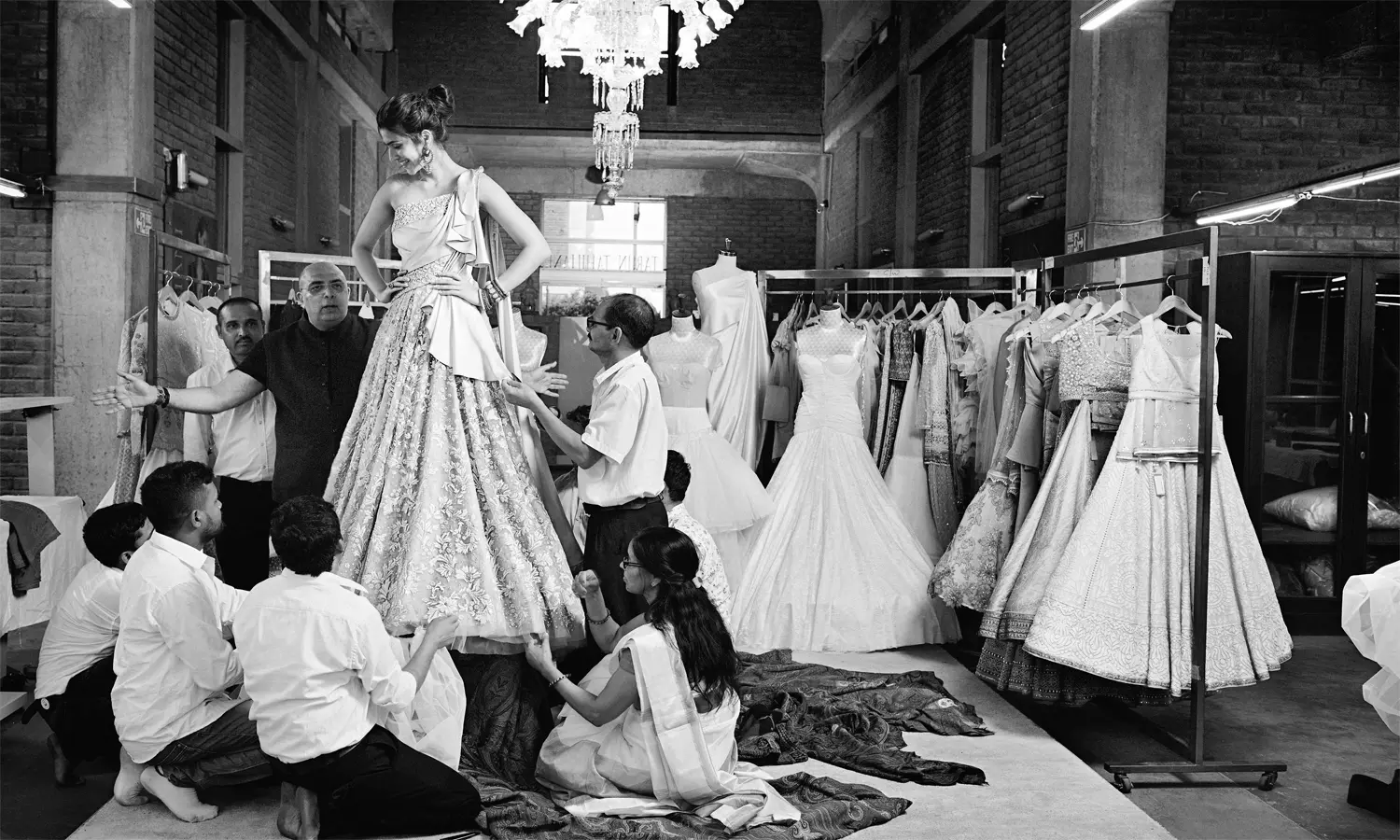
Hyderabad: As guests gathered from different parts of the world at the grand Taj Falaknuma Palace, Tarun Tahiliani began not with spectacle but with gratitude. He thanked everyone for being there and gently eased into a story he said he had told many times over the years. This time, he explained, it felt important to take people on a visual journey of what his understanding of Indian fashion had been, because Indian fashion, as he put it, “is like no other fashion in the world.”
He spoke of India first as a textile civilisation. For centuries, fabric was draped rather than constructed. Sculpture, miniature paintings and murals became the only way to understand how people dressed because there was no realistic documentation of clothing until the British arrived. “We had no actual, accurate depiction of what Indians wore,” he said, reminding the audience that India absorbed influences across time yet remained rooted in cloth. While many see Indian fashion as colour, embellishment and technique, his own fascination deepened when he travelled across the country and observed how people draped themselves. “If three people wore the same drape, they looked entirely different,” he said. Body, gesture and individuality shaped the garment. He compared it to three women walking into a room in the same Prada dress and looking almost identical. In India, sameness of fabric allowed for complete individuality.
He recalled that two hundred years ago, one could identify where they had landed in India simply by the way cloth was draped. Language, dialect and textile existed alongside distinct styles of wrapping. Fashion, he stressed, was never a constructed idea in India as it was in the West. It was fluid, instinctive and deeply personal. The saree, he explained, evolved not as a garment to be abandoned but one to be reimagined. His own journey into the structured drape and later the concept saree began because young women were forgetting how to wear sarees and panicking at the idea of them. He wanted something that felt like a saree but spoke the language of modern life.
As images moved from sculpture to Ajanta, Ellora and Elephanta, he spoke of fine gossamer fabrics, belting, sensuality and simplicity. Indian ornamentation, he said, came from how things were tied, jingled and carried. Drawstrings allowed garments to adjust, and prosperity was once signalled by fullness of form. “People wanted to look bigger,” he said, because it meant abundance. He moved across centuries with ease, from Pahari miniatures to Mughal India, where refinement came from wealth, stability and extraordinary textiles woven with real silver and gold. Sheerness existed not for display but for heat and comfort.
When tailoring entered India with the British, fashion shifted. He spoke of the White Mughal, James Kirkpatrick, and Hyderabad’s layered history, where Indian, Islamic and European influences met. Paintings by Raja Ravi Varma became a turning point, offering clear visual records of how people dressed. “That’s all we had,” he said, and from those images, fashion slowly began to take form once technical expertise arrived decades later.
He moved through independence and the symbolism of Gandhi’s khadi, calling the spinning wheel a unifier and a declaration of self-reliance. Simplicity became power. Post-independence socialism followed, and then India, where many remembered growing up in, with tailors, restraint and everyday clothing shaped by need rather than display.
His own story began to crystallise in 1987 in Bombay, in the city’s oldest building, when his wife met Sal and together they decided to start 'Ensemble'. They saw extraordinary Indian design being exported but unavailable at home. With little investment and a shared belief, Ensemble opened with designers who would go on to define Indian fashion. “That opening night was amazing,” he recalled, a moment when Indian design finally claimed space within India.
As Bollywood grew louder and more extravagant, he admitted to feeling disconnected from excess that lacked cultural grounding. In 2003, when Milan invited him to show, he was told clearly that if India was to be shown, it had to work through a global lens. That moment, he said, marked the birth of what he called India modern. “Let’s take a craft, lets take what is Indian, and let’s make it contemporary,” he said, adding that exporting was never his dream. He wanted India to dress itself.
The early years were difficult. The reviews were strong, but production failed, and reality hit hard. Yet the clothes endured. Pieces from 2003 were still wearable decades later. That, for him, was the essence of Indian fashion, timeless, adaptable and rooted in drape. He travelled through Kutch, Kerala and across communities, photographing men and women whose clothing was instinctive and unconscious. “That’s the beauty,” he said. Identity emerged not from design but from living with cloth.
He spoke candidly about excess in royal costumes and weddings, of brides weighed down by garments they could barely move in. “I have seen brides weeping,” he said, firm in his belief that beauty did not require suffering. His response was lightness, softness and garments that respected the body.
He reminded everyone that Indian fashion was too extraordinary to be reduced to machines or shortcuts. It needed care, restraint and understanding. “People want to be Indian. They just don’t know how to do it like their great-grandfather.” His life’s work, it seemed, had been about showing them how, not by invention, but by remembering.
