At Henry Cowell Redwoods State Park in California, interpreter Emily Tekler traces the stories of ancient trees that have endured fire, healed over their scars and continued to grow. Their survival offers a perspective on resilience, the cycles of a forest and the importance of protecting what remains of the old-growth redwoods.
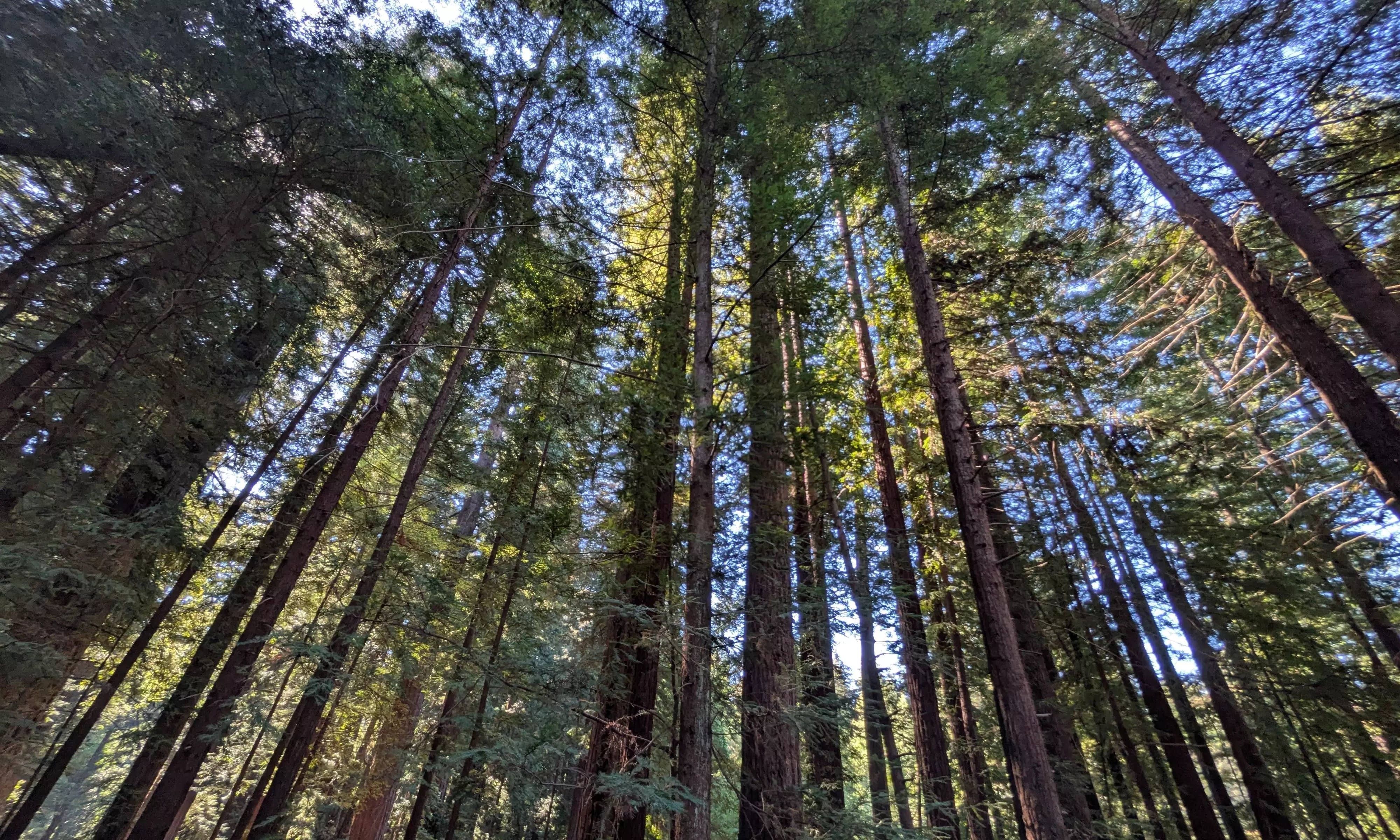
The first thing one notices about the redwoods at Henry Cowell Redwoods State Park is their size. Their trunks rise far beyond the reach of the eye, their bark bears the marks of another time, and the forest floor is shaded by a canopy that has stood through centuries of change. But look closer, and the trees begin to tell a different story. Some have hollowed interiors, some carry scars left by fire, and others have grown over the very damage that once threatened them. On World Sustainability Day, what could offer a better lesson than these tree? Curious much? Read on…
On a walk through the park, Emily Tekler, an interpreter with California State Parks, invites visitors to read these details as evidence of how a forest survives. “I encourage you to touch the bark and explore the different textures and the different colours,” she says, stopping beside a tree marked by fire. The damage is visible, but so is the life that continues above it. The leaves remain green, even where the trunk has been burned away in places.
Emily Tekler
California is known for raging wildfires, but Redwoods, Emily explains, have several natural defences against fire. Their bark can be extraordinarily thick, reaching as much as a foot in some places. Beneath it lies the living part of the tree, which carries water and nutrients up and down the trunk. Because this section is wet, it is harder to burn than dry wood. These features can help protect a tree when fire moves through the forest.
But they do not make redwoods invulnerable. “Redwoods can experience fire. They are pretty fire resistant,” Emily says, pointing to a cross-section of a tree that shows how a fire can enter the trunk and burn into its dry centre, known as the heartwood. Once a fire reaches this part, the damage can be substantial. In some cases, it creates a cavity inside the tree, leaving an opening that may remain long after the fire has passed.
What is remarkable is what can happen next. Redwoods can continue growing around the damaged section, gradually sealing the opening with new growth. Emily shows a section of wood where the outline of a fire scar can still be felt as a ridge. Each year, the tree has grown a little more around the wound.
“After the fire, you can see something pretty unique happens. Each year, the tree heals or seals a little bit more until about 15 years later, it closes that gap completely,” she says, referring to one example. “It really depends on the tree. It depends on the intensity and severity of the fire. And if we are in a drought or not that year, there’s a lot of different factors.”
A tree may look intact from the outside even when the evidence of an old fire remains hidden within it. Emily demonstrates this with one of her favourite examples. Knocking on the trunk produces a sound that suggests solid wood, but lean closer and you can hear that part of the tree is hollow. The bark has grown over the opening, concealing the cavity created by fire. “It’s not always obvious that a fire happened if it seals up,” she says.
For a story about sustainability, the redwoods offer a perspective that extends beyond the dramatic sight of a tree surviving a blaze. Resilience here is not simply the ability to withstand damage. It is also the slow process of recovery, the capacity to continue growing around what has been lost, and the interdependence that allows the forest to persist.
Some of the trees at Henry Cowell are old enough to make human history seem brief. One section of redwood displayed along the trail has been dated by its rings to around 2,200 years old. Emily describes it as the oldest redwood whose rings have been counted and documented, while allowing that older trees may exist.
“Trees, redwoods included, will put on a ring for each year,” she explains. The rings vary in size depending on how much rain or sunshine the tree received. In old-growth redwoods, they can be packed so closely together that they are difficult to distinguish without looking carefully.
The 2,200-year-old section gives visitors a way to measure time differently. Its growth began long before many of the events people use to mark history and the tree eventually fell in 1930. The wood that remains is a record of centuries of changing conditions.
Yet the history of the redwoods is not only a story of endurance. It is also one of loss. “Out of everywhere that the Coast Redwood has historically lived, we are in a 5% territory of where the old-growth trees still are,” Emily says. “Ninety-five per cent of the Coast Redwoods that were in existence got logged.”
Much of that logging took place in the late 19th century, when the trees were valued for their timber. The survival of old-growth stands at Henry Cowell is partly connected to a different use of the land. The area became a resort, offering people a place to visit and spend time among the trees rather than cutting them all down.
The park’s history is intertwined with Henry Cowell, who made his money producing lime from marble. The lime was used to make make the mortar and plaster that held the bricks together for buildings in San Francisco. After the 1906 earthquake, which devastated much of the city, the suitability of brick construction came under scrutiny and building materials changed, she says.
The trees, meanwhile, remained. Their survival through changes in the economy and the way people used the land has left a living record of the region’s past. The forest is not untouched by human activity, but it continues to provide a place where visitors can see what remains of an older landscape.
One of the most striking examples is a giant redwood with a fire cavity extending almost 30 feet up its interior. The tree was once used as a room at the resort. People carved a door-shaped opening into the existing fire cavity, added windows and according to the story passed down about the site, fitted the space with a bed and a wood stove. It was also known as the honeymoon suite.
The windows have since been sealed over by the tree’s growth and the opening that served as a door has gradually become smaller. Emily says visitors who return to the park after many years have noticed the difference.
The tree is both a reminder of the way people have interacted with the forest and an example of how a living organism continues to change around those interactions. Its hollow interior bears the evidence of fire, while the bark continues to grow over the opening. Standing inside it, visitors can look up into the darkened cavity and see how far the damage extends.
It is also strikingly quiet inside. The tree’s history is dramatic, but the experience of standing within it is subdued. It is a place where the effects of fire, the passage of time and the tree’s continuing growth can be seen together.
Not all the forest’s responses to fire are visible in a single trunk. Emily explains that redwoods can also regenerate by sprouting from their roots. Although thousands, perhaps millions, of tiny seeds fall onto the forest floor each year, many struggle to grow in the shade of an established old-growth forest.
The seeds are remarkably small. A single cone can contain around 100 seeds. A mature tree produces many cones, but the presence of seeds does not guarantee that new trees will grow. “They will rarely sprout. Not enough sunshine for them in this forest,” she says.
When a fire opens the canopy and more sunlight reaches the forest floor, conditions can become more favourable for seedlings. Redwoods can also produce new growth from their roots, allowing them to regenerate without relying entirely on seeds. In this mature forest, Emily says, many redwoods are effectively cloning themselves.
At nearby Big Basin, where a major fire occurred six years ago, she had seen new trees emerging. Henry Cowell, by contrast, is a mature old-growth forest, where the emphasis is more on nurturing the trees already established than on expecting large numbers of new seedlings to take hold.
The redwoods’ interconnected root systems offer another lesson in resilience. Their roots are shallow, extending only about five feet below the surface, but spread out over a wide area. Trees can fuse with one another, and their roots are intertwined underground. This helps anchor them in place, making it less common for redwoods to fall during storms.
“They are great, very community-oriented trees in that way,” she says.
The image is a useful one, although she is careful not to claim that every cluster is a single organism. Some trees that have grown together may be genetically similar, while others may be different. Without genetic testing, it is not always possible to tell precisely how they are related.
“It is both one tree and three or four trees,” she says of one particularly complex formation. “It’s hard to say whether it’s one tree or four tree without getting really nerdy about it.”
The uncertainty is part of what makes the forest interesting. Trees that appear to be separate can merge at their trunks; a hollow tree can remain alive; a fire scar can be sealed over so completely that it is no longer visible. The forest holds evidence that is easy to miss if visitors look only at what is immediately apparent.
For Emily, that is part of the point of slowing down and paying attention. A walk through the redwoods is not only about looking up at enormous trees. It is also about noticing the smaller processes that sustain the forest: the roots beneath the soil, the moss growing on fallen timber, the new shoots emerging from old trees and the insects and other animals that depend on decaying wood.
When a large redwood falls, the park generally leaves it where it is. The fallen trunk becomes habitat, supports moss and other growth and gradually contributes nutrients to the forest. Removing a massive tree would also require machinery that could damage the delicate root systems of the surrounding redwoods.
Emily offers a phrase to describe this change in perspective: “The death tree is the birth of a log.”
A fallen tree may appear lifeless, but its role in the ecosystem is far from over. It can provide shelter for small creatures, including salamanders and create conditions for other organisms to grow. What appears to be an ending becomes part of the forest’s next stage.
The park does remove some smaller fallen material, but it also manages the accumulation of branches and other vegetation on the forest floor. Emily points to piles of gathered material that are burned under controlled conditions during the winter. These prescribed burns are intended to reduce the amount of fuel that could otherwise contribute to a more intense wildfire.
“Starting fire in the best of conditions instead of fighting it in the worst of conditions,” she says, explaining the thinking behind the practice.
She also places the approach in a longer history of land management. Indigenous people in California have used fire in different ecosystems for thousands of years to maintain productive and healthy landscapes. The park’s prescribed burns are a modern management practice, but the wider history of using fire to care for land extends back much further.
Fire, then, is not simply an outside force that the forest must endure. Its effects depend on the conditions in which it occurs, how intensely it burns and how the landscape is managed. A fire can cause severe damage, but it can also create openings that allow new growth. The challenge is understanding those differences and managing the forest with them in mind.
The seasonal changes in the park offer another reminder that a forest does not always look its healthiest. Emily says the end of summer and beginning of autumn can make California’s landscape appear particularly dry or lifeless. The redwoods, however, retain their green leaves throughout the year, while moss and other growth respond to rainfall.
“When it rains, a lot more life. The moss perks up,” she says.
What looks dormant is not necessarily dead. Some plants are waiting for conditions to change, and the return of rain brings a visible shift in the forest. It is another form of resilience, less dramatic than surviving a fire but no less important to the rhythms of the ecosystem.
At Henry Cowell, these processes unfold on a scale that can be difficult to comprehend. The tallest tree in the park, known as the Giant, measured 282 feet the last time it was measured a few years ago, Emily says. It is not the tallest coast redwood in the world, but its height is enough to make visitors struggle to see its crown from the ground.
The scale can be overwhelming, but Emily repeatedly asks visitors not to climb on the redwoods or step on their roots. The root systems are sensitive, and even a small seedling can be crushed by a careless foot. “These trees are welcoming us into their forest and providing us lovely shade today,” she says. “And so it’s nice to take care of them in return.”
The request is simple, but it captures the relationship between people and the landscape. Protecting an old-growth forest involves more than admiring its most spectacular trees. It means recognising the fragile systems beneath them, allowing fallen wood to support new life, respecting the space in which seedlings grow and understanding why some parts of the forest need careful management.
The redwoods at Henry Cowell have lived through fire, logging, changing land use and centuries of environmental shifts. Their scars are not all visible, and their recovery does not follow a fixed timeline. But the forest offers a powerful reminder that resilience is not the same as being untouched. The trees have endured damage, changed around it and continued to grow.
At the end of the walk, the redwoods remain where they have stood for centuries, tall enough that their tops disappear from view. Their continued presence is not a guarantee that the forest will always remain as it is. The loss of most of the coast redwood old-growth habitat is a reminder of how much has already disappeared.
What remains at Henry Cowell is both a record of survival and a responsibility. The trees cannot tell their stories in words, but their rings, fire scars, hollow trunks and new shoots reveal what they have lived through. Protecting them begins with learning to see those stories, and understanding that the forest’s future depends on how people treat it now.

