Kiss Day Decoded : Art, Love, and a Little Lip-Lock Science

A smooch through history, biology, and Valentine’s Week.
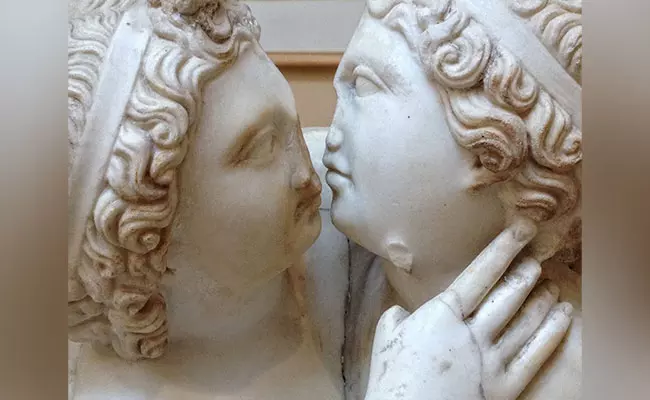
A kiss is one of the simplest gestures humans share, yet it carries an extraordinary depth of meaning. It can express love, longing, comfort, passion, reverence, reconciliation, and even farewell. Kiss Day, celebrated every year on February 13 just before Valentine’s Day, is dedicated to honoring this timeless expression of affection. Across centuries, kisses have inspired poets, artists, scientists, and lovers alike, leaving their imprint not only on canvas and marble but also on culture, ritual, and even human biology.
Gustav Klimt’s luminous masterpiece The Kiss (1907–1908)
Picture courtesy : Instagram
Auguste Rodin’s marble sculpture The Kiss
Picture courtesy : X
Francesco Hayez 's The Kiss
Picture courtesy : X
Edvard Munch - The Kiss
Picture courtesy : X
René Magritte - The Lovers
Picture courtesy : X
Even in ancient art, the kiss appears as a quiet but powerful motif. Roman frescoes discovered in Pompeii depict couples in tender embraces. Medieval illuminated manuscripts sometimes showed symbolic kisses representing peace or loyalty. Across civilizations, artists returned to the same theme because the gesture transcended language. As Victor Hugo once reflected that life is the flower for which love is the honey, these artists seemed to understand that the kiss is where that sweetness crystallizes into form.
Kiss Day itself, though modern in origin, taps into this long heritage. Unlike ancient festivals with clearly documented beginnings, Kiss Day emerged as part of Valentine’s Week, a cultural expansion of Valentine’s Day that gained popularity in the late twentieth century before spreading globally. Valentine’s Day traces its roots to Roman traditions and the legend of Saint Valentine, a priest said to have performed secret weddings for lovers. Over time, commercial creativity and cultural imagination shaped the days leading up to February 14 into a sequence—Rose Day, Propose Day, Chocolate Day, and others—each marking a stage in the unfolding narrative of romance.
Within that narrative, Kiss Day serves as the penultimate chapter. After admiration is expressed through flowers and feelings are confessed through words, a kiss represents trust and closeness. It is the quiet culmination of anticipation. Valentine’s Week unfolds almost like a love story: the first glance, the confession, the promise, and finally the moment of intimacy that confirms everything unspoken. As Ingrid Bergman beautifully observed, a kiss is nature’s way of stopping speech when words become superfluous. It is the turning point where declarations fall silent and emotion takes over.
Yet kissing is not only the territory of poets and painters; it is also the subject of science. When two people kiss, their bodies release oxytocin, often called the “love hormone,” which strengthens emotional bonds and builds trust. Dopamine surges through the brain, creating feelings of pleasure and reward, while serotonin helps stabilize mood. Cortisol levels decrease, reducing stress and promoting relaxation. In a surprisingly practical sense, kissing may even support immunity, as partners exchange small amounts of bacteria that help the body adapt and build resistance. A gesture that feels poetic is, at the same time, biologically purposeful.
Writers across generations have tried to capture this dual magic. Mae West once quipped that a man who can kiss well is usually a man who can do anything well, blending humor with insight about confidence and connection. Margaret Atwood, ever attentive to rhythm and repetition, suggested that while words accumulate power one after another, a kiss after a kiss after a kiss becomes passion itself. And Paulo Coelho has written that when we are in love, we open