When Art Stitches Together Nations, Cultures and Economies

Acclaimed artist NS Harsha reflects on how his 2007 installation Nations has evolved from an exploration of relationships between countries into a larger commentary on technology, human interconnectedness and the changing nature of our world. First conceived in 2007, ‘Nations’ brings together 193 sewing machines and colourful threads to explore the complex relationships that connect and divide the world. Making its India debut at Jaipur’s City Palace, the acclaimed artist discusses how the installation has acquired new meaning in an increasingly technology-driven world.
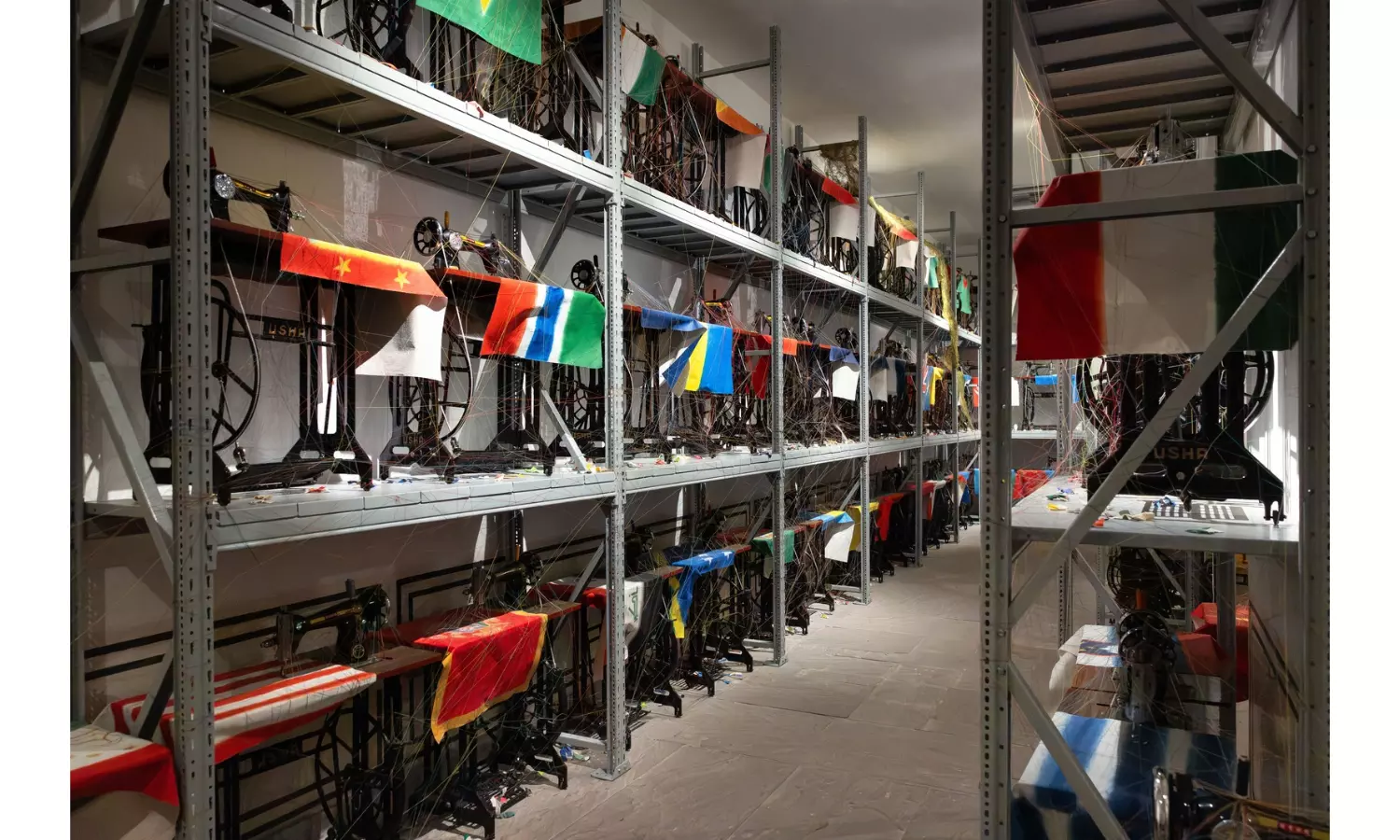
The world may be divided by national boundaries, flags and political identities, but its economies, cultures and people remain intricately connected. It is this paradox of a world that is simultaneously fragmented and interconnected that contemporary artist NS Harsha explores through Nations, an ambitious installation featuring 193 sewing machines linked by colourful threads.
First conceived in 2007, the installation is being presented in India for the first time as part of Traces of Us, a contemporary art exhibition celebrating 300 years of Jaipur at the City Palace. What began as an exploration of the complex relationships between nations has, over the years, acquired a larger meaning for the artist. Revisiting the work in Jaipur, Harsha finds himself thinking less about individual countries and more about the planet as a whole.
“Though I started with the idea of Nations as complex woven relationships between nations, during the installation this time, I felt it is more about our planet and structures of human communication. We humans have already started working at machine’s pace, so interconnectedness is largely driven by technology rather than culture, like in earlier times,” he says.
The choice of sewing machines as the central medium is particularly significant. For Harsha, the machine represents more than the act of stitching fabric. It becomes a metaphor for the relationships, dependencies and exchanges that hold societies and economies together. The 193 machines, connected through threads that stretch across the installation, create a visual representation of a world where no country can function entirely in isolation.
“When I think of India, I feel it is a country that is sewn together with many cultures, food and languages. Similarly, our world is at such a juncture that it is close to impossible for a country to operate or survive by being completely isolated from the world. Such a sewn state can be visualised best through a sewing machine,” he explains.
The artist also acknowledges the significance of Usha International’s association with the work, given the brand's long-standing connection with sewing and craftsmanship in India.
“In this context, it is amazing that Usha International responded and invested belief in this piece,” he says.
NS Harsha
The installation’s colourful threads offer another layer of interpretation. Some run freely between the machines, while others appear tangled, clogged or broken. Rather than being merely decorative elements, they suggest the uneven relationships between countries, reflecting the complexities of globalisation, economic dependencies and shifting alliances.
Harsha reveals that the threads themselves carry traces of the installation's earlier presentations. He has increasingly begun reusing threads from previous versions of the work, allowing their accumulated forms and textures to become part of its evolving visual language.
“Since last time, I have started reusing threads from earlier installations. They come in an entangled and clogged state. I use them to create different forms and shapes along with the sewing machine formations. With this new exercise, I have the facility to respond to the times in which the installation is being shown,” he says.
This ability to acquire new meanings without losing its original premise is central to how Harsha views the work. While the world around it continues to change, the fundamental idea of interconnectedness remains relevant. Political shifts, technological advances and changing global relationships may alter how audiences interpret the installation, but its underlying proposition remains constant.
“Art has an integral quality of being timeless. It anchors on certain eternal qualities of life. From time to time, readings may change, but this piece, at its core, has a constant proposition, which is the woven state of things,” he says.
The India debut of Nations also brings a new dimension to the installation, with its presentation at Jaipur’s historic City Palace. Despite having travelled to several locations around the world since its creation, the work had never previously been exhibited in India. The opportunity came through curator Udit Bhambri and Jaipur Centre for Art, who proposed bringing the installation to the city as part of the exhibition.
For Harsha, Jaipur’s historical association with power, leadership and cultural heritage made it a particularly meaningful setting, especially in the context of the city's 300-year milestone. The architecture, too, became an active part of the creative process, influencing how the installation was configured.
“Though it was created in 2007 and travelled to many places in the world, I never had an opportunity to show it here in India. It was indeed Udit Bhambri and JCA who proposed the thought. I felt it was deeply relevant because of the historicity of power, leadership and the idea of celebrating 300 years of Jaipur. Especially this time, the work has remoulded itself into the space, complementing the architecture,” he says.
Part of the larger exhibition Traces of Us, Nations is presented alongside works by artists including Arpita Singh, Bharti Kher, MF Husain and Shilpa Gupta. Through its use of familiar objects and an expansive visual vocabulary, Harsha’s installation invites viewers to look beyond geographical boundaries and consider the invisible threads that connect people, cultures and economies.
For a work first imagined nearly two decades ago, its renewed relevance lies perhaps in its ability to accommodate the contradictions of the present. The world may be increasingly connected through technology, yet the relationships that sustain it remain complex, fragile and constantly evolving. In Harsha’s hands, 193 sewing machines become a reminder that the world, much like a piece of fabric, is held together by threads that are rarely visible until we look closely.