Beyond Ready Mixes: MTR’s Fresh Batter Push Enters a New Category

MTR’s entry into fresh batters in Hyderabad reflects a larger shift towards region-specific innovation, blending convenience with deeply rooted culinary preferences.
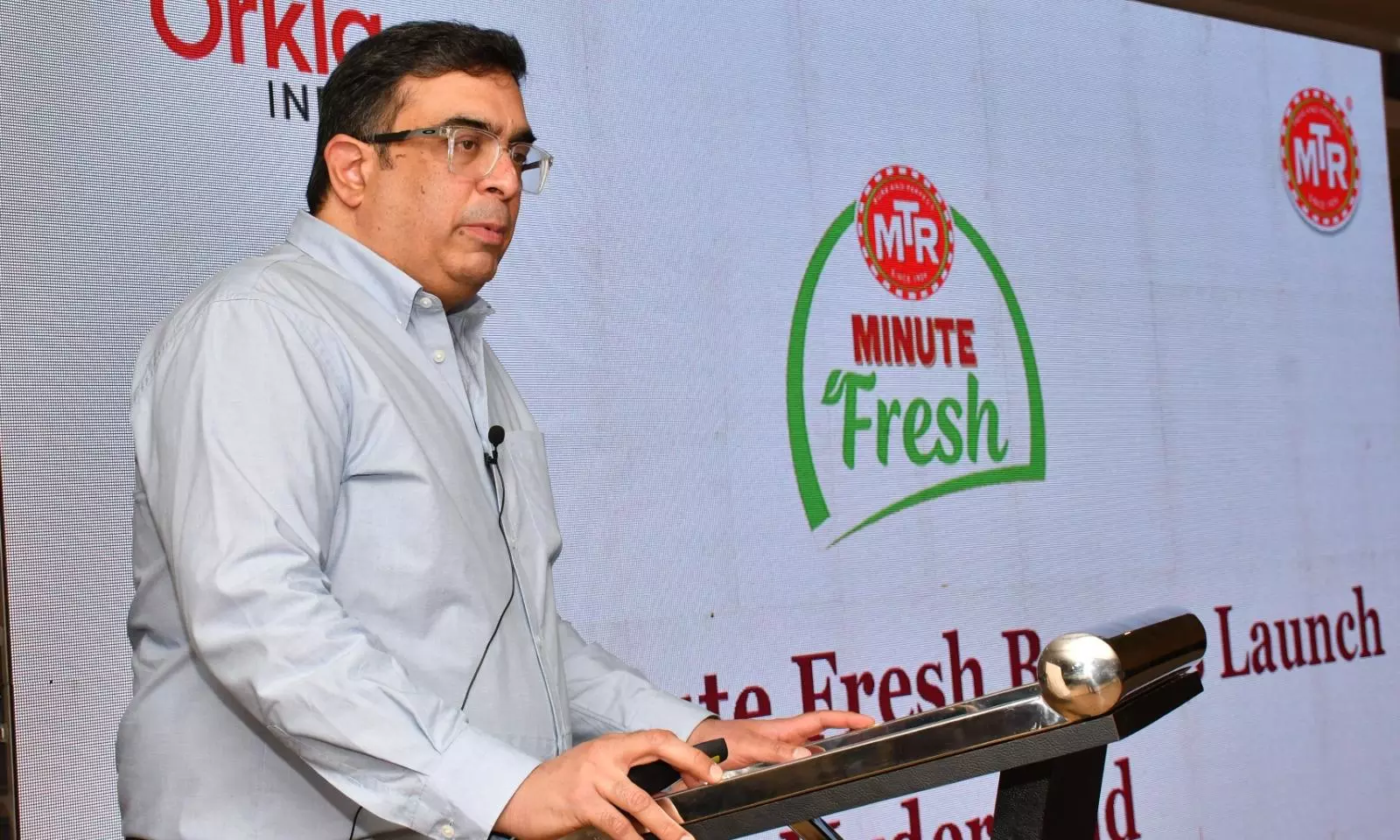
The move into fresh batters may look like a natural extension for MTR, but for Sunay Bhasin, CEO of MTR foods, it is less about launching a new product and more about responding to a shift that has been reshaping Indian kitchens.
“Consumer needs keep evolving,” he says, almost as a matter of fact. “The products are the same, but the formats change depending on what the needs are.”
That idea sits at the centre of MTR’s latest launch in Hyderabad, where the company has introduced its Minute Fresh Batter range with separate variants for dosa and rice rava idli. It is a decision rooted not in convenience alone, but in a deeper understanding of how food is still made and valued at home.
For a brand with a 102-year legacy, now part of Orkla India, this evolution has been deliberate. Orkla India itself, formed after the acquisition of Eastern, operates across three business units including MTR, with spices and convenience foods as its core pillars. Within that, breakfast has emerged as a critical category, contributing to nearly a third of its portfolio.
But Bhasin is quick to point out that innovation at MTR rarely begins in a boardroom. “It is not a one-time exercise,” he says, referring to the company’s cuisine centres of excellence in Bengaluru and Kochi. “Our team of chefs, along with R&D and marketing, are constantly working with consumers. They go to homes, they cook with them, they travel, they work with food historians and local chefs.”
That continuous immersion has built a repository of over 4,000 recipes, but more importantly, it has sharpened the company’s ability to decode regional nuances. The Hyderabad launch reflects exactly that. “These nuances, what differentiates one market from the other from an ingredient or recipe standpoint, that knowledge is quite deeply ingrained within the team,” he explains.
It is also why the company chose to introduce two distinct batters rather than a single, standardised product. In a market where many brands push uniformity for scale, MTR is betting on specificity. The insight, Bhasin says, came directly from consumers. “During the course of our survey, we learned that people in Andhra and Telangana prepare dosa and idli batters separately at home. One single pack does not do justice to that.”
The approach mirrors MTR’s broader strategy in the Telugu States market, where it has already introduced region-specific products such as spicy sambhar blends, karam podis and chilli variants tailored to local preferences. Andhra Pradesh and Telangana together account for a significant share of its demand, supported by a distribution network that reaches thousands of villages.
Anupam Nair, Chief Marketing & Growth Officer and Sunay Bhasin, CEO, MTR Foods display MTR Minute Fresh Batter Range in Hyderabad.
Yet, the shift to fresh batter brings its own set of challenges, particularly around quality and logistics. Unlike dry mixes or ready-to-eat meals, batter is a cold chain product, where even minor lapses in storage can affect taste and shelf life.
MTR’s answer has been patience. “That’s why we took three years to come here,” Bhasin says, referring to the company’s earlier rollout in Bengaluru. “We had to learn the entire system. There is a full dedicated supply chain that is built for this.”
The Hyderabad launch marks only the second market for the category, and the company is treading carefully. Distribution, at least for now, is focused on quick-commerce and e-commerce platforms, where temperature control can be more tightly managed. At the same time, MTR has put systems in place to monitor quality at the last mile. “If something doesn’t sell, we take it back,” he says, adding. “We don’t want to compromise on the consumer experience.”
The emphasis on experience is telling. For all the talk of convenience, Bhasin insists that taste remains non-negotiable. “People are more conscious today about convenience of a higher order, but also authenticity,” he says. “They don’t want to trade one for the other.”
That tension between speed and tradition is precisely where MTR sees opportunity. The company already caters to multiple consumer segments through different formats, from its three-minute breakfast range aimed at time-strapped users to its classic mixes for more involved cooking. Fresh batter, in that sense, becomes the next layer in an expanding ecosystem.
“It is a part of our evolution,” he says. What lies ahead is still being shaped. While the company has a pipeline of products, it is not in a rush to scale the batter business nationally. “One step at a time,” he repeats, a phrase that comes up more than once in the conversation.
For now, Hyderabad is both a test bed and a statement. It signals MTR’s intent to move closer to the consumer, not just through distribution but through a sharper understanding of how regional food habits are changing. In a category where much of the competition is either hyperlocal or heavily standardised, that middle ground could prove decisive.
And if there is one thread that runs through Bhasin’s thinking, it is this: staying relevant in Indian kitchens is less about reinventing what people eat and more about reimagining how they get there.
