For Doctors, Their Greatest Teachers Are Patients Themselves

On Doctors' Day, five specialists share the unforgettable patients who transformed not just their careers, but the way they view medicine, their hopes and the human spirit of never giving up
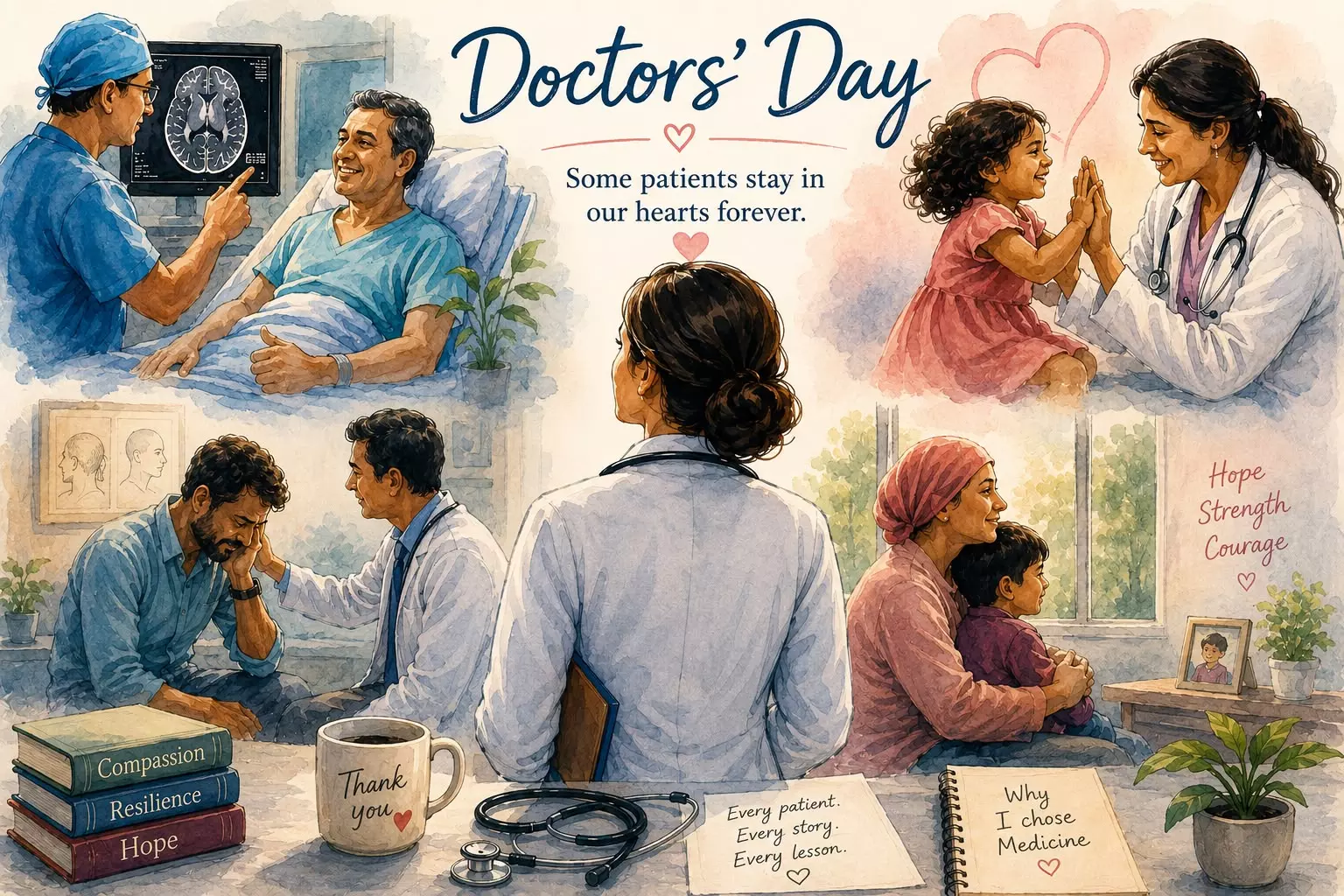
For doctors, thousands of patients pass through their consulting rooms over a lifetime. Diagnoses blur into one another, surgeries become routine and years of practice sharpen both instinct and skill. Yet almost every doctor carries the memory of one patient who refused to become just another case history. They are the ones who altered perspectives, challenged medical certainty and reminded doctors that healing is as much about humanity as it is about science.
Dr. Shighakolli Ramesh, Senior Consultant Neurosurgeon, Medicover Hospital.
For Dr. Shighakolli Ramesh, Senior Consultant Neurosurgeon, Medicover Hospital, Secunderabad, that patient arrived in the most critical condition imaginable. A 50-year-old was brought in with deep coma, rapidly worsening neurological status and on ventilator support. Investigations revealed a lesion deep within the brain that had caused obstructive hydrocephalus, making emergency intervention the only option.
"The patient underwent emergency neuroendoscopic surgery for excision of the lesion along with cerebrospinal fluid (CSF) diversion. The postoperative recovery was gradual but remarkable. The patient regained consciousness, was successfully weaned off the ventilator, and eventually walked out of the hospital independently," recalls Dr. Ramesh.
Seven years later, follow-up MRI scans continue to show no recurrence. Looking back, the case reinforced a lesson that has stayed with him ever since. "Cases like these remind us that, as doctors, our responsibility is to make the right diagnosis, offer the best possible treatment, and never lose hope. Not every outcome is predictable, but extraordinary recoveries do happen. Our duty is to give every patient the best chance possible, because sometimes, what seems impossible today becomes tomorrow's miracle."
Dr. Sai Manasa Darla, Clinical Head and Fertility Specialist, Oasis Fertility.
For Dr. Sai Manasa Darla, Clinical Head and Fertility Specialist at Oasis Fertility, the patient she can never forget was only two days old. The newborn had been born with an impending rupture of a myelomeningocele over her spine. Delaying surgery could have resulted in life-threatening meningitis and lifelong disability.
What stayed with Dr. Darla was not merely the complexity of the operation but the memory of anxious parents handing over their newborn, trusting strangers with their child's future. Years later, an unexpected invitation arrived for the little girl's third birthday.
"When I saw her running around, smiling, playing with other children and excited to begin school, it was an emotional moment that is difficult to put into words. In that instant, I wasn't thinking about the surgery, I was thinking about the life she had ahead of her."
That reunion reshaped how she viewed every child entering the operating room. "Experiences like this remind me that our work is not just about treating a disease. It is about giving a child the opportunity to grow up, chase dreams and create memories with their family. That little girl changed the way I see every patient who comes into my operating room."
Not every life-changing patient arrives with a life-threatening illness. Sometimes, they come carrying invisible wounds.
Dr. M. Venkateswar Rao, Hair Research and Transplant Surgeon and Founder of Goglo Hospital.
For Dr. M. Venkateswar Rao, Hair Research and Transplant Surgeon and Founder of Goglo Hospital, one middle-aged man seeking a hair transplant changed his understanding of cosmetic surgery. The Telugu expatriate, a sportsperson based in the Middle East, had endured unimaginable personal tragedy. His marriage had ended, he had lost his young son following heart surgery, and depression had consumed him. Rebuilding his life, he felt, had to begin with rebuilding his confidence.
Having travelled across several countries, he had repeatedly been told that his advanced baldness could not be treated. During consultations, he broke down while recounting his journey. Performing the transplant made Dr. Rao realise that aesthetic procedures are rarely just about appearance.
The experience reminded him that restoring someone's confidence can be just as transformative as treating an illness. For some patients, a renewed sense of self becomes the first step towards reclaiming life after devastating loss.
Dr. Kishore B. Reddy, Managing Director and Chief Ortho-Oncologist at Amor Hospitals.
For Dr. Kishore B. Reddy, Managing Director and Chief Ortho Oncologist at Amor Hospitals, one young mother forever changed his understanding of resilience.
She was an Indian living in Australia, barely in her twenties, diagnosed with stage IV osteosarcoma of the thigh bone. She had a newborn son and knew her prognosis was poor. Most patients with advanced disease survive little beyond a year, but she had only one goal, to stay alive long enough for her son to grow old enough to remember her.
"She taught me how to fight life," says Dr. Reddy. "All of us in the medical fraternity gave her a life expectancy of one to one-and-a-half years. But with her sheer willpower, she survived for five years."
Despite the cancer spreading to her lungs, she continued to battle the disease, living long enough to see her son begin school before eventually passing away. Dr. Reddy says she left him with a lesson no medical textbook ever could. "One thing she has taught me in life is that the mind is very strong and if the mind is determined, the body will listen to it."
Medicine often celebrates breakthroughs, technologies and successful procedures. Yet, for the doctors who dedicate their lives to healing others, their greatest teachers are often the patients themselves. Through impossible recoveries, extraordinary courage, unwavering hope or the quiet determination to keep going despite overwhelming odds, these individuals leave behind something far greater than medical records.
Long after prescriptions are forgotten and hospital corridors fade from memory, they continue to remind doctors why they chose medicine in the first place, not simply to cure disease, but to stand beside people in the most defining moments of their lives.
