The brain is vulnerable at every stage of life. What changes is the nature of the threat — and the width of the window to intervene.
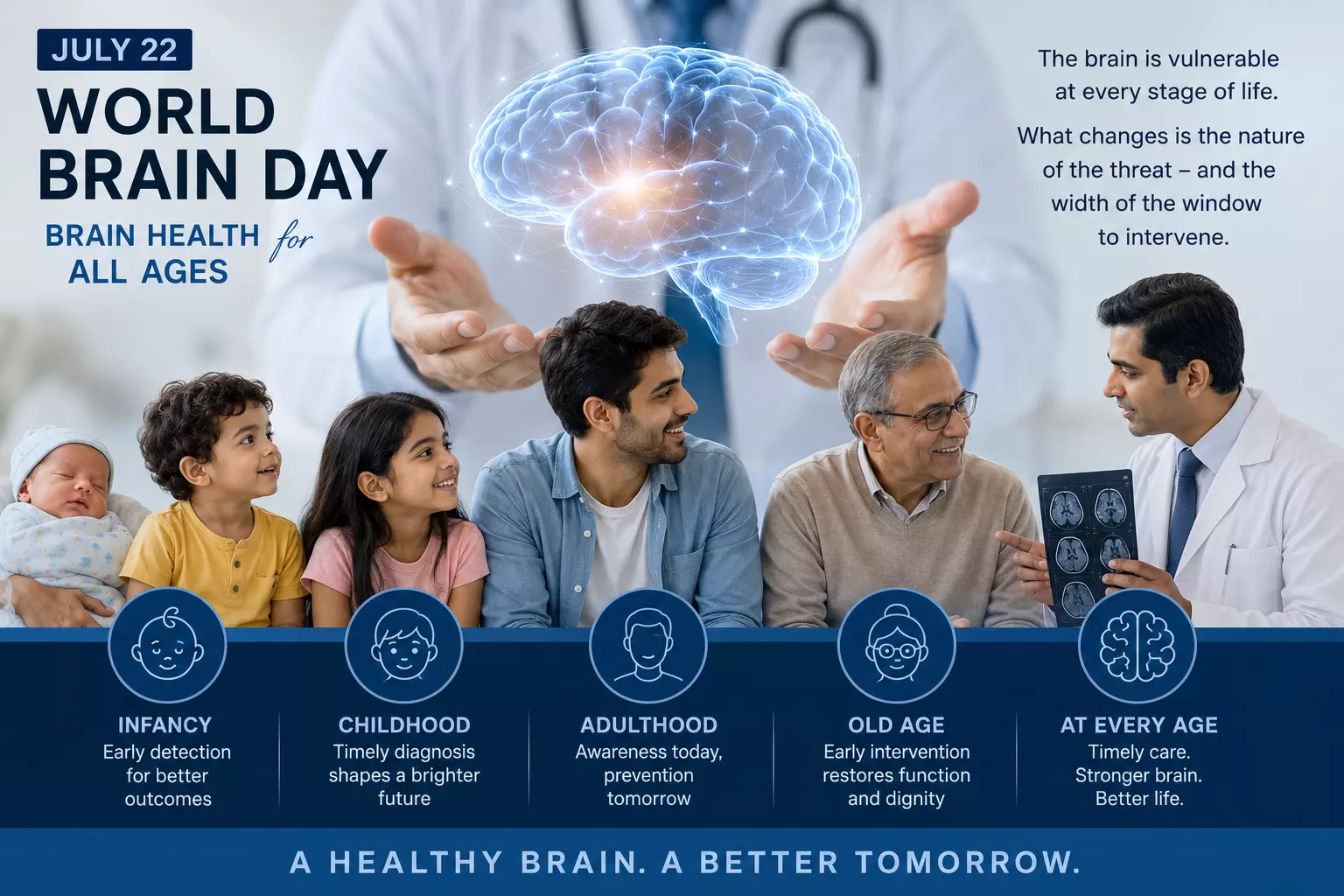
Every July 22, the World Federation of Neurology observes World Brain Day. This year's theme — Brain Health for All Ages — is, for a neurosurgeon, not an awareness campaign. It is a clinical reality I navigate in my OPD every week.
The brain is vulnerable at every stage of life. What changes is the nature of the threat — and the width of the window to intervene.
In Infancy
Hydrocephalus — abnormal fluid accumulation in the brain — affects 1 to 3 per 1,000 live births globally. For decades, the standard treatment was a ventriculoperitoneal shunt: a permanent mechanical device that fails, gets infected, and follows a child through every year of their growing life with revision surgeries.
Endoscopic third ventriculostomy, a keyhole procedure that creates an internal cerebrospinal fluid pathway within the brain itself, has in appropriate patients substantially reduced the need for permanent shunts. The critical variable is timing. Families who arrive in the first months, when the brain is most plastic and the endoscopic approach most viable, have fundamentally better outcomes than those who arrive after a year of watching their child deteriorate.
Neural tube defects affect approximately 1 in 1,000 births in India according to ICMR data. These are conditions requiring neurosurgical assessment within days of birth — not months.
In Childhood
Brain tumours are the leading cause of cancer-related death in children. Epilepsy is the most common chronic neurological condition in the paediatric age group, affecting approximately 10 million children in India. For those with drug-resistant epilepsy — seizures persisting despite two or more correctly chosen medications — surgery achieves seizure freedom in 50 to 86% of cases, according to data published in the Annals of Indian Academy of Neurology. Medication alone in this cohort achieves less than 5%.
Yet in Telangana and Andhra Pradesh, the majority of children with drug-resistant epilepsy never reach a neurosurgical evaluation. The stigma around seizures, misdiagnosis as behavioural problems, and family fear of brain surgery conspire to delay a referral that could alter a child's neurological future.
In Adulthood
The 25 to 50 age group presents the greatest mismatch between symptom onset and treatment-seeking. Brain tumours affect 5 to 10 per lakh population in India, with a significant cluster in the 35 to 55 age group. Road traffic accidents — responsible for 60% of all traumatic brain injuries in India per the Indian Head Injury Foundation — predominantly strike working adults.
What I see consistently in this cohort is not ignorance. It is rationalisation. Persistent headaches attributed to stress. Mild weakness on one side dismissed as fatigue. A first seizure explained away as overwork. By the time these patients reach a neurosurgeon, the window for the most straightforward intervention has often narrowed considerably.
Minimally invasive and endoscopic techniques have changed the surgical equation substantially. For many planned brain and spine procedures, discharge within 72 hours and return to work within two weeks is achievable. The fear of brain surgery that delays presentation is based on a picture of neurosurgery that is twenty years out of date.
In Old Age
Normal pressure hydrocephalus — causing gait disturbance, cognitive decline, and urinary incontinence — is routinely misdiagnosed as Alzheimer's disease in elderly patients. It is surgically treatable. Chronic subdural haematomas following seemingly minor falls are common in the elderly, and when evacuated early, recovery is rapid and complete. Both conditions share a pattern: families accept deterioration as inevitable aging when it is in fact a reversible surgical problem.
The One Message
The World Federation of Neurology's five messages for World Brain Day 2025 are awareness, education, prevention, access, and advocacy. The sixth, which I would add from a neurosurgical standpoint, is timeliness.
Every stage of life carries neurological conditions that are treatable — and in many cases curable — when caught at the right moment. The failure in India is not surgical capability. It is the time lost between first symptom and first consultation.
The brain does not give second chances as generously as other organs. But it does give them — if you come in time.
The article is authored by Dr. Ramesh Shighakolli, Senior Consultant Neurosurgeon, Medicover Hospitals, Secunderabad