Gaurav Gupta Couture Unveils The Divine Androgyne At Paris Couture Week, Spring/Summer 2026

The Divine Androgyne collection has newly developed embroidered filament architecture, created through a proprietary thread-engineering technique in the atelier.
Looking back at his previous Paris Spring/Summer 2025 collection, Across the Flame, several media outlets referred to Gupta’s life partner, Navkirat Sodhi, as his wife. A label casually assigned, yet deeply revealing. For the couturier, this moment became a catalyst for inquiry. Why must relationships be defined through rigid structures? Why must identities be fixed within social hierarchies? Why must energies be named before they are felt?
This misunderstanding did not end in clarification but opened a deeper space for reflection.
The Divine Androgyne questions not individuals, but the deeper binary frameworks through which relationships are defined. Deep at its heart lies the ancient Indian school of philosophy of Advait or non-duality. Its essence views all existence as one.
Time is treated not as chronology but as material. Space, not as distance but as architecture. The body becomes a site where these forces are negotiated. Architecture and anatomy. Matter and memory. Consciousness and energy. Creation and dissolution. These are not opposites in conflict but delicately balanced systems that generate the very seed of life through their dependence on each other.
A defining technical foundation of the season emerges through a newly developed embroidered filament architecture, created through a proprietary thread-engineering technique in the atelier. Thousands of fine threads are structured into web-like networks that map nervous systems and energy points across the body. This language appears most powerfully in the paired twin silhouettes, where two bodies are connected through continuous cords, and in a black, body-mapped gown that traces the invisible circuitry of the human form. Each of these garments required approximately 700 hours of hand embroidery, transforming thread into living anatomy.
The collection then enters a restrained exploration of a fantasy forest, where bloom and decay unfold as parallel states of existence. This language appears with precision in a sculpted bridal gown and a sari gown, where nature is treated not as ornament, but as structure. Mogra, Indian jasmine, is engineered directly into the architecture of these garments as a sacred material language. In the white bridal silhouettes, rebirth replaces ceremony, and the bride emerges as transformation. Each of these pieces required over 900 hours of embroidery and the collaboration of nearly 50 artisans. From here, the collection turns towards origin and the earliest states of becoming. In a focused exploration of the first creatures, hybrid surfaces and engineered resin constructions imagine the first attempts of matter to organise itself into life. This language appears most strikingly in a cosmic gown constructed from over 2,000 individually placed resin elements, assembled to form a shifting, extraterrestrial surface. These silhouettes imagine creation not as a finished form, but as a fragile experiment in becoming.
Space and time unfold as a single continuum. Across sculpted gowns and corseted silhouettes, crystallised networks and deconstructed watch components trace orbital formations on the body. Clock hands, silver bases, and mechanical plates are reimagined as ornament, revealing the anatomy of time on the surface. Rooted in the Vedic philosophy of cyclical time, the designs collapse past, present, and future into one form, with Preciosa crystals introducing a controlled, mapped luminosity. Sculpted ruffles and corded structural lattices express balance as a living, unstable state in a final quest for equilibrium. These constructions shape movement, gravity, and cosmic order within the same surface.
This search culminates in a monumental temple-statue inspired corset, sculpted through a custom-developed fibre moulding technique. Taking approximately 700 hours from conception to completion, the form resembles sacred stone in motion, as if a temple sculpture had stepped out of time and into breath.
Couturier Gaurav Gupta says, “Every silhouette in this collection is built as a living structure. We are not decorating the body, we are mapping consciousness, memory, and movement onto it through craft, architecture, and time. These garments are meant to feel alive, as if they are still in the process of becoming, carrying within them the tension between what is seen and what is felt.”
Crystals are realised through a continued collaboration with Preciosa, the Czech heritage house renowned for precision-cut Bohemian crystal. This third collaboration integrates over 30,000 crystals across the collection, introducing controlled luminosity and reinforcing the dialogue between light, matter, and form.
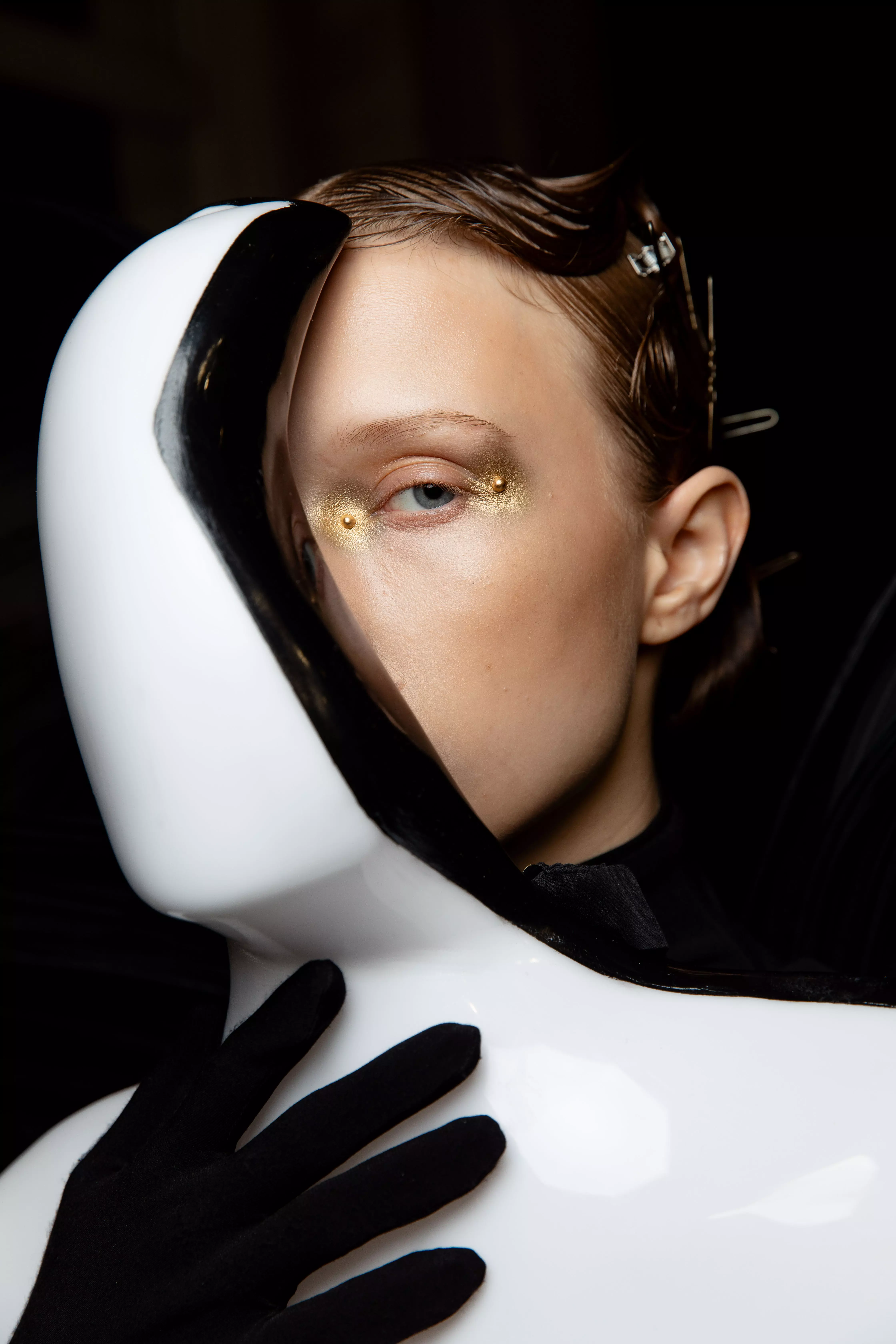
The collection’s metaphysical vision is further brought to life through makeup crafted by Marieke Thibault, Global Senior Artist, MAC Cosmetics. Drawing from the ancient language of marma points, the beauty narrative maps energy across the face through illuminated half-moon spheres and a light-struck skin finish. As Thibault notes, “Faces become cosmic surfaces, mapped with energy. A fluid, gender-transcendent anatomy is enhanced through layers of ultra-reflective textures—using MAC Lightstruck Liquid Skinfinish—infused with metallic pigments and studs shifting from white to gold to silver.”
At its foundation, The Divine Androgyne examines balance as form. Not as an idea, but as architecture. A body where opposing forces are held in the same frame, and transformation becomes the only constant.
