Odisha Bets On Rare Earths, Ocean Science, Space To Drive Next Growth Phase

Centre, state draw up roadmap spanning critical minerals, marine biotech, life sciences and space manufacturing.
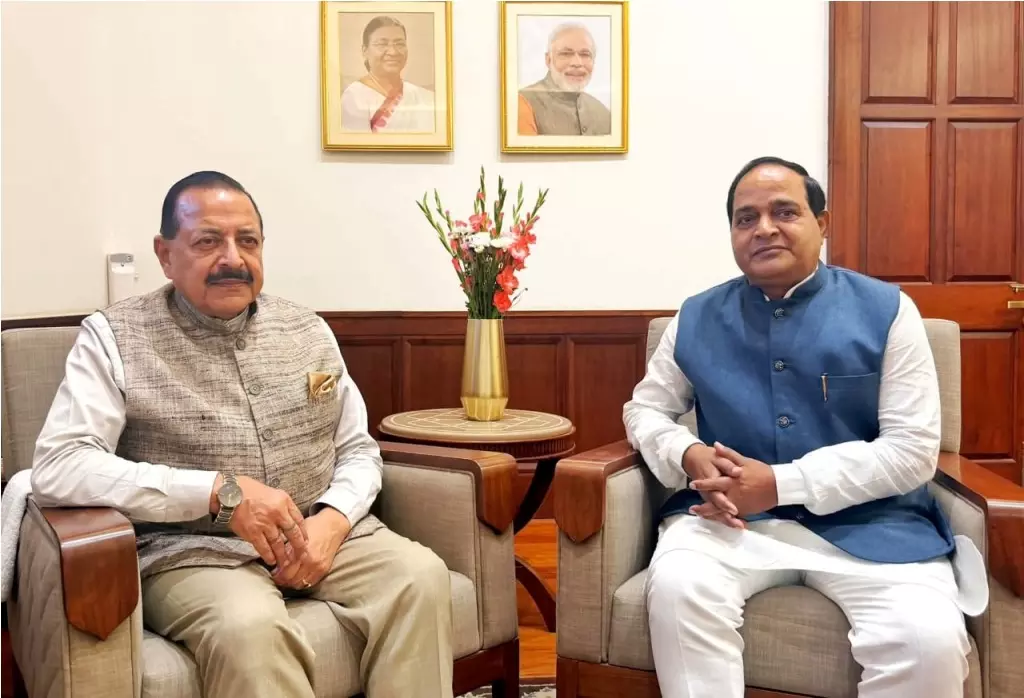
Bhubaneswar: Odisha is seeking to recast its development story around science, technology and high-value manufacturing, with the Centre and the state working on an integrated roadmap covering rare earths, marine biotechnology, space technology, life sciences and deep-sea resources.
The roadmap took shape during a meeting in New Delhi on Tuesday between Union minister of state for science and technology and earth sciences Dr Jitendra Singh and Odisha science and technology minister Krushna Chandra Patra.
The strategy seeks to leverage Odisha’s mineral wealth, 480-km coastline, marine biodiversity and growing network of scientific institutions to create new research, industrial and employment opportunities.
At the centre of the plan is Odisha’s proposed role in the Rare Earth Corridor (REC) announced in the Union Budget 2026-27. Odisha is among four states identified for dedicated rare-earth corridors, along with Kerala, Andhra Pradesh and Tamil Nadu.
The corridors are envisaged as integrated ecosystems covering exploration, mining, processing, research and manufacturing. For Odisha, this could open opportunities in advanced materials and other strategic industries while helping the state move beyond its traditional extraction-led economic model.
Marine biotech push
Odisha is also seeking to turn its marine resources into an engine of biotechnology-led innovation through the Odisha Marine Biotechnology Research & Innovation Corridor (OMBRIC).
The initiative brings together IIT Bhubaneswar, Berhampur University, Fakir Mohan University, NIT Rourkela, IISER Berhampur and the Institute of Life Sciences (ILS), Bhubaneswar. The next phase is expected to deepen collaboration with CSIR and the Department of Biotechnology.
The meeting also cleared the way for expansion of the Institute of Life Sciences, with the Odisha government to provide 50 acres of additional land. The expansion is expected to strengthen biotechnology research under the Bio-E3 framework — Biotechnology for Economy, Environment and Employment.
Space, deep ocean on radar
Space technology has emerged as another potential growth area. Discussions included closer cooperation between Odisha’s space capabilities and ISRO and the possibility of establishing a Space Research and Manufacturing Centre through a public-private partnership.
The roadmap also covers the Deep Ocean Mission and deep-sea fisheries. Odisha’s Deep Sea Fishing Mission (2026-2036) aims to expand offshore fishing and strengthen the marine economy.
The proposed Science City is another component of the emerging ecosystem, with a focus on scientific awareness, experiential learning and encouraging young people to pursue science and technology.
The Centre and state have also discussed stronger coordination among scientific institutions in Odisha to develop joint programmes spanning critical minerals, marine sciences, biotechnology, Earth Sciences and space technology.
Dr Jitendra Singh said the eastern coastal region could play a larger role in India’s emerging nuclear and marine roadmap, with Odisha capable of making a significant contribution.
The larger ambition is to move from resource extraction to research, innovation, value addition and manufacturing. The challenge will be converting these initiatives into commercially viable technologies, skilled jobs and new industries. If sustained Centre-state coordination delivers on the roadmap, Odisha could emerge as a major science and technology hub on India’s eastern coast.
