Ladakh Cracks Down On Illegal Off‑Roading In Wildlife Zones

₹2 Lakh Penalty Imposed on Tourists for Violating Fragile Wildlife Zones.
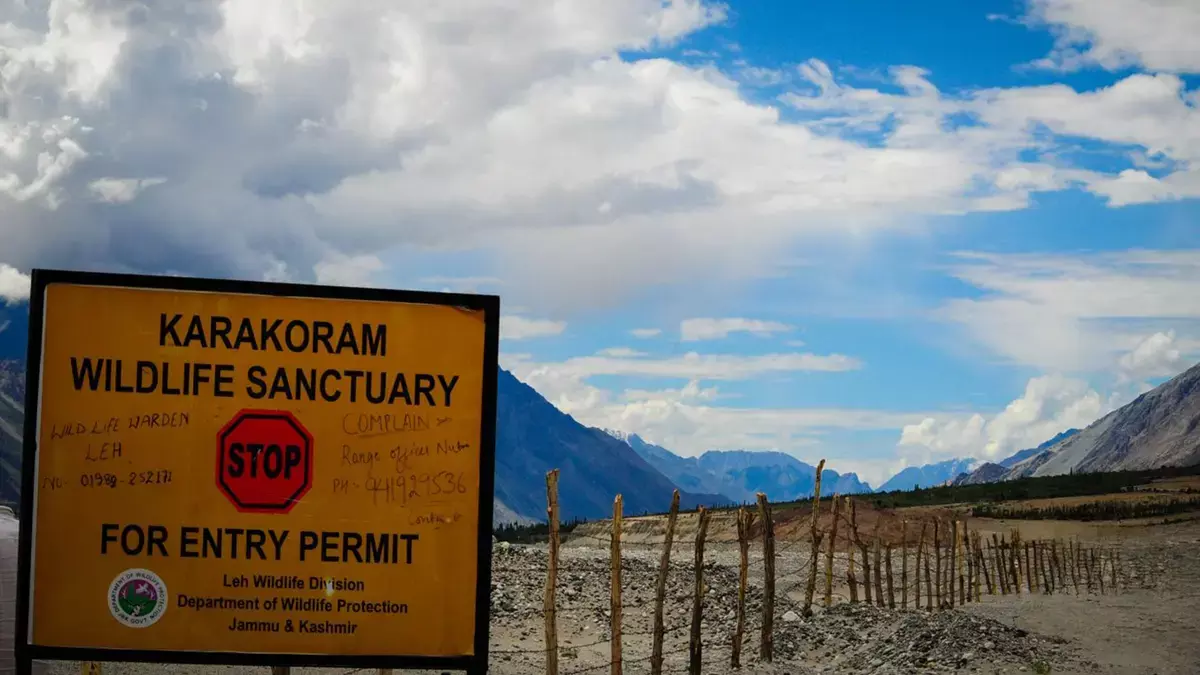
Srinagar : In a first-of-its-kind enforcement action, the Union Territory of Ladakh has sent a strong message against irresponsible tourism by imposing a cumulative penalty of ₹2 lakh on four tourists found guilty of illegally driving their vehicles through Pangong Lake and other ecologically sensitive protected areas.
The unprecedented move forms part of an intensified crackdown on off-roading activities that threaten Ladakh’s fragile high-altitude ecosystems and wildlife habitats.
The action was initiated by the Wildlife Department under the explicit directions of Lieutenant Governor Vinai Kumar Saxena, who has reiterated the administration’s commitment to preserving Ladakh’s unique biodiversity. Emphasising the need for responsible tourism, the Lt. Governor stated that while Ladakh warmly welcomes visitors from across the country and abroad, such visits must not come at the cost of environmental degradation. He urged tourists, adventure seekers, and vehicle owners to strictly refrain from entering protected zones or disturbing natural habitats.
According to officials, the four violators—vehicle owners hailing from Himachal Pradesh, Chandigarh, Punjab, and Uttar Pradesh—were each fined ₹50,000 under the provisions of the Wildlife (Protection) Act, 1972. Their vehicles were seized and subsequently released only after the fines were duly paid. The action followed multiple instances of violations identified during routine patrolling operations as well as through surveillance of social media platforms, where several videos of illegal off-roading had gone viral.
The violations spanned multiple ecologically sensitive locations, including Merak and Lukung along the picturesque Pangong Lake, Nurboo La in Hanle, and Sumur in the Nubra Valley. These regions fall within protected zones such as the Changthang Cold Desert Wildlife Sanctuary and the Karakoram (Nubra–Shayok) Wildlife Sanctuary, both of which are home to rare and endangered species adapted to harsh climatic conditions.
In one of the most recent incidents recorded on June 23, a Mahindra Thar was seen being driven directly into the pristine waters of Pangong Lake near Merak for stunt purposes. This act not only disturbed the natural habitat but also contributed to pollution in the lake, which is known for its ecological and scenic significance. In another case, a Hyundai Creta was found engaged in off-road driving near Lukung within the Changthang Cold Desert Wildlife Sanctuary. The vehicle was later intercepted at Zingral near Changla Pass on the same day and impounded by authorities.
Further violations surfaced through widely circulated social media videos. On June 20, footage emerged showing a Mahindra Thar (PB-65BL-8698) being driven through a stream inside the Karakoram (Nubra–Shayok) Wildlife Sanctuary, causing significant damage to the habitat and undermining the ecological integrity of the area. Following coordinated intelligence efforts involving local police, the vehicle was successfully intercepted at Kharu on June 21.
Similarly, on June 17, another viral video captured a Toyota Fortuner (HP 37H 7888) being recklessly driven off-road near Nurboo La within the Changthang Cold Desert Wildlife Sanctuary. Alarmingly, the driver was reportedly chasing a Tibetan gazelle—a protected species—further aggravating the gravity of the offence.
Acting swiftly, wildlife officials conducted an overnight search operation in coordination with law enforcement agencies and traced the vehicle outside a homestay in Hanle on the morning of June 18.
Officials confirmed that all four offenders subsequently paid the prescribed penalty of ₹50,000 each, after which their vehicles were released. The administration underscored that these actions were necessary not only as punitive measures but also as a deterrent to prevent similar violations in the future.
Reaffirming the administration’s zero-tolerance approach, Lt. Governor Saxena stressed that off-road driving within or near protected areas constitutes a punishable offence under the Wildlife (Protection) Act, 1972. He warned that stringent enforcement will continue against anyone found violating environmental norms, as part of sustained efforts to safeguard Ladakh’s delicate ecosystems, preserve its biodiversity, and ensure that tourism remains sustainable and responsible.
This decisive crackdown marks a significant step in balancing tourism with conservation, sending a clear signal that Ladakh’s natural heritage is not to be exploited but respected and protected for future generations.
Similar instances have been reported from various parts of Kashmir over the past few months; however, except for a few cases, most violators have gone unpunished.
