GIZ, PepsiCo, Bayer Join Hands to Boost Climate-Resilient Maize Farming

4 Nov 2026 5:41 PM IST4 Nov 2026 5:41 PM IST
Three-year HARVEST programme to promote regenerative agriculture and reach 35,000 farmers across Maharashtra and Madhya Pradesh.
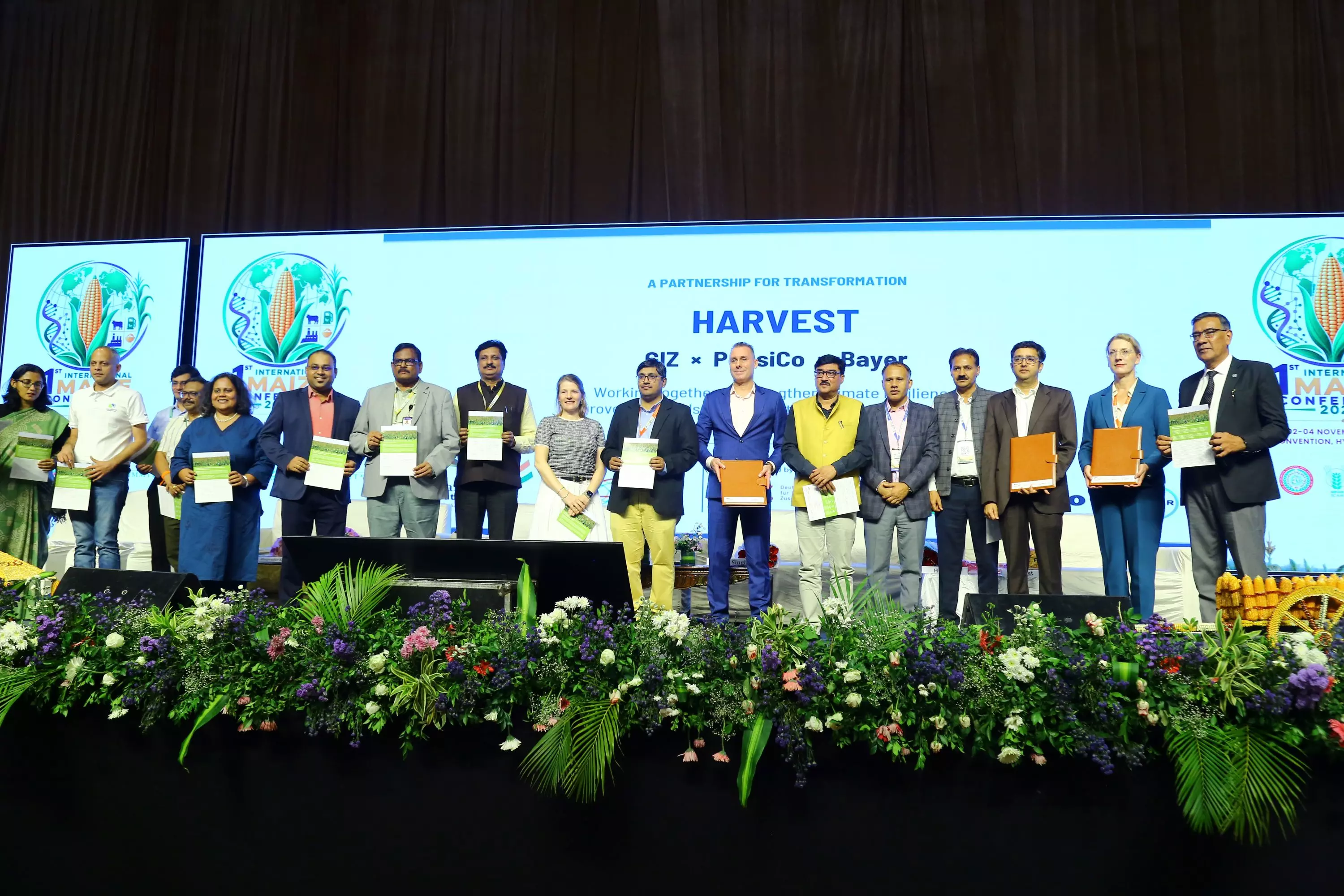
Deutsche Gesellschaft für Internationale Zusammenarbeit (GIZ) GmbH, PepsiCo India Holdings Private Limited and Crop Science Division, Bayer AG, today announced HARVEST (Holistic Agricultural Climate Resilience and Versatile Ecosystem Strengthening Techniques), a public-private partnership programme aimed at advancing regenerative agriculture and strengthening the climate resilience of maize-based farming communities in India.
Implemented under the develoPPP programme on behalf of the German Federal Ministry for Economic Cooperation and Development (BMZ), HARVEST will work with farming communities in Maharashtra and Madhya Pradesh. The partnership will bring together scientific expertise, farmer capability building, practical on-ground interventions and value-chain engagement to support more resilient and sustainable agricultural production. Over its three-year duration, the initiative aims to reach 35,000 farmers through training and capability building.
PepsiCo and Bayer have partnered for over two decades in the potato value chain. With GIZ joining as a partner and research support from the Indian Institute of Maize Research (IIMR), this collaboration now extends to maize, aiming to strengthen resilience, sustainability and innovation across the food system. PepsiCo and GIZ have also collaborated on a project in Thailand (2021–2025), focused on the potato and rice value chains. The initiative demonstrated how structured interventions and collective action can deliver meaningful outcomes in improving farmer incomes, advancing regenerative agriculture and reducing emissions. Project HARVEST builds on these learnings and the proven model, scaling its impact in India. Maize is an important crop in India, serving as food, animal feed and an industrial raw material, while supporting the livelihoods of smallholder farmers. However, increasingly erratic rainfall, drought, rising temperatures and pressure on natural resources are creating greater production risks for farming communities. Addressing these challenges requires solutions that strengthen the resilience of farms while continuing to support farmer livelihoods.
HARVEST aims to address this by promoting locally relevant regenerative agriculture practices across maize-based farming systems, including rotational crops. The initiative will focus on areas such as soil health, efficient use of water and agricultural inputs, crop diversification and farming practices that can help farmers better manage climate-related risks.
Importantly, the project will seek to build the case for farmers to transition towards regenerative agriculture at scale, while helping de-risk that transition. Alongside introducing sustainable farming practices, HARVEST will focus on building farmers’ knowledge and capabilities and providing opportunities for them to see and assess these practices under local farming conditions.
Combining science, farmer learning and ecosystem strengthening
HARVEST will combine scientific evidence with practical farmer learning while strengthening the wider ecosystem that supports farmers. Working with independent research institutions, including the Indian Institute of Maize Research and relevant government institutions, the project will develop locally adapted recommendations informed by research, soil and water assessments, and technical expertise.
Demonstration farms and farmer-to-farmer learning will help farmers observe regenerative practices, learn from practical experience and exchange knowledge. Alongside this, HARVEST will build the capabilities of public extension services, agronomists and farm leads, embedding expertise within local support networks and enabling successful practices to reach more farmers over time. The initiative will explore how stronger market linkages and closer alignment between sustainable production and value-chain requirements can create a stronger proposition for farmers adopting regenerative agriculture. By connecting improved farming practices with resilient agricultural value chains, the partnership aims to support environmental outcomes alongside long-term farmer and business value.
GIZ quote:
Ulrike Ebeling, Country Director, GIZ India and Bhutan, ‘HARVEST brings together GIZ’s experience and local networks with the innovation and expertise of PepsiCo and Bayer. Our partnership shows that development goals and business interests can go hand in hand. Together, we will improve livelihood opportunities for farmers and build more sustainable agricultural value chains, while creating a strong business case. This will benefit farmers, consumers, the environment, and businesses alike.
Ashok Rai, Senior Director and India Market Supply Officer, PepsiCo India, said, “At PepsiCo India, we believe progress in agriculture is strongest when driven in partnership. We have proven success in driving longstanding agri partnerships along with soil health focus when it comes to potato farming in India; we are now bringing that expertise to maize farming through Project HARVEST, in partnership with GIZ and Bayer Crop Science.
Guided by pep+ and our Positive Agriculture agenda, we aim to enable maize farmers adopt regenerative and climate-resilient practices that can strengthen soil health, use resources more efficiently and build greater resilience for their farms and livelihoods. Project HARVEST reflects our partnership for progress philosophy and our ambition to help build a more resilient agricultural ecosystem in India.”
Simon Wiebusch, Country Divisional Head, Crop Science Division of Bayer for India, Bangladesh & Sri Lanka said, “For regenerative agriculture to scale, sustainability and farmer economics have to move together. No single organization can achieve this alone. By leveraging our complementary strengths and taking a collaborative, ecosystem approach, we can bring together science, innovation, farmer capabilities and value-chain partnerships to create greater value for farmers. Through HARVEST, we aim to demonstrate how this collective approach can build more resilient farms and sustainable food systems.”
Building on this ecosystem approach, HARVEST will bring farmers, researchers, public institutions and private-sector partners together to test and refine regenerative practices under real farming conditions. By linking independent research and hands-on farmer engagement with stronger value-chain connections, the partnership seeks to contribute to healthier soils, more efficient use of natural resources and greater farmer resilience, and to offer a model that can be shared and scaled beyond Maharashtra and Madhya Pradesh.
( Source : Deccan Chronicle )

Next Story