How Engineers Are Building Zojila Tunnel Through One Of Himalayas’ Toughest Terrains

For Harpal Singh, Project Head and General Manager, Megha Engineering and Infrastructures Ltd, the Zojila Tunnel is far more than an engineering project. It is a test of human endurance, a lifeline for Ladakh and a legacy that engineers working in one of the world’s most challenging terrains hope will outlive them.
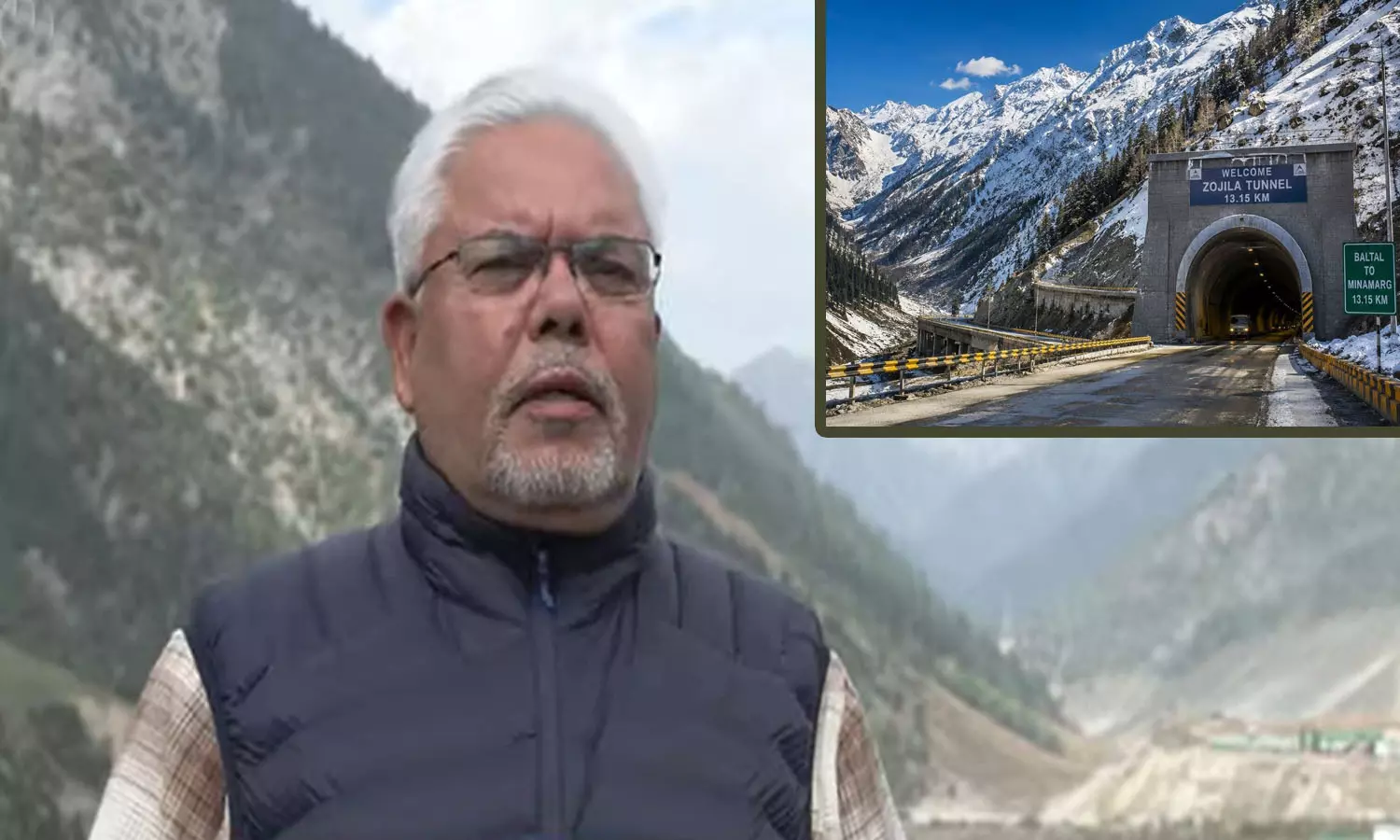
When Harpal Singh graduated from Thapar Engineering College, Patiala, in 1984, the idea of building tunnels through the Himalayas was hardly part of the engineering landscape he imagined for himself.
“I did not have it in my mind that I would do dams and tunnels,” he recalls. At the time, tunnelling in India was largely associated with hydropower, irrigation and some urban sewerage projects. Highway and railway tunnels were not the kind of projects young engineers expected to work on, and Zojila was not a name that figured prominently in their professional vocabulary.
Four decades later, Singh is Project Head and General Manager, Megha Engineering and Infrastructures Ltd (MEIL), which is executing the Zojila Tunnel Project. Having seen the project through some of its most difficult phases, he believes the 13-km tunnel represents something much larger than an engineering achievement.
“It’s not only a tunnel, it’s a monument,” he says.
The significance, according to Singh, lies in what Zojila has meant for connectivity to Ladakh. The pass has historically remained closed for months during winter, leaving people and essential supplies dependent on difficult weather conditions and, at times, air transport.
“Zojila remained closed three to five months,” Singh says, adding that the period has now reduced to two to three months. The tunnel, he believes, can change that equation by providing all-weather connectivity.
For local communities, that could mean access to medicines, food and fuel throughout the year, while reducing the isolation created by winter. Singh expects the improved connectivity to also open up opportunities for tourism and employment in places such as Sonamarg, Dras and Kargil.
“A patient from Dras has to be airlifted to Srinagar, a child from Kargil has to appear for an exam,” he says. “Ladakh will no longer be cut off.”
But getting there has meant working in conditions that test both engineering judgment and human endurance.
Singh describes Zojila as “a geological laboratory”, where the character of the rock can change dramatically over short distances. One stretch can present hard rock, while another may involve squeezing or crumbling ground, water-bearing strata and changing stresses. The tunnel is also being built in a seismic zone. “Every 10 metre, it changes,” he says.
Then there is the weather. Temperatures can fall to minus 30 degrees Celsius, pipelines can freeze, heavy snowfall can block access roads and moving workers between camps and the tunnel itself becomes a challenge.
During excavation, the risks are particularly high because the permanent lining comes only after the initial support has stabilised the tunnel. “During excavation stage it is very unsafe,” Singh says.
The project has also carried a human cost. Singh recalls losing a worker when a section of the tunnel collapsed and the machine he was operating was caught beneath the collapsed roof.
“So, it’s very risky. Any mistake means you are always under a roof which is cracked, seepage of water and still you have to work,” he asserts.
The scale of the tunnel adds another layer of difficulty. At 13 km, the tunnel could not be approached through multiple access points because of the geography of the Zojila Pass. Work therefore progressed from two fronts, one from the Kashmir side and the other from Ladakh.
For the engineers and workers living there, the challenge is not confined to the worksite. Engineers, technicians and workers have come from different parts of India, while families remain far away. The remote location offers little access to schools, colleges and the everyday support systems that families depend on.
“Our families always suffer,” Singh says. And while the workers may be physically present at Zojila, he believes the greater sacrifice is being made by the families who stay behind. “Our families are making the real sacrifices for this country, not us,” he notes.
That sense of purpose is also central to the way Singh motivates his team. At a high-altitude project where cold, isolation and difficult working conditions can take a toll, he believes salary alone is not enough. “You cannot motivate people to work at 11,000 feet with just salary. You need purpose,” he says.
He tells his team three things. The first is that they are not simply building a tunnel, but creating something that will become part of history. The second is that every meter excavated has a human consequence, whether it means saving a soldier hours in the snow or making a difficult journey safer for a family in Kargil. And the third is leadership by participation. “I stay with them, I eat in the same mess,” Singh says.
For him, leadership in such terrain cannot happen from behind a desk. Senior engineers and managers need to be visible when conditions are difficult, reaching the site early and when necessary, helping clear roads along with the workers.
That approach became particularly important during the harsh winters. Singh remembers arriving at the project when heavy snowfall virtually emptied Sonamarg. Villages were evacuated, hotels closed and even government establishments were largely deserted.
Yet hundreds of workers remained at Zojila. “I have to build this tunnel, otherwise it will take 15 years,” he recalls telling a police officer who questioned how people could still be working in such conditions.
The project also brought an unexpected relationship with local communities. Villagers who had initially left the area during winter later chose to remain nearby, providing accommodation and local knowledge that could prove valuable during avalanches and other emergencies.
Technically, the project has relied on the New Austrian Tunnelling Method (NATM), a philosophy based on understanding how the rock behaves after excavation and using its temporary stand-up time to provide the required support.
“When we blast the rock to make a passage, it gives you some time,” Singh explains. “During that period you have to apply support.”
The method is particularly useful in conditions where the ground behaviour can change rapidly. Singh points out that tunnelling technology has evolved and that Tunnel Boring Machines offer another approach where conditions and logistics allow, but drilling and blasting with NATM remains relevant in locations where TBMs cannot be transported or used effectively.
The engineering challenge is accompanied by another responsibility: limiting the impact on the environment.
Singh acknowledges that construction inevitably causes some environmental damage, but says the focus is on minimising it. Water emerging from the tunnel is treated before being discharged, construction material is taken to designated dumping areas, equipment is monitored for pollution, and air, water and noise levels are periodically assessed.
Waste is also sent to designated processing facilities, while plantation and measures for local wildlife form part of the effort to reduce the project’s impact.
“There is some damage which cannot be completely eliminated,” Singh says. “But any kind of development, I think generally comes at the cost of environment only,” he notes, matter-of-factly.
For the people working on Zojila, however, the larger objective remains clear. The tunnel is intended to reduce the dependence of an entire region on seasonal connectivity and make movement possible through a route that has historically been vulnerable to winter.
A breakthrough was achieved on June 9 this year, marking a significant stage in the project. For Singh, the meaning of the project goes beyond the concrete, rock and machinery. “You are not building a tunnel, you are building history,” he tells his engineers.
And perhaps that is what keeps the people at Zojila going when the temperature drops, roads disappear under snow and the nearest comforts of ordinary life remain far away.
