8 Facts About Octopus Anatomy You Probably Didn't Know

8 Oct 2025 6:04 PM IST8 Oct 2025 6:04 PM IST
Here are some facts about the cephalopod's anatomy that explain why they are remarkable creatures
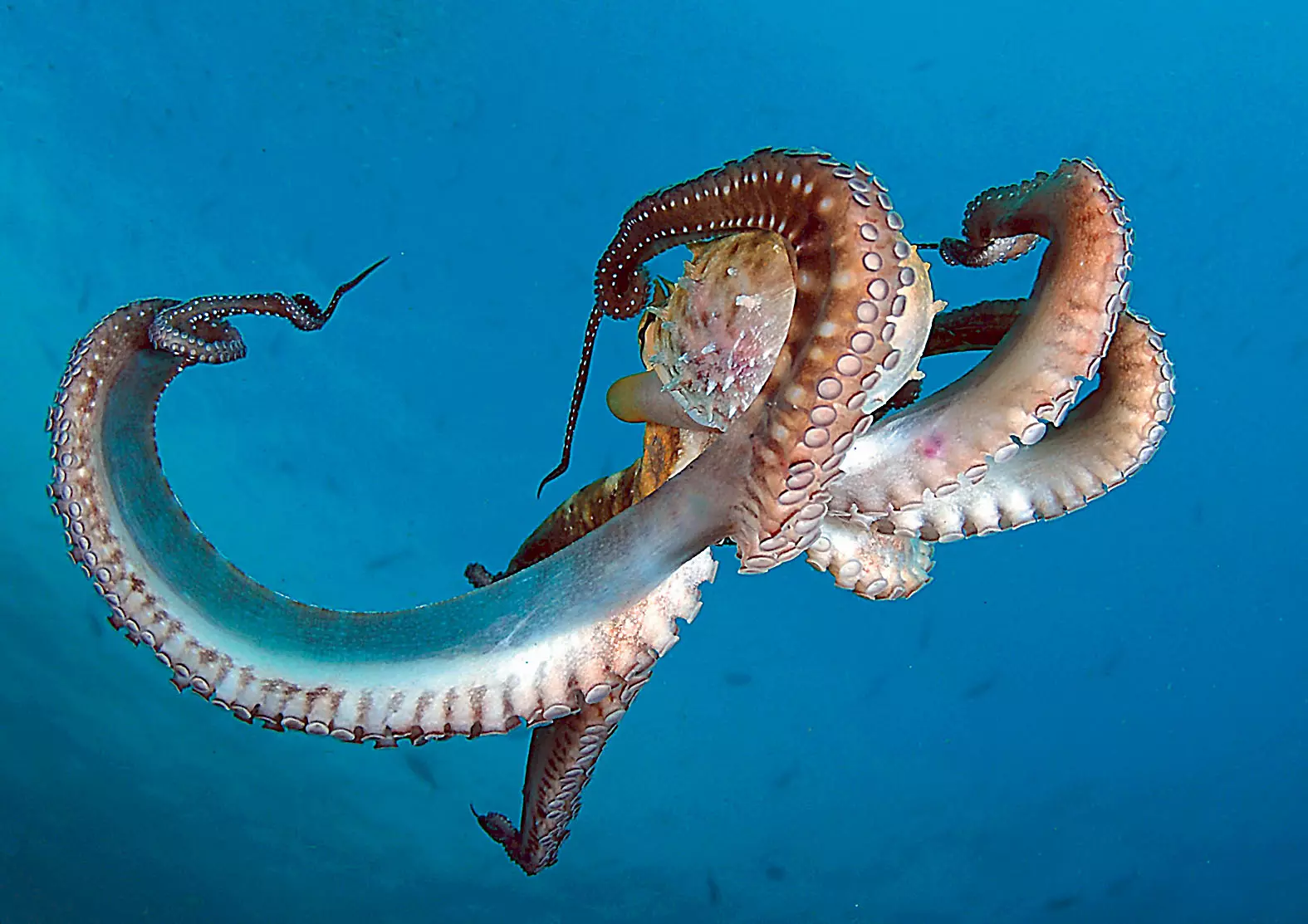
Representational Image (DC File Photo)
Amongst millions of sea creatures, octopuses are some of the most extraordinary marine species across the world. From their fluid body movements to their ability to open jars and worm their way through the smallest enclosures, their existence is absolutely fascinating. But why exactly are octopuses such remarkable creatures? On World Octopus Day, here are some facts about the cephalopod's anatomy that might explain why:
1. Blue Blood - Octopuses require more oxygen than other invertebrates. Hence, their blood contains a copper-based protein called hemocyanin, which is more efficient at transporting oxygen in low temperatures and low oxygen concentrations. The hemocyanin makes octopuses’ blood appear blue.
2. Zero Bones - As an invertebrate, the octopus has no skeletal system. It is comprised of soft tissue and muscle. The hardest part of an octopus' body is its beak, located at the base of its arms. As long as the octopus can fit its beak into any given space, the rest of its body can flow through easily.
3. Three Hearts - These creatures have three hearts: two branchial hearts to pump blood to their gills and one systemic heart to circulate it around the body. They have a high metabolism and, subsequently, a high oxygen demand. Hemocyanin isn't as effective in carrying oxygen compared to haemoglobin, so it's believed that octopuses need more than one heart to compensate.
However, the cephalopod doesn't use its systemic heart while swimming, which is why it is typically seen crawling on the sea floor instead.
4. Nine Brains - Smart animals tend to have a higher brain-to-body ratio, and the octopus' brain-to-body ratio is the largest amongst invertebrates, even larger than many vertebrates. Octopuses have a cluster of neurons called a ganglion, or mini-brain, in each of their eight tentacles, a ninth brain overseeing their nervous system. The ninth brain can also override other brains and operate the tentacles.
5. Independent Arms - The common octopus has around 500 million neurons (the same as a dog), and two-thirds of them are located in the tentacles. With the help of its ganglia, an octopus can perform separate tasks with each of its tentacles. The distribution allows for independent processing and control, faster reaction times, and efficient multitasking.
6. Black Ink Jets - Many octopuses escape danger by squirting ink, obscuring their predators' vision. In their ink sacs, they produce melanin, the same pigment in human skin and hair. The compound tyrosinase, the catalyst for melanin production, also burns predators' eyes and temporarily stuns their ability to smell and taste. Octopus ink effectively protects them from other creatures.
7. Camouflage - Masters of camouflage, octopuses can change colour, brightness, pattern, and even texture to evade the prying eyes of their predators or even impress their mates. However, unlike humans, octopuses have only one colour receptor. Inspecting their dumbbell-shaped pupils, researchers speculated that an octopus' eyes act as prisms. By changing the shape of their pupils, they can bring different colours into focus.
8. Human Recognition - Possessing excellent, camera-type eyes and high-level visual processing is crucial for the octopus' survival. Hence, they have large optic lobes, which help them recognise individuals outside their own species, including humans. They can even differentiate between humans by observing their behaviour, as an experiment by biologists at the Seattle Aquarium shows.
Over the course of two weeks, a group of octopuses were able to distinguish between a "nice" keeper and a "mean" keeper, despite wearing the same uniform, and behaved differently with them.
This article is authored by Tejasree Kallakrinda, interning with Deccan Chronicle
( Source : Guest Post )

Next Story