The Muse and the Movement: Shovana Narayan Revisits Kadambari Through Kathak

Kathak exponent Shovana Narayan reflects on Tagore, Kadambari Devi, and why classical dance must touch the soul rather than chase attention.
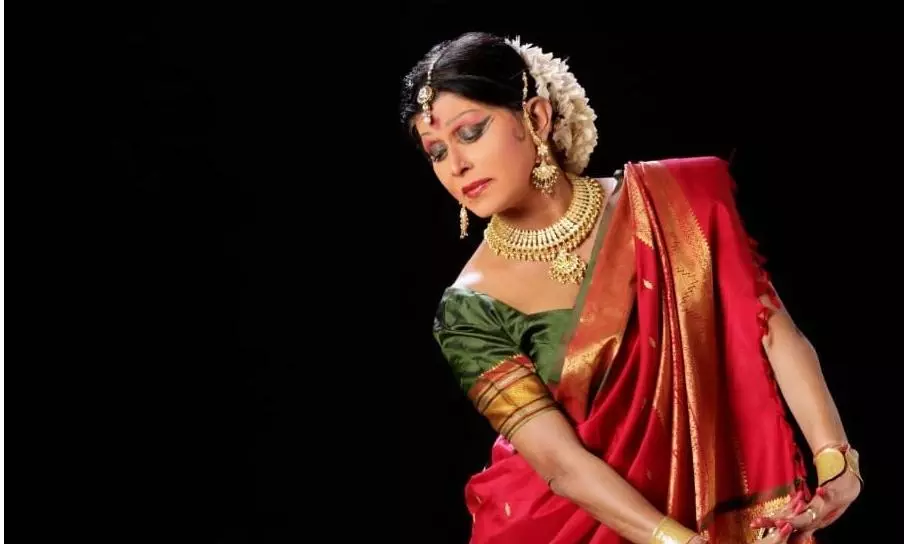
For Kathak maestro Shovana Narayan, dance has never been merely a performance. It is a lifelong conversation…with history, literature, philosophy, and the inner self. “I love what I do,” she says, adding, “I love exploring. learning. dancing. That’s my way to express myself.”
That enduring passion finds expression once again in ‘Kadambari: The Poet’s Muse’, a dance production that revisits the life of Kadambari Devi, Rabindranath Tagore’s sister-in-law and one of the most mysterious figures associated with the poet’s formative years. Rooted in the idiom of Kathak and enriched by Rabindra Sangeet, the work seeks to understand not only a relationship but an entire cultural ethos.
Narayan believes that revisiting Tagore today is not an exercise in nostalgia but an exploration of ideas that remain startlingly contemporary. “Today we are talking about an integrated education system. But it was always there in our scriptures. Tagore created that environment at Santiniketan long ago, where philosophy, education, performing arts and literature were all breathing the same ethos.”
For her, Tagore’s world reflected a holistic vision of learning that modern institutions are only now rediscovering.
“We are formalising something today that already existed. The seeds had been sown long ago. We tend to forget that.”
The same, she says, is true of social ideas that are often presented as modern innovations. Conversations around women’s education, dignity and agency had already entered literary discourse in the late nineteenth and early twentieth centuries.
“There was a whole genre of writers who spoke about women not as weak figures but as women of strength and character. So when we revisit these ideas today, we realise that a lot of work had already been done.”
At the heart of Shovana Narayan’s production is Kadambari Devi, Rabindranath Tagore’s sister-in-law, who entered the Tagore household as a nine-year-old child. “Her marriage was not a happy one. She was always yearning for her husband’s attention,” Narayan notes. In that emotional solitude, Kadambari formed a deep companionship with the young poet. “They became the best of buddies. He would confide in her. She encouraged him to write. She was his confidante, his mentor, his sounding board, his muse.” She also affectionately called him “Robi” and “Bhanu,” names that appeared in some of his earliest writings. Yet Kadambari’s life was marked by isolation and tragedy, and her death left a lasting imprint on Tagore. For Narayan, her story reflects a wider reality: “She represents the vast majority of women—educated and capable, yet not always truly empowered within themselves.”
As someone who has spent decades performing and teaching Kathak, Narayan is often asked how classical dance can remain relevant to younger audiences whose attention spans have dramatically shortened. Her answer is disarmingly simple. “If something touches their heart, they get hooked. It is how you present it.” She recalls how solo performances once lasted for hours.
“In earlier days a solo could go on for two, three, even four hours. Today if someone performs for one hour, we say, ‘Wow!’ Usually, it is thirty or forty minutes.” The challenge, she says, is not dilution but condensation.
“I do not compromise on anything. The only thing I compromise on is the stretching part. I capsule it so the essence remains.”
Young audiences often gravitate towards the visually dynamic aspects of Kathak like rapid spins, intricate footwork and rhythmic complexity. “Young people like the foot-tapping parts, the spins and the energy. But I like to present a balance between technique and expression.” If that balance is right, she believes audiences instinctively connect.
“They journey with you. I have seen teenagers come back and say they had goosebumps or tears in their eyes. So they are sensitive. It is a question of how you approach them.”
One of the biggest misconceptions about classical arts, she feels, is the belief that they are incomprehensible. “People say they don’t understand it. But it is not their fault. They have not grown up with it.” The environment surrounding audiences plays a major role. “Where do you see classical dance or music discussed in the media today?” she asks. “If something is not part of your daily atmosphere, it begins to feel distant.”
Training in classical arts has also evolved over the decades. While the spiritual core of the guru-shishya tradition remains intact, practical realities have altered the structure. “In ancient times students lived with the guru,” she explains. “It was like a boarding school. They were absorbing not only the skill but also the ethos of life.” Today, students attend classes for a few hours and then return to their own routines. “What is important is that along with the skill, the spirit of the art must also be transmitted. Otherwise you produce skilled craftsmen, not artists.” For her, artistry lies beyond technique. “An artist is something different, beyond craftsmanship.”
Narayan also believes that young people should approach dance not as a shortcut to fame but as a lifelong path. “Shortcuts may give you something for a short time. But then you fall.” Instead, she urges young dancers to cultivate depth, dedication and patience.
“Every profession demands integrity and sincerity. There are no shortcuts anywhere.” Her metaphor is vivid. “Do you want to be like a Diwali firecracker that dazzles for a moment and then fizzles out? Or like incense in a temple that burns slowly and spreads fragrance?” For Narayan, the choice defines not only an artist but a life. “Dance gives you roots. And when your foundation is strong, the tree grows stronger and bears more fruit,” she signs off.
