Pride Is Also Protest: Hyderabad LGBTQIA+ Activists on Identity, Rights and Representation

The discussion highlighted a sharp divide between mainstream depictions and the lived realities of the LGBTQIA+ community in India
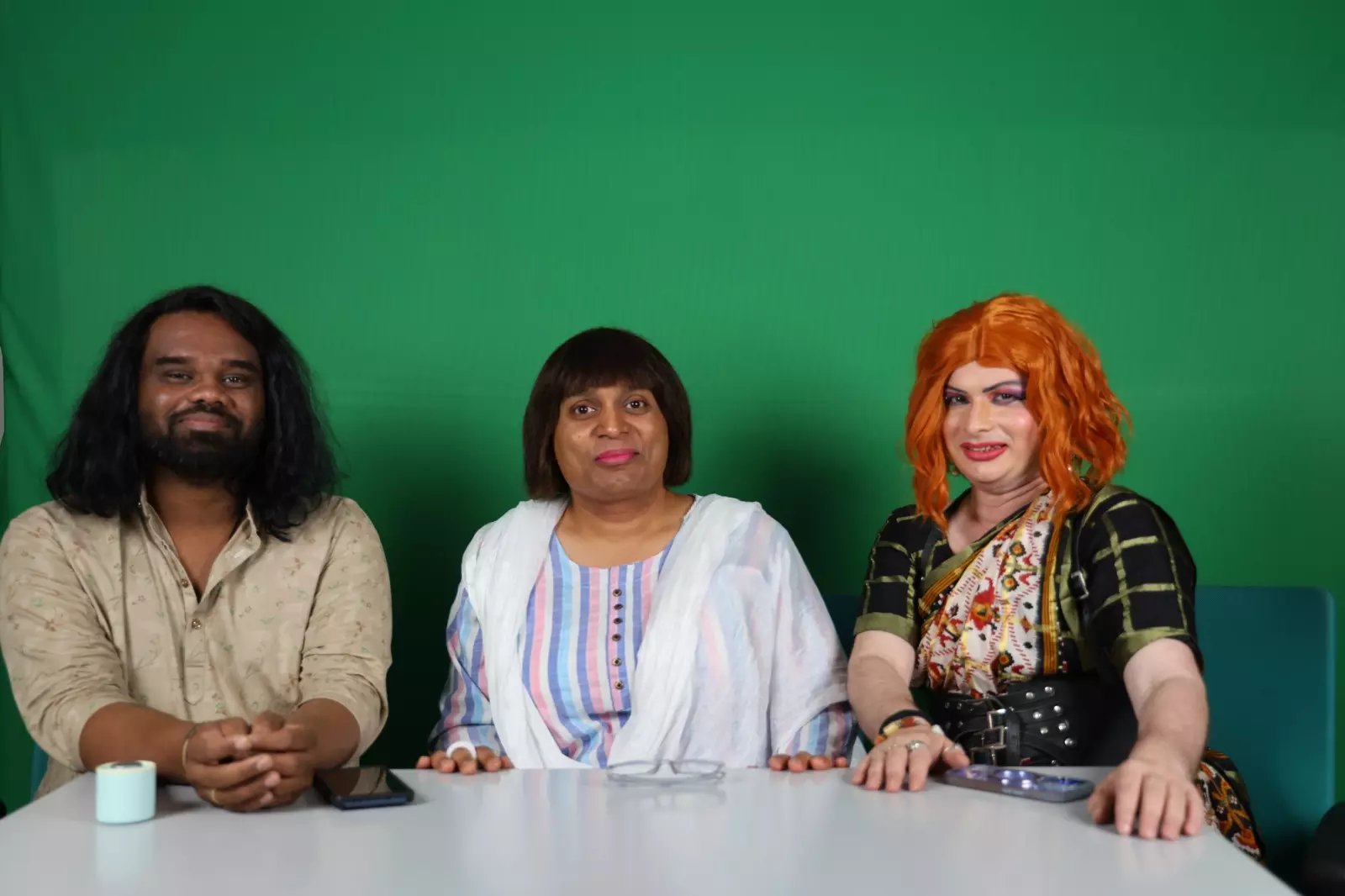
Hyderabad: On the occasion of Pride Month, Hyderabad’s own queer and LGBTQIA+ activists came together for a panel discussion. Anil (Savithri), founder of Mobbera foundation, Patruni Sastry (Sas Who Maa), a visual and performance artist and human rights activist and Vyjayanti Mogli, an Indian RTI and transgender rights activist, sat down for a discussion on the evolution of the queer movement in Hyderabad, the journey of self-discovery and the fight for self-determination. The discussion highlighted a sharp divide between mainstream depictions and the lived realities of the LGBTQIA+ community in India.
Reflecting on the difficulty in navigating an identity, Patruni noted that in their teens, only two identities from the queer spectrum - trans women and gay men - were visible, and it took until age 21 to find personal clarity. While a “new vocabulary” now offers community members a “hope of euphoria”, Patruni argues that media representation remains inadequate. “There still is no good representation of, you know, trans, non-binary, or genderqueer people in our mainstream society”.
Anil highlighted the film industry’s “obscene” portrayal of queer people. Anil remarked that they are just reduced to being a side character to add filler material to the stories. This stands in contrast to the progress of the queer community in Telangana, where Anil said that “a doctor is working in a government hospital” and “40 plus trans women and men are working in traffic police, HYDRA and Hyderabad metro”.
The discussion rejected the idea of queer expression being a Western concept. Patruni argued that drag has been viewed as an alien concept only because of the language used to describe it. Patruni stated, “It was very important for me to give this context to the Indian audience, and that’s when they own this art form as a generalised art form.” Patruni emphasised that theatrical gender-bending is a staple across the country: "We have the concept of drag in every state of India where there is at least one art form where men dress up as women and perform as a theatrical thing”.
Addressing the claim that queer identities are not Indian, Vyjayanthi asserts that this argument “can be denounced by citing even the Puranas. Similarly, instances of queer representation can be found in mainstream majoritarian religions like Hinduism or dharmic religions like Buddhism, Sikhism and so on.” She pointed out that there are “enough and more examples in Hinduism or transgender persons, although the word transgender is not the word used”.
Anil recounted the history of Mobbera Foundation, noting, "Initially, when we started the flash mob at Osmania University, we struggled a lot. We were attacked by the police. We then realised that a lot has to be done in this city for the people who identify differently".
Anil also addressed the "hypocrisy" of the corporate industry. While corporations often talk about “inclusivity”, they continue to discriminate in practice, which leads many gay and bisexual men to fear coming out due to career stagnation. “Just because of my identity, you do not have to pull me back to L2 level,” Anil added.
To dismantle stigma, the activists say they use their own lives as tools of protest. Anil explained that his "secret weapon" is simply his existence: "My secret weapon is me, how I behave, how I walk, how I talk and how I live my life." Specifically, regarding non-binary visibility, Anil stated, "The way I dress up sometimes, like I wear a kurta on the top and a lehenga on the bottom, that itself is a weapon for me to fight stigma against non-binariness".
Patruni echoed this sentiment, describing performance as a divine tool: "My drag is my weapon because it challenges male and female egos. I think drag is my 'Brahmastra'". Patruni added that the goal is to shift perspectives: "When I see tilting heads towards me, I think I’ve done my job".
Vyjayanti emphasised that the fight for rights requires profound internal preparation and humility. One should know when they have been a total jerk to oneself and others and ask for forgiveness to both, as there is nothing wrong with asking for forgiveness, “it is nothing but human to own up”, she adds.
The panel offered a critique of the "sympathy game" played by filmmakers. Patrúní questioned why queer characters are almost always shown dying by the end of a film: “Don't you think we have happy lives?” Patruni emphasised the need for "trans joy," pointing to documentaries like In Transit as better alternatives to mainstream filmmaking. Anil added that filmmakers often tell trans actors, “you don't look trans enough,” because they don't fit the stereotype of being “six feet tall with broad shoulders”.
Vyjayanti exposed a darker reality within the film industry, discussing the exploitation of queer and trans background artists. She described "commitment" as a "cursed word of abject deprivation in the Telugu film industry," explaining that "all it means is that you need to be available after these so-called auditions to warm the beds of all these casting directors". Vyjayanti noted that "trans people and queer people have no laws to protect them" from such sexual predation.
Talking about “rainbow washing” during Pride Month, Vyjayanti argued that true commitment must be year-round, encompassing the rights of “domestic workers to acid attack survivors to persons, families dependent on manual scavenging”. Anil declared, “Pride is not only joy, but Pride is also protest. We ask for our rights. Those are basic human rights that every citizen of this country or globally deserves”.
The activists concluded by praising the unique, grassroots nature of Hyderabad's queer community. Anil highlighted the importance of "chosen families" for those abandoned by their biological relatives. Hyderabad has more chosen families within the community, and they are closely associated with each other, irrespective of ideologies, political, religious, or caste. Vyjayanti recalled that the city's pride, the Queer Swabhimana Yatra, was a "people-led movement" rather than one driven by corporations or NGOs.
Vyjayanti maintained that the right to self-identification is an unshakeable part of the Indian Constitution's "Golden Triangle”, the harmonious and independent relationship between Articles 14, 19 and 21 of the fundamental rights. She stated, "What is democracy without self-determination? Nothing. Democracy is the biggest nothing of all time without self-determination".
Vyjayanti concluded with a promise: "We will defend it with our lives. We'll put our necks to it".
This article is written by Archana Prasad, student of EFLU, interning at Deccan Chronicle)