The Registry of Sarees: Where Every Thread Holds a Story

The Registry of Sarees brings together 45 archival textiles in an exhibition, 'Perched upon a woven sky', that looks beyond geography and tradition to explore light, colour, craft, conservation and the conversations that keep textile knowledge alive
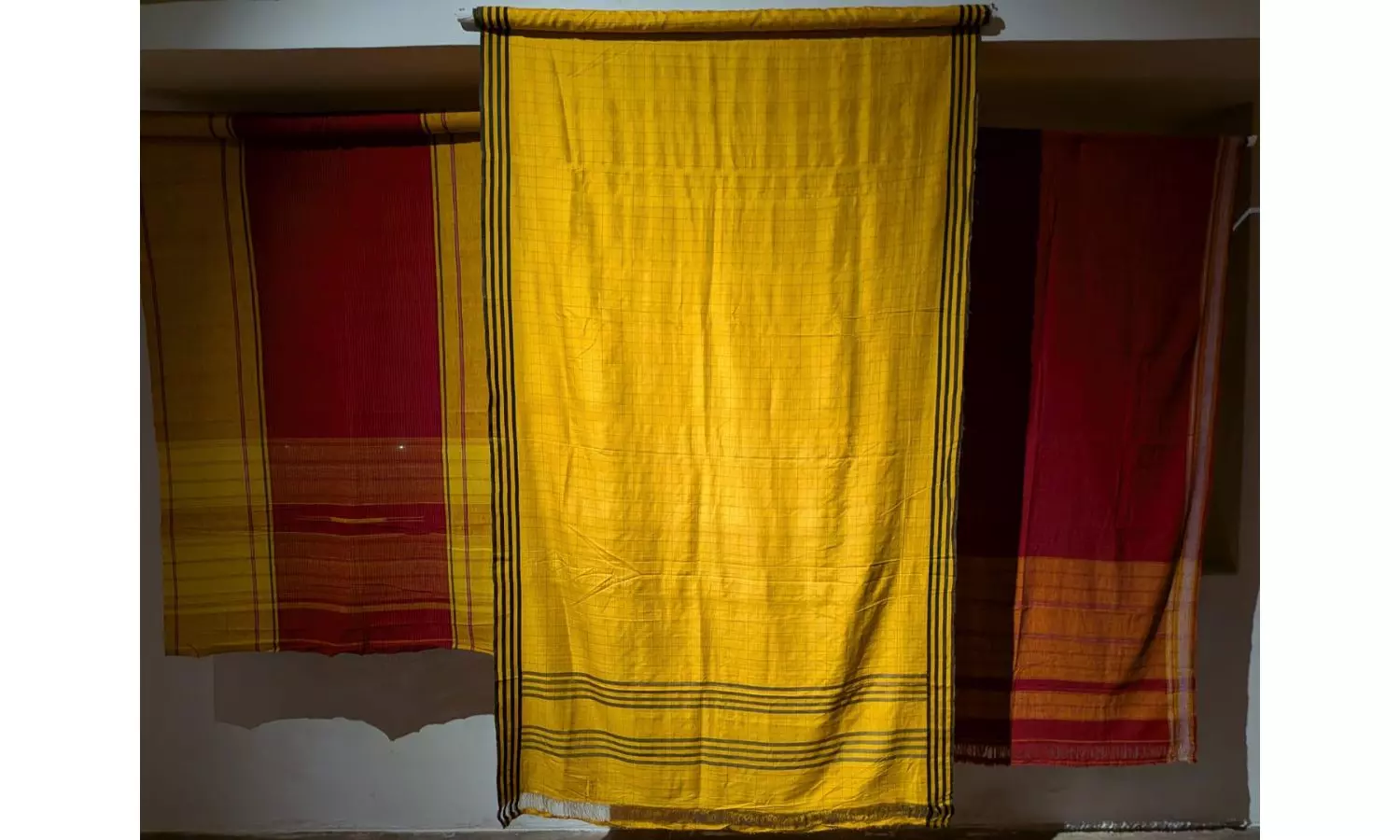
A saree can be many things. It can be something inherited from a grandmother, something worn for a special occasion, a piece of craft, a marker of identity or simply a beautiful textile. At The Registry of Sarees in Bengaluru, however, the saree becomes something else too: an archive.
The inaugural exhibition, ‘Perched upon a Woven Sky’, at The Registry of Sarees showcases 45 textiles from its collection, bringing together pieces that span different regions, materials, techniques and periods. But this is not an exhibition organised around geography. Instead, it invites you to look at textiles through light, colour, structure and perception.
“The whole concept of this exhibition draws attention to three things. One is the structure, light and colour,” says Aayushi Jain, curator, The Registry of Sarees.
The exhibition follows the changing chromatic conditions of a day. Darker textiles suggest night, gradually moving into the pinks and purples of dawn, the yellow of emerging sunlight, the colours of dusk and eventually back into darkness.
“It is trying to align with the chromatic conditions of the day. So, how night changes to dawn, then you have the sunlight, then you have the dusk and then again midnight. That is how the whole exhibition has taken its final form,” Aayushi says.
It is a deliberate departure from the familiar way of presenting textiles through their place of origin. “We have not curated this exhibition based on geographical representation or cultural representation. We have chosen these textiles based on colour, structure and their interaction with light,” she says.
The effect becomes apparent as you move through the space. A handwoven cotton textile from Andhra Pradesh brings together black and gold, with muga used along the selvedge. Muga, a variety of silk traditionally associated with the Northeast, creates a matte contrast that allows the zari to catch the light more strongly.
“When you have something matte, then even the glossy has a better shine,” Aayushi explains.
Three textiles from Banaras then bring different kinds of zari into the conversation. One uses badla, a flattened metallic wire that reflects light almost like a mirror. Others show how zari interacts differently with cotton and silk.
The exhibition space, designed by Vishvesh Surve, is an essential part of this experience. The reflections and shadows are not simply atmospheric additions but are carefully designed to change the way the textiles are perceived.
“Badla is a metallic wire and it works like a mirror. So, when light falls on it, it reflects back,” Aayushi says.
A Jamdani from Bengal offers another lesson in how textiles travel and evolve. While the technique originated in Bengal, it has also been adopted by Banaras weavers. Elsewhere, a tissue zari textile shifts dramatically depending on where you stand. From one end of the room it appears predominantly gold. Move across and pink begins to emerge.
One of the most striking pieces is a Jamdani that is around 120 years old. Its copper base was electroplated with silver, but over time the silver has worn away, leaving behind a delicate interplay of coppery pink and silver.
“This is how different layers of the metal are interact,” Aayushi says.
The exhibition continues this conversation between material and light through textiles from Bengal, Banaras, Pakistan and Kanchipuram. A peacock feather textile, for instance, changes dramatically under different lighting. Under yellow light, it appears mostly yellow and bronze, with very little green. Under white light, green begins to emerge.
Aayushi uses the example to explain how perception itself can be shaped by light. What appears to be colour may actually be the result of the way light interacts with a material.
The 45 textiles are drawn from The Registry of Sarees’ larger archive of around 2,000+ pieces. They have been donated, purchased or handed over, but their value is not determined simply by age, rarity or the purity of their zari.
“What we are trying to do here is look at it not from those lenses but look at it from a technique point of view,” Aayushi says. “If the technique has been lost, then it becomes a very important textile to collect.”
That philosophy is central to the Registry’s approach to conservation. An old textile is not simply an object to be stored safely. It is a record of how something was made, the materials that were used and the knowledge that went into it.
“Materiality is of course important but along with the gold zari we would also want to know how does a copper zari look like. What are its specifications? What are its qualities?” Aayushi says.
The textiles are carefully conserved, with the collection rolled in Tyvek, a material that helps protect them from microbes and light. An in-house conservator periodically checks the pieces, while the exhibition itself follows museum standards for lighting. Older textiles are particularly sensitive to light, which is why the exhibition uses carefully controlled illumination.
The exhibition will be on view for only 20 days. That is partly because The Registry of Sarees does not operate like a conventional museum with permanent displays. Its purpose is research and documentation, with exhibitions acting as a way of bringing that knowledge into the public domain.
“Not everyone has access to an old archival piece. Here you get an opportunity to learn things that you have already been seeing across your daily lives, but here you get to see it from a more educational point of view,” Aayushi says.
Yet she is quick to clarify that the space is not simply about education. “It’s not really a place for education but it’s a more conversational space,” she says. “It is a conversation.”
That idea of conversation runs through The Registry of Sarees, which has been building its collection for a decade. Ally Matthan, the driving force behind the Registry, says the archive has been developed thoughtfully over ten areas of study. “This is a collection that has been built over 10 years, it’s not an overnight thing,” Ally says.
The larger idea, she explains, is to create conversations around sarees and make textile knowledge accessible to as many people as possible. The exhibition is therefore only one part of a much wider vision.
“The exhibiting of the sarees is just one small part of what we are trying to do. We are trying to enable a dialogue between different streams,” Ally says.
That dialogue extends into identity, circularity, materiality, processes and skills, and eventually into Yali, the contemporary design initiative that draws on the knowledge gathered through the Registry.
Historical sarees are not treated as garments to be worn. They are treated as artefacts that can inform what comes next. “We treat them as artifacts to inform us. So we take that information and make new sarees at Yali,” Ally says. The idea is not to turn archival knowledge into nostalgia. It is to let it move.
That is why Yali works with handwoven fabric and communities that include Arani, Kanchipuram, Ponduru and Benares. The process is collaborative. Designers and practitioners sit together, look at old textiles, discuss possibilities and work back and forth until something new emerges.
“There is a lot of interaction with the designer informing the actual practitioner that transfers something into fabric,” Ally says. It is a slow process, and deliberately so.
The Registry of Sarees is not trying to produce a vast catalogue of products. It is interested in what happens when knowledge travels between disciplines, from an old textile to a designer, from a designer to a weaver, and eventually from the finished piece to someone who will wear it.
The saree, then, becomes much more than something to admire behind glass. It is a record of skill, material, trade, memory and changing tastes. It is also a starting point for conversations that can move into design, fashion, conservation and identity.
Perhaps that is why the most interesting thing about this exhibition is not that it preserves old textiles. It is that it refuses to leave them in the past.
