Tracing Light Through Movement: Yamini Reddy on Surya and the Soul of Kuchipudi

18 Dec 2025 11:51 AM IST18 Dec 2025 11:51 AM IST
Kuchipudi dancer Yamini Reddy reflects on creation, choreography and the responsibility of carrying a centuries-old art form forward as she brings Surya to Hyderabad
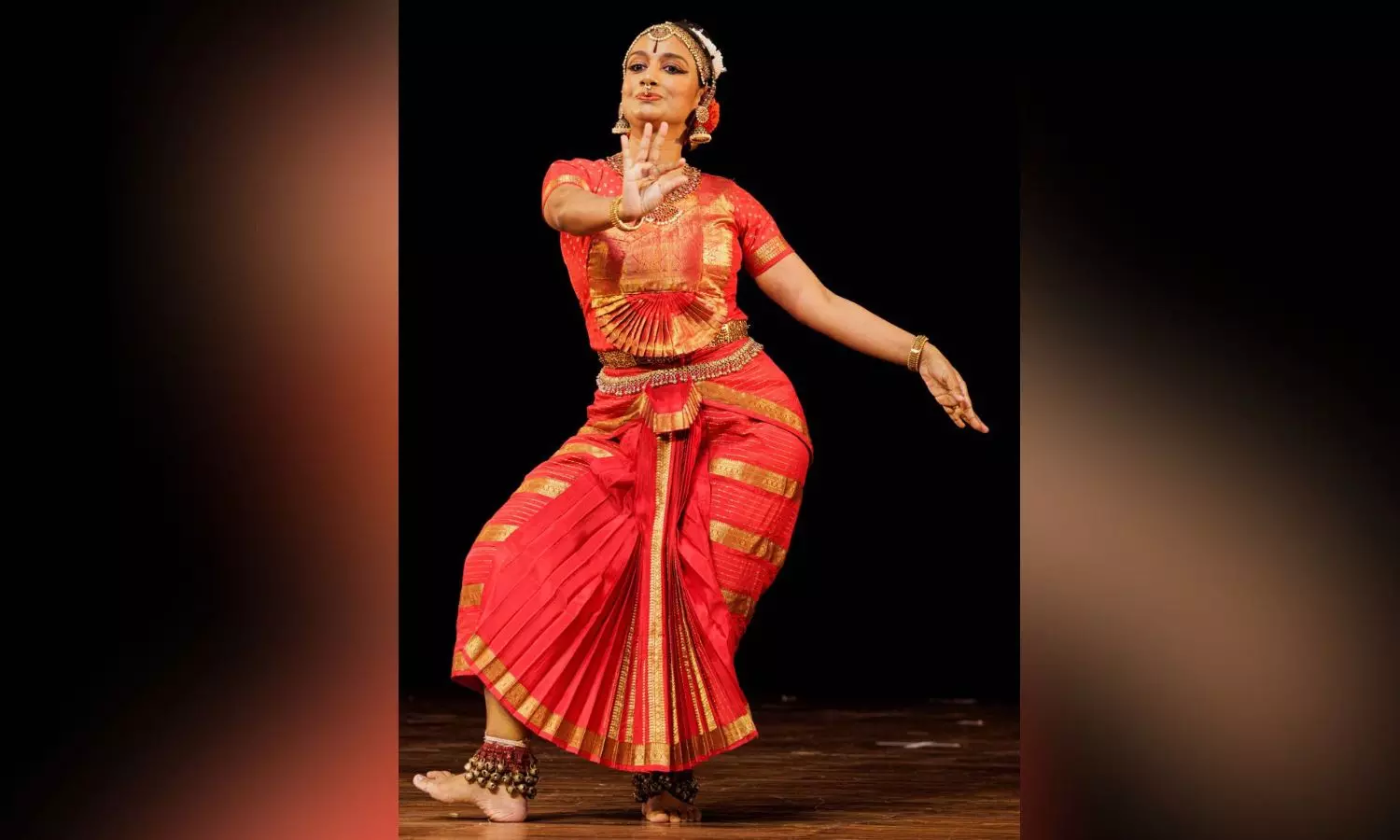
Yamini Reddy.
As Yamini Reddy prepares to present Surya at Shilpakala Vedika in Hyderabad, there is a sense of quiet fulfilment in her voice. “Surya is a dance production that was conceived by me in 2018,” she says. “I wanted to present it in Hyderabad in 2020, but we were hit by COVID. Now that things have normalised and we are back in the flow, I am very happy to finally bring it to the Hyderabad audience. It’s a real pleasure.”
The idea of Surya began not with choreography, but with thought. “One day I was reading something about creation, and it got me thinking that creation would have started with primal light,” Yamini recalls. That curiosity led her to deeper research, where she encountered the Nasadiya Suktam. “It questions how the universe came into existence. Was there anything before this, or was there nothing? Did God create this on purpose or was it an accident? I found that extremely beautiful.”
From there, the idea took shape. “I came across many concepts and theories about the existence of Surya and how it came to life,” she says. “I decided to do my own take on Surya — how light is responsible for creation on earth — and that’s how the idea was born.”
The production also marks a deeply personal milestone. Yamini assisted her parents in the choreography, bringing together generations of artistic thought. “I am very happy that I was able to bring my vision to life through Surya,” she says.
While grounded in traditional Kuchipudi grammar, Surya consciously steps beyond familiar mythological narratives. “Kuchipudi is a very beautiful art form where storytelling comes very easily — it’s in its DNA,” Yamini explains. “We are a combination of theatre forms and temple dances.” Yet this time, she chose a different path. “Usually, we perform stories of gods and goddesses. But with Surya, I wanted to make it more about nature than divinity.”
That shift also meant reimagining how Kuchipudi speaks to contemporary audiences. “I wanted to make it relevant today,” she says. “So we have brought in technology — light design, stage design, and we have worked deeply on the music as well. We have tried to do something unique with Surya.”
Choreographing for a 25-member ensemble with live music came with its own challenges. “The biggest challenge was aligning the timelines — choreography, music creation, and bringing all the dancers together,” Yamini says. “It starts with ideation between me and my parents, then I first bring it out on my own body as an individual dancer. Once that’s set, we teach the dancers, and then a lot of practice follows.”
At the same time, music and technical design are built in parallel. “All these elements have to blend together so the final presentation feels smooth and unobtrusive,” she adds. “Thanks to everyone’s cooperation and effort, I think it’s going to come out beautifully.”
Growing up under the mentorship of her legendary parents was both a gift and a challenge. “It was intimidating in the beginning,” Yamini admits. “They are geniuses in this field, and I sometimes felt my ideas were too small.” Over time, that hesitation gave way to confidence. “I learned to trust my ideas and bring them to life.”
The lessons she absorbed were foundational. “At the time of creation, we must be patient. Nothing should be done in a hurry,” she says. “It’s also very important to master the art before venturing into new creation, so we don’t disturb the grammar of the form.”
For Yamini, choreography holds a special place. “As a dancer, choreography is about bringing your vision to life,” she says. “With Surya, I had a clear vision, and I am happy I have been able to give it life.”
Precision, synchronisation and rasa, she believes, come down to one thing. “Practice, practice and practice,” she says firmly. “You train the body so deeply that you eventually forget it. Only then can you reach inside and bring out emotion and rasa.”
She adds that coordination with musicians and technical teams demands the same discipline. “Without practice, none of this is possible. Practice is the key to everything.”
Reflecting on how the field has changed, Yamini gets candid. “My parents definitely had a better time as dancers. Today, we are competing with many other entertainment spaces. We are constantly fighting for attention.” Artists, she feels, are also expected to juggle too many roles. “Earlier, artists had the luxury of focusing only on their art. Now we are expected to do a hundred other things.”
Yet her belief in classical dance remains unwavering. “This is not entertainment,” she says. “Classical dance is an education. It’s a lifestyle change. It’s a transformation of yourself.” While challenges exist, she also sees hope. “There are many young people deeply invested in classical arts. It’s now in their hands to take this legacy forward.”
On the question of financial sustainability in the profession, Yamini is honest. “I don’t think dancers get the due they deserve compared to many other fields,” she says. “But we don’t work for money. We work with passion, believing that money will follow.”
At the same time, she stresses the need for systemic support. “These are not commercial arts,” she says. “It’s the responsibility of society, people and governments to sustain them. Artists need security. Without a free mind, there can be no original thought.”
As Surya prepares to light up the Hyderabad stage, Yamini’s words echo the spirit of the production itself — rooted in discipline, shaped by inquiry, and guided by light.
( Source : Deccan Chronicle )

Next Story