The pop-up, running from November 12 to 21, feels less like a restaurant event and more like being invited into someone’s home.
When you meet Chef Meera, you don’t first think of her as a chef. You see an architect, thoughtful, precise, quietly observant, someone who knows how to build structures that last. But as she talks, you slowly realise that she has simply shifted from building homes of concrete to building homes of flavour. And in Kanak at Trident Hyderabad, where ‘A Thali Full of Telugu Traditions’ is currently unfolding, you see exactly what that journey looks like.
The pop-up, running from November 12 to 21, feels less like a restaurant event and more like being invited into someone’s home. And that is exactly how she designs it. “Telugu food is often very misrepresented,” she says at the start, almost sighing. “There are only a few recipes you will find in most places. But if you touch any household, the number of dishes we make is too much. Every item has a story.”
Her own story begins in Visakhapatnam, though her roots stretch into West Godavari. “So, I make food from both the regions,” she says with a smile. “And mostly vegetarian. That’s the food I grew up with.” She recalls papadams, (appadalu, vadiyalu), with a kind of affection that only someone who has lived inside their flavours can have. “Each region has its own version. But outside, we are treated as one category. When you actually eat them, they each hold a story.”
Chef Meera
Those stories began to reveal themselves to her unexpectedly, far away in the US, while studying architecture. She had never cooked growing up. “My grandma never let anyone into the kitchen. Only when I went for my Masters, I started missing the food. I was fed up eating jeera rice and sweet dal every day. So I started cooking from memory. One dish at a time. That’s how it started.”
What began as feeding herself slowly became a craft. She cooked for friends, sometimes for 30 or 40 people at a time, without thinking twice. “For the longest time, I couldn’t cook for two,” she admits. “My apartment was a bachelor pad. Everyone used to come there. Maybe that’s where the ‘chef’ in me unknowingly began.”
Today, her approach to Telugu food is rooted in clarity, memory, technique, and ingredients. She is known for her knowledge of Shadruchulu, the six fundamental tastes of Telugu cuisine, something she uses to balance every plate she creates. “People think Andhra food is all about chili and tamarind,” she says. “But not everything needs tamarind. If you choose the right tomatoes, you don’t have to add anything else. I want the ingredients only to speak.”
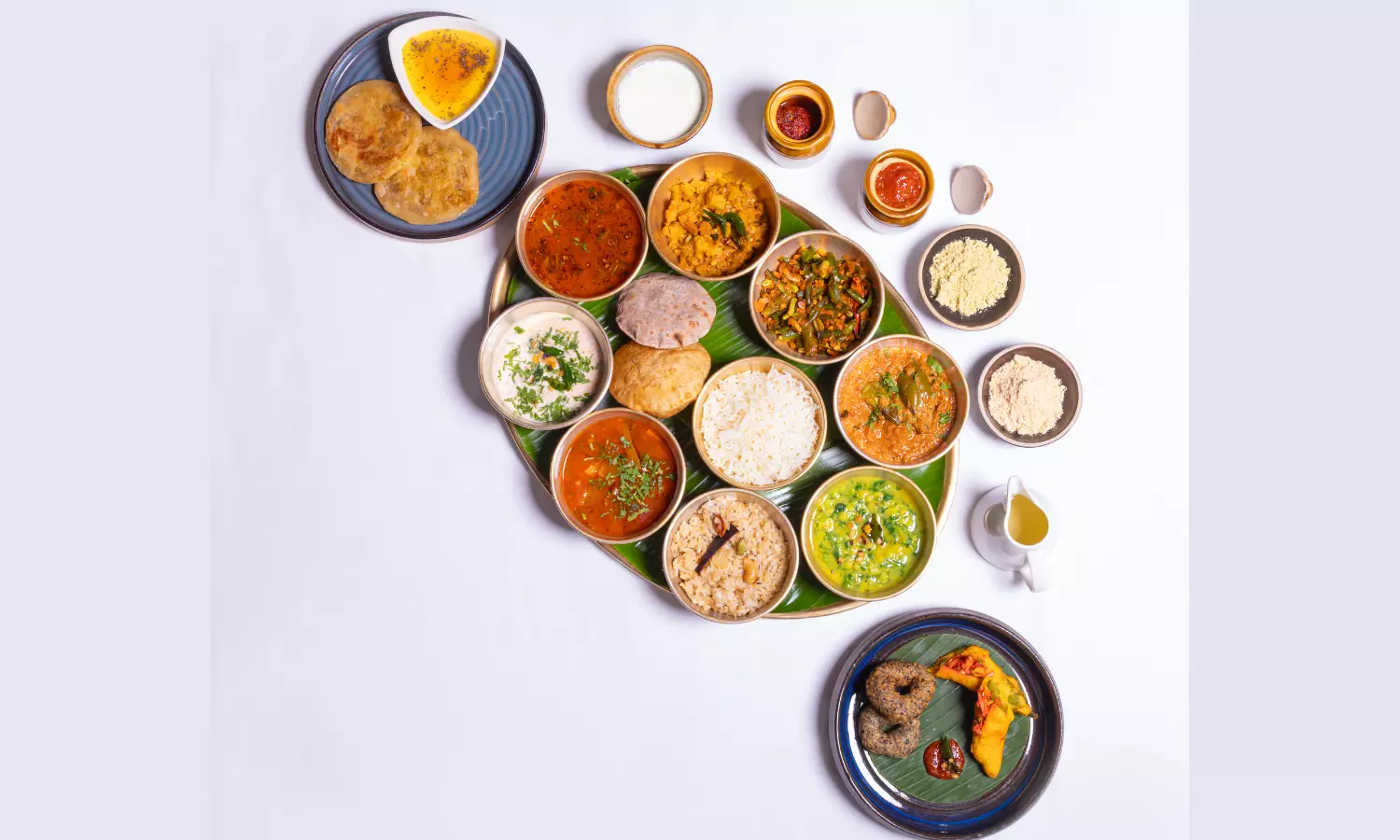
At Kanak, her menu feels like a gentle walk through Telugu kitchens, past and present. She brings Usiri Avakaya pachadi (amla pickle), Gongura pachadi, Kandi Podi, Sonti Podi, a winter-friendly dry ginger mixture meant to guard against colds. She talks about each with the intimacy of someone who has made them hundreds of times. “These are very common things we grew up with,” she says. “But in restaurants, you will never find them.”
Her vegetarian appetisers showcase the forgotten, the seasonal, the quietly extraordinary, like Mirapakayi bajji stuffed with peanuts, the Vizag street food style and Pottu minapappu Vada, made with whole black urad dal. “Earlier even idli and vada were made with this,” she says, adding, “It’s more nutritious, more tasty. But you don’t see it outside homes.”
Her cooking is deeply home-style, slow, respectful, rooted—be it the Gongura dal or the humble Chikkudukaya, a simple stir-fry, which is said to be a hot favourite among guests at the Trident. Her Chukkkura pappu, Guthi vankaya kura, Mukkala pulusu, Aratikaya kura, Mullakada rasam, tomato perugu pachadi, kobbaripala annam—all reminds you of the warm hospitality of a Telugu home.
Her non-vegetarian dishes carry the same honesty: Kodi Vepudu (chicken fry) with cashews made with her own garam masala, or the Tawa Chepa (fish fry) with a flavour that lingers long after the bite.
Desserts include Junnu, Bobbatlu, and Putharekulu. “The hotel wanted something that’s not often found in a setting like this,” she explains. “Junnu especially, if you do it wrong, it becomes pudding. But when you do it right, it must have a porous texture.”
Her research goes deep, even into forgotten staples like ragi and jowar. “Long ago, people used to eat ragi roti in the southern Andhra region. So I introduced it. We are talking about all of Andhra after all,” she says. And perhaps that is the heart of this pop-up. She cooks all of Andhra. Not the Andhra of restaurant menus, but the Andhra of families, seasons, land, memory, and borders gently blending into each other.
When asked why she began doing pop-ups, her answer is simple: “Just the interest to do something exciting and to share recipes.” In that one line, you understand her. She isn’t trying to impress. She is trying to preserve it.
At Kanak, that intention becomes a thali, full of warmth, nuance, history, and the familiar comfort of home. A thali built not by a chef, but by an architect who knows that the strongest foundations are always made of memory.

