After Independence, India’s institution-builders shaped the nation’s future. We remember Vikram Sarabhai for ISRO and IIM Ahmedabad. But Indian cinema had a builder too! Jagat Murari, who shaped the Film and Television Institute of India (FTII) in Pune into the institution that has nurtured talent from the 1960s to this day.
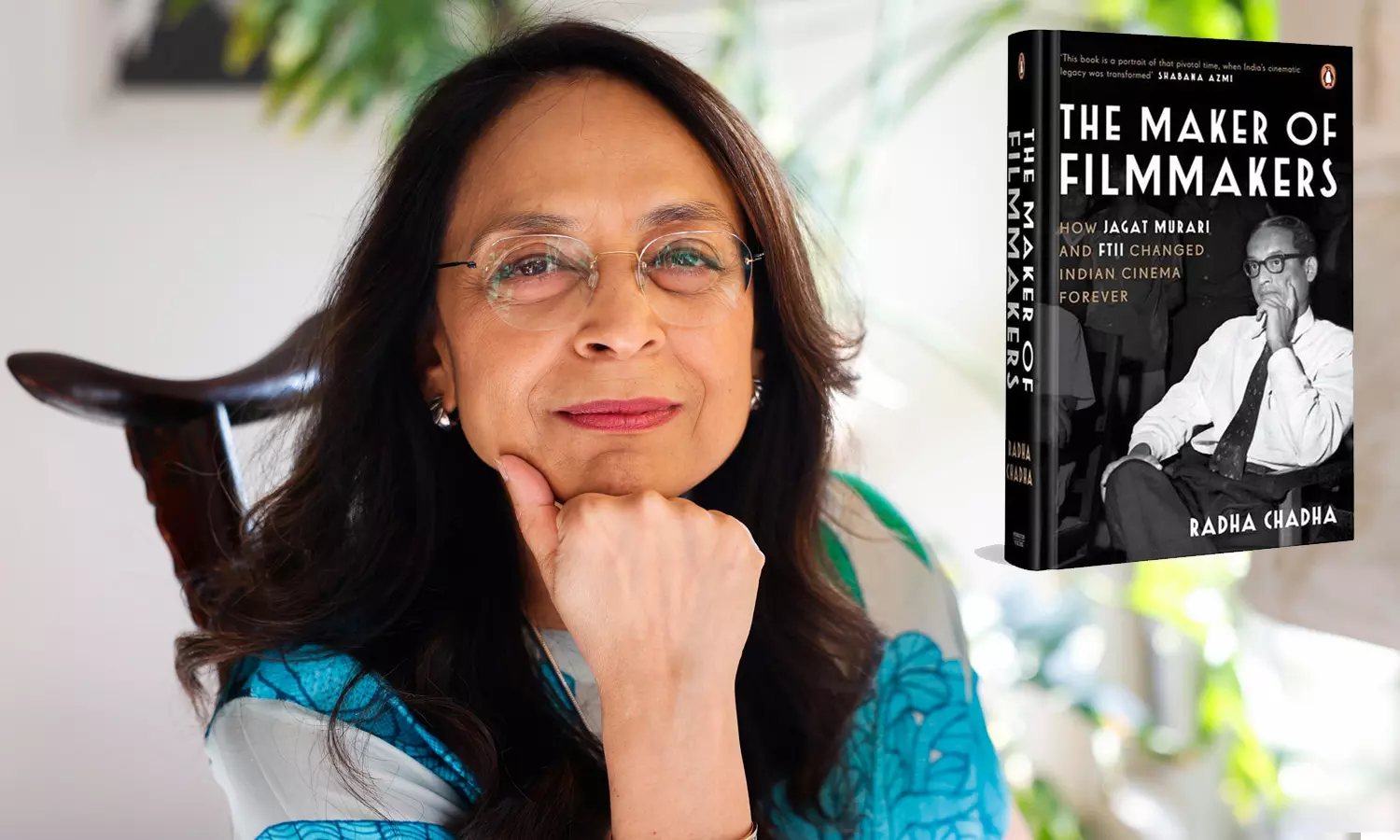
Radha Chadha, columnist and author of
The Maker of Filmmakers, How Jagat Murari and FTII Changed Indian Cinema Forever, a biography of her father, tells Deccan Chronicle’s P. Charitha about the man who helped establish and build FTII, an institution that has trained generations of actors, directors, writers and technicians, and set the legacy of Indian cinema.
The entrance to the Film and Television Institute of India. (circa 1970) | Image by Arrangement
What made you write this book, and what were the challenges?
I felt that I had to tell this piece of cinematic history. That’s the job which I did, and which had its challenges. A biography requires that almost every scene you write or construct has to be as honest and as close to what happened at that time, which means referring to lots of material, to two, three different sources at the same time.
Was there anything that surprised or intrigued you?
There were many, many surprises, both from the interviews and from going through his papers. One of the biggest was that he had interned with Orson Welles, who is considered one of the finest filmmakers in the world. He went to study cinema before Independence at the University of Southern California, which was the only film school in the US at that time, and he interned with Welles on the making of Macbeth. There are lots of lessons that he learned from Welles. That shaped my father as a filmmaker, and in turn it would shape the filmmakers that he made at the Institute.
From the interviews, many of his students spoke about love. Love as a part of leadership style was a surprise to me, but it was so consistently played back. He was like a father figure to them. It was like a big family. He not only helped them on academic issues, he also stepped in on personal issues. This was just a decade and some years after Independence. Many of the students were very short of money, and many faced a lot of resistance from their own families. Some were cut off financially. On top of which, this was an absolutely new school with very limited resources.
How did he create an environment for artists to flourish?
To make creative people, scores upon scores, year after year, is about creating the environment in which they would flourish. An artist needs originality, which they really emphasised at the Institute. It needs free thinking, debate, disagreement.
Jagat Murari and Satyajit Ray observing an acting class in 1969 | Image by Arrangement
He made sure that his students were exposed not only to Indian cinema of all kinds, from Satyajit Ray and Ritwik Ghatak to the commercial cinema, but also to world cinema. He managed to get all the major landmark films into the Institute, whether it was Eisenstein and Welles, Godard or Ingmar Bergman.
Adoor Gopalakrishnan told me that the most important thing he learned at the Institute was to look within. You can see the best films in the world, but finally, you only have yourself as an artist and filmmaker. Many others talk about the same thing: the importance of finding your own voice.
Tell us about the New Wave of Indian cinema.
The New Wave started in the late 60s. The Institute started in 61, so literally a decade later its impact on Indian cinema came in the form of the New Wave. It was this exposure to world cinema, to the finest filmmakers. Every student had to make a diploma film in his final year, a short film with all the bells and whistles in terms of dialogue, music and effects, and these films were highly experimental. It was emphasised that you have to be original, as against copying what is happening elsewhere. A direct outflow of that was the Indian New Wave, where they broke away from the formula of Indian cinema at that time, which was big budget, big stars, over-the-top acting and very melodramatic plot lines.
Subhash Ghai as a student at FTII in 1965.
Jaya Bachchan (née Bhaduri) in Suman (1970),an FTII student film.
Shabana Azmi & her classmate Neelam Mehra in front of Jayakar Bungalow.
Naseeruddin Shah.
They replaced that with small budgets, new actors, very realistic performances, shot on location, and they often used literary stories from well-known Indian authors. Pick up any New Wave film and it is either directed by an FTII alumnus or has actors from FTII. Jaya Bhadhuri ( now Bachchan) Shabana Azmi, Naseeruddin Shah and Om Puri became poster children of the Indian New Wave. Among the technicians, the cinematographer K K Mahajan shaped the way we view the world with his very realistic, very artistic and stunning photography. This entire ecosystem that the FTII alumni created helped the New Wave not only come to be but flourish, and the movement grew in the 70s and 80s.
Apart from FTII, he also helped set up the National Film Archive of India and the film festivals. How did he navigate the ministry and bureaucracy?
In today’s terminology, he would be called a serial entrepreneur. The Institute came under the Ministry of Information and Broadcasting, not the Ministry of Culture. He had not only the minister as the boss, but several other bureaucrats who would weigh in on many things. He took the Institute up when it was barely six months old and grew it into this iconic film school.
Jagat Murari taking his boss Indira Gandhi, then the Minister for Information and Broadcasting, on a tour of the Institute in 1964 | Image by Arrangement
His boss in the early years was Indira Gandhi, who was Minister of Information and Broadcasting in Lal Bahadur Shastri’s cabinet. She was a film buff, an early member of the Film Society movement, along with Satyajit Ray and I K Gujral. She really helped the Institute in its initial years and gave him a free hand. For the first decade the Institute was a small organisation and the government did not really look into it that much, so he was able to do whatever his vision was. In later years there was a lot of supervision, or interference, whatever you call it.
He was given the National Film Archive job almost three days after he joined the Film Institute. India’s cinematic heritage, the prints on celluloid, were all disintegrating, and nothing had been collected. One of the first films to get was Dadasaheb Phalke’s first film, Raja Harishchandra. In the early days the Archive sat on the campus, used the same vaults, and screened films where the students could see them. It was symbiotic, and a labour of love for him.
The Film Festival Directorate happened much later, and the National Awards also came under it. The peacock symbol and the branding is all his work. The first structured International Film Festival of India was the fifth edition, and the slot was shared, believe it or not, with Tehran, which ran a festival in even years while India ran it in odd years. 1975 was a watershed year, with theatres full and films like The Godfather selling out. He did not set up the Films Division, but he was there right at the start. He made his documentary films there before moving to the Film Institute.
If he were to visit the campus now, what would make him proud?
FTII has been through its ups and downs, but it has never taken its eye off creating spectacularly talented filmmakers. In recent times you have people like Payal Kapadia scoring prizes at Cannes. There are Resul Pookutty and Sudeep Chatterjee, directors like Sanjay Leela Bhansali, and the younger generation like Jaideep Ahlawat and Vijay Varma. They follow the same legacy of filmmakers that he made.
He would be proud of the impact this one film school has had, on the New Wave and on regional language cinema. Film schools have also mushroomed across India, and almost invariably they are helmed by or have teachers from the Film Institute, for example Subhash Ghai’s Whistling Woods.
That tradition has spread across India, and I think he would be very proud of that.
Also Watch: Jagat Murari’s Mission Was To Create Filmmakers to Raise Indian Cinema Standards