The Women Artisans Reimagining Madhubani for a New Generation

A unique collaboration between Mysore Saree Udyog and MAATI is giving Madhubani art a contemporary canvas in Hyderabad. Through hand-painted textiles, direct artisan engagement and a renewed focus on sustainable livelihoods, the initiative is helping a centuries-old tradition find relevance with a new generation
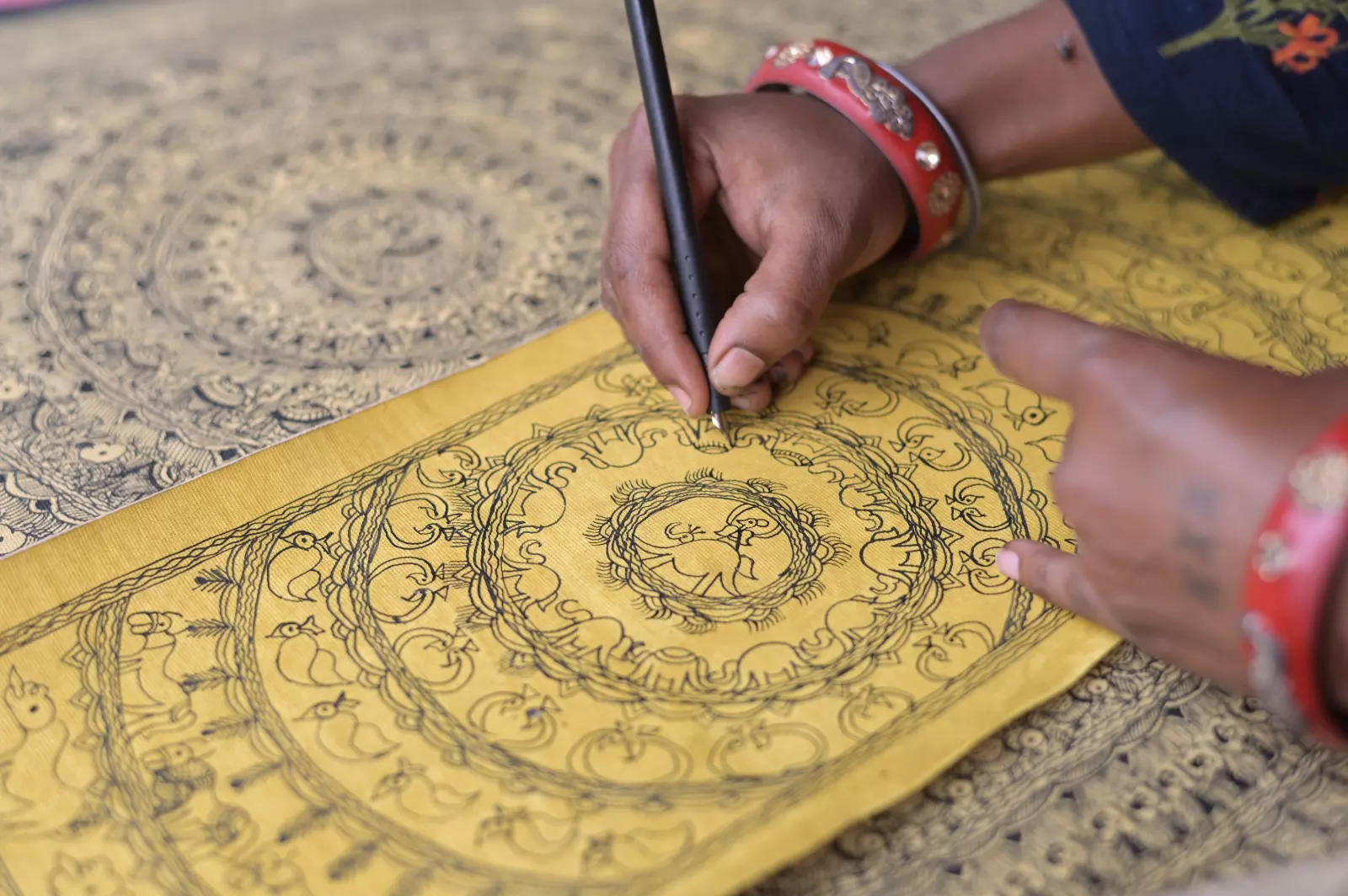
For centuries, Madhubani art has lived on the walls of homes, in ceremonial spaces and on sheets of handmade paper, carrying stories of nature, mythology and everyday life. Today, that same art is finding expression on sarees, scarves, apparel and home furnishings, opening new pathways for both artisans and audiences.
At Mysore Saree Udyog in Hyderabad, a two-day showcase titled Madhubani, Made to be Worn brings together the traditional artistry of Bihar's Mithila region and a contemporary retail platform. The exhibition, organised in collaboration with MAATI, an initiative of Kadam supported by Tata Trusts, is as much about preserving an ancient art form as it is about ensuring that the people behind it continue to thrive.
For Anil Sancheti, Partner at Mysore Saree Udyog, the collaboration emerged from a shared purpose.
"We had visited a MAATI exhibition in Bengaluru and were deeply impressed by the collection. We have always believed in supporting artisans and traditional crafts, and our end goal was the same. We wanted to create a platform that would help these artisans reach more people while ensuring that these traditions continue to flourish," says Sancheti.
The challenge, however, extends beyond preservation. In a world increasingly shaped by fast fashion, traditional crafts must continuously find ways to remain relevant.
Piyush Jain, Partner at MSU believes adaptation is key. "Earlier, Madhubani art was largely confined to frames, walls or pottery. Today, it is appearing on sarees, scarves and many other products. We are trying to create new forms and fusions that appeal to younger generations. If we don't adapt, these art forms risk disappearing."
The exhibition reflects that philosophy. Intricate hand-painted motifs inspired by nature appear on handwoven textiles, while contemporary silhouettes and products make the art accessible to a wider audience. One can see 'Pokhar' being a central theme in the art work. The Madhubani patterns on the textile bring about fine lines and rhythmic patterns, that ripple like water, and layered like leaves.
For the artisans themselves, the transition represents far more than a design evolution. It offers visibility, economic opportunity and a chance to build direct connections with the people who wear and appreciate their work.
Amitava Bose, President of Kadam Foundation, explains that MAATI, which stands for Mithila Art and Artisan Transformation Initiative, was created with exactly this objective.
"The artisans are incredibly skilled. We are not teaching them how to paint. Madhubani is a craft that is over 2,500 years old. What we are doing is helping them build sustainable enterprises, connect directly with markets and create opportunities that allow them to continue practising their craft with dignity," he says.
The initiative plans to create 100 artisan-led enterprises over the next few years, supporting nearly 1,000 artisans across Madhubani and Darbhanga.
Bose believes one of the biggest gaps in the traditional craft ecosystem has been the distance between creators and consumers.
"When people buy something, they rarely know who made it or what story lies behind it. Every product has a story. Our role is to connect the artisan with the end customer and create that dialogue," he says.
That dialogue becomes especially meaningful when listening to artisans such as Laxmi Didi from Madhubani.
Laxmi Didi from Madhubani
She has been practising the art since 2007, growing up in a family deeply connected to the tradition. Her father is a state award-winning artist, and she learned by watching generations before her.
"Earlier I worked in the traditional style, but after joining MAATI we started drawing inspiration from our surroundings in new ways," she says. "I believe nothing is constant in life and change is always good if it is for the better."
One of the most personal expressions of that evolution is her artisan enterprise logo, Vasundhara.
"The name is connected to my life. My family has stood by me through thick and thin. Just as Vasundhara is rooted to the earth, I am connected to my family. That is why I chose the name," she says.
Her words reflect a recurring theme throughout the exhibition: tradition is not static. It grows, adapts and draws strength from its roots.
For Chandini Devi from Darbhanga, the journey into Madhubani art began differently. Unlike many artists in the region, she did not inherit the craft from her family.
Chandini Devi from Darbhanga
"My family was not involved in it, but I saw my neighbours practising it and got interested," she says. "I have been doing it for five years now. We wanted to take it to the next level, so we trained and learned new skills to become self-sufficient."
After undergoing training through the programme, she now hopes exhibitions such as this one will help the art travel beyond its traditional boundaries.
"We have come here with hope," she says. "We want more people to see our work, understand it and help create awareness so future generations continue to preserve this art."
That hope is echoed in every artistic piece on display.
As consumers increasingly seek authenticity, sustainability and a deeper connection to what they buy, traditional crafts are finding renewed relevance. Yet their survival depends not only on appreciation but on creating viable livelihoods for the communities that sustain them.
By bringing artisans, storytellers and audiences together under one roof, the collaboration between Mysore Saree Udyog and MAATI offers a glimpse of what that future could look like. A future where heritage is not preserved behind glass, but worn, celebrated and carried forward into everyday life.
