Book Review | Wise, Wry Himalayan Parables

Once upon a time these tales were told to a live audience
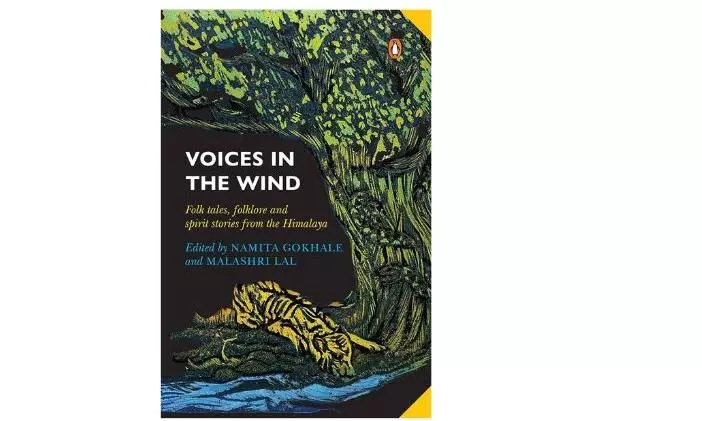
A tribute to our collective imagination, parables dedicated to nature and the cosmos, these folktales abound with the original ‘magic realism’, sparkling with quirky twists and earthiness.
Their richness and vast narratives, pithily told, are prodigiously celebrated in Voices in the Wind: Folktales, Folklore and Spirit Stories from the Himalaya. Elegantly compiled and edited by Namita Gokhale and Malashri Lal, the stories spread an enormous canvas of delight in front of us — capturing the shadowy spirit world where humans, animals and nature interact deeply with each other, and linear time melts away. Interwoven with wit and humour, sexual undertones and sometimes horror, they remind us of those moments when romantic endeavours, noble escapades, as well as godly and ungodly pursuits, all exist side by side. And those moments are not in the past, as we know. You just have to listen with your heart.
But the only difference is that the audience— instead of being present in a group — is now reading the stories, individually. And the communities which gave birth to these tales can be identified through geography.
Gathered painstakingly from Kashmir, Ladakh, Himachal Pradesh, Uttarakhand, Sikkim, the Northeast, Bhutan and Nepal, each story brings a freshness of prose and, occasionally, poetry from that mighty terrain with its deep forests, fast flowing rivers and unique divinity. The brevity of the folktale is ideal for today’s generation and is mindful of how much wisdom lies within the Himalayan dwellers, engaged as they are in a turbulent existence. Facing the vagaries of nature, and the trials of urbanisation — the reader has a deep appreciation that while many of these narratives were handed down from generation to generation — they still bear relevance to the times and the literature of this century.
This makes the collection even more compelling, as few have attempted the daunting task undertaken by Gokhale and Lal. Even to be able to identify repositories of these ageless narratives would be difficult today — and yet the two editors have succeeded in identifying and persuading a range of storytellers to preserve them by writing them down. This is challenging as close-knit communities disintegrate and we are increasingly socially and mentally distanced from this mysterious terrain of myth and legend — where the lives of animals and humans are interchangeable, depending on the whims of the supernatural and other godlike creatures who dwell within dense vegetations and rough -hewn rocks. Climate change has impacted not just the environment, but wordsmiths as well.
Illustrated with woodcuts created by Nalinakshya Talukdar, the stories have been contributed by a variety of authors — from Namita Gokhale to Pramod Kapoor, to the Queen Mother of Bhutan, Gyalyum Ashi Dorji Wangmo Wangchuk and others whose skill and knowledge are equally undeniable.
Once upon a time these tales were told to a live audience. In the first few lines of the stories from Bhutan for example — we imagine how the storyteller would call out to his listeners “dangbo... o… o… dingbo... o…o…” and they would respond with a murmur which meant that they were eager to listen…
Now, as we dive deep into this excellent collection, we understand only too well why the audience was so rapt.
Voices in the Wind: Folktales, Folklore and Spirit Stories from the Himalaya
Ed. by Namita Gokhale and Malashri Lal
Penguin
pp. 336; Rs 999
