Book Review | Sober Biography Of A Dazzling Intellect

That he was a polymath would be a vulgar generalisation indeed. But Ramaswamy dutifully shows up the limitations of Damodar Kosambi’s work in each of his fields of study, though in each one of them his intervention and his contribution is nothing less than brilliant, whether it is his work on Bhartrihari’s Satakatrayam, the most famous collection of poems spanning ethics, eroticism and renunciation in the entire Sanskrit literature
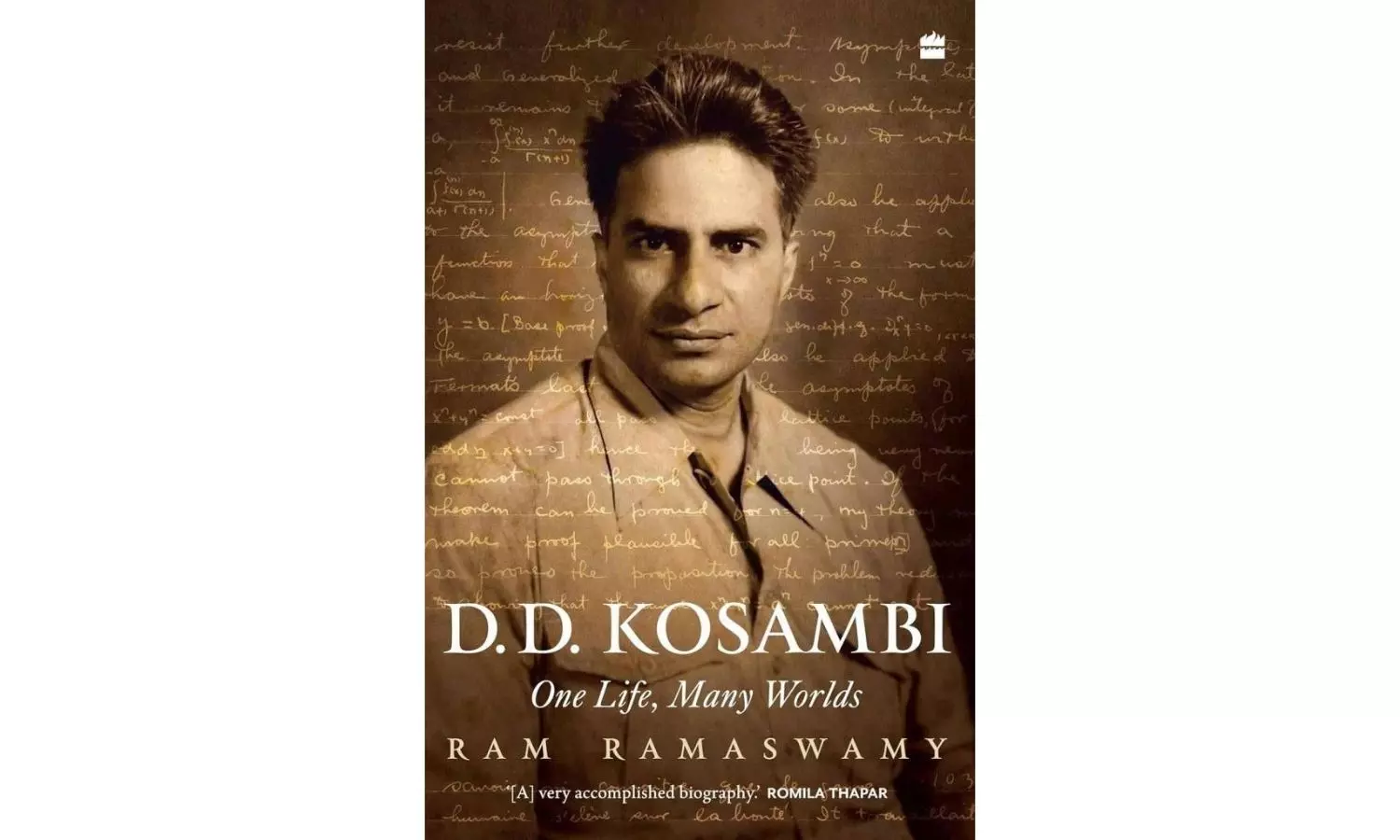
Ram Ramaswamy has undertaken the most difficult task of a biographer, to write about a genius whom he admires immensely, but whose shortcomings and limitations in his fields of specialisation — mathematics, statistics, Sanskrit poetics, archeology, history — and the rough edges of his personality are not overlooked. It is a rare accomplishment to write about the dazzling intellect of D.D. (Damodar Dharmanand) Kosambi — more admired and adored than critically debated — without being dazzled.
Ramaswamy had also done the right thing in writing about his father, Dharmanand Kosambi, the Gauda-Saraswat Brahmin from Goa, who left home and wandered across India, Nepal, Ceylon (now Sri Lanka), Burma (Myanmar) and in India visited Poona, Madras, Benaras, Bodh Gaya, Calcutta, before finally ending as an academic in Harvard University. Dharmanand became a Sanskrit and Pali scholar, became a Buddhist, a Buddhist monk, before renouncing monkhood and devoting himself to propagate Buddhist thought. He focused on the Buddhist text, Visuddhi Magga of Ashwaghosha.
Because of his father’s Harvard engagement, his son and his daughter were educated in America. Damodar Kosambi studied at Harvard, even as his sister Manik went to Radcliffe. It would not be possible to understand the son without knowing about the father because the intellectual trajectory followed by the father is shared by the son. Dharmananda was a Buddhist and a Marxist, while son Damodar did not take to Buddhism but became a Marxist.
Damodar Kosambi was not the orthodox Marxist. He was a true-blue scholar and intellectual, who was far above the card-holding Communist Party member. He admired Marx, Engels and Lenin, and he was unsparingly critical of the United States. But this independence of mind and intellect is something that he imbibed from his Harvard education.
That he was a polymath would be a vulgar generalisation indeed. But Ramaswamy dutifully shows up the limitations of Damodar Kosambi’s work in each of his fields of study, though in each one of them his intervention and his contribution is nothing less than brilliant, whether it is his work on Bhartrihari’s Satakatrayam, the most famous collection of poems spanning ethics, eroticism and renunciation in the entire Sanskrit literature. Or his masterpiece, An Introduction to the Study of Indian History. He shows that Damodar Kosambi lagged behind in mathematics because of his other intellectual pursuits, and that he was not the deeply-grounded Sanskritist as many others were. And he gives a fair sample of scholarly responses to his work on Indian history, where his peers in history admired his brilliance but they did not refrain from nitpicking the things he overlooks in Indian history. And now that is a balancing act of great dexterity on the part of the biographer.
The most curious detail that Ramaswamy cites is Damodar Kosambi’s dedication of his book on Bhartrihari: “To the sacred memory of the great and glorious pioneers of today’s society, Marx, Engels, Lenin: nutanamaanavasamaajasya purascharana, marx, engels, lenin/naamadheyaanaam tejaswinaam mahaamaanavaanaam puneetasmaranaartham.” That is the quirk of a genius.
D.D. Kosambi: One Life, Many Worlds
By Ram Ramaswamy
HarperCollins
pp. 384; Rs 899/-
