Book Review | Fiery Memoir Locates Constitutionalism

Jaising conceptualises the Constitution as a site of belonging
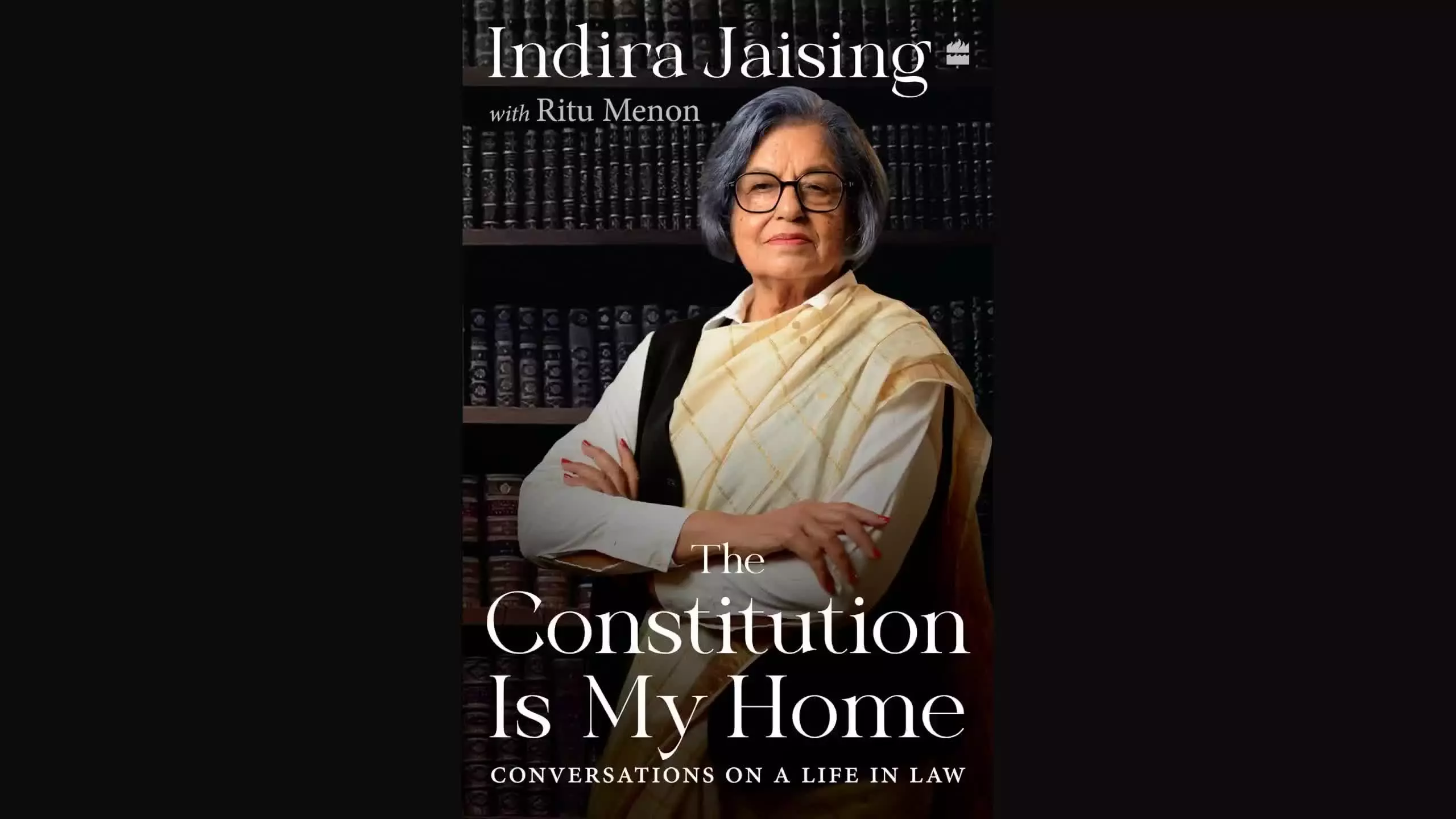
Written in dialogue with Ritu Menon, Indira Jaising’s recently published memoir chronicles over five decades of her engagement with the law, while simultaneously tracing the evolution of constitutional rights in postcolonial India. The book compellingly embodies the feminist dictum that “the personal is political”. Jaising’s experiences of displacement, gender discrimination and professional struggles are not merely individual narratives but sites through which larger constitutional, feminist and democratic questions are articulated. On the other hand, her feminist legal vision reshapes constitutional interpretation by challenging assumptions of legal neutrality that obscures structural inequality based on gender, caste, class, religion and sexuality.
Jaising conceptualises the Constitution as a site of belonging. Drawing upon her family’s experience of displacement during the Partition, Jaising concedes there was no geographical terrain that she could call home. Instead, the constitutional idea of inclusivity and unity within diversity, the idea of rights guaranteed to citizens irrespective of caste, class, creed and gender, became her personal space, a home to return again and again. This formulation resonates with contemporary debates on constitutional morality vs majoritarian politics. The Constitution emerges not as a static legal text but as a dynamic and contested framework whose vitality depends upon continuous public engagement and institutional accountability.
Departing from the conventions of chronological autobiography, the book unfolds through discussions of landmark legal cases, personal experiences, and political struggles. This conversational format checks self-celebration and allows personal experience to illuminate broader questions concerning justice. The duo revisits several landmark legal struggles on issues ranging from gender justice, sexual harassment, domestic violence to labour rights, environmental protection minority rights and citizenship. Rather than treating these cases as isolated judicial achievements, Jaising demonstrates how strategic litigation founded on interpretation of the Constitution has functioned as a means of expanding democratic rights for the marginalised communities. For her, litigation and social movements have always remained intertwined. The Sabarimala case is discussed as a pivotal moment where the Supreme Court affirmed women’s right to enter the temple, foregrounding constitutional morality over religious exclusion. The Rupal Bajaj case is highlighted as a landmark in recognising sexual harassment as a violation of dignity. The debates around NRC and CAA are examined as instances where questions of selective citizenship challenge the inclusive vision of the Constitution. Jaising also emphasises that justice must remain independent of religion, that constitutional principles cannot be subordinated to faith-based norms in a secular democracy.
Finally, the book reflects on the challenges faced by the judiciary post-2014. The increasing pressures on judicial independence, the threat to collegium system of recruitment, the manipulative rostering of cases to the favoured judges and the shrinking space for dissent — all these endanger the future of the hard-earned autonomy of judiciary, notes Jaising. The role of judiciary in safeguarding constitutional values is being jeopardised. This is what makes the book a politically timely contribution. It demonstrates that constitutionalism is a continuous practice of democratic resistance sustained through legal activism, feminist politics and civic engagement.
The Constitution Is My Home: Conversations on a Life in Law
By Indira Jaising
HarperCollins
pp. 236, Rs 699/-