An important culinary book packs in a burst of flavours; from nostalgia to friendship to showing the readers how Delhi’s restaurant culture continues to evolve
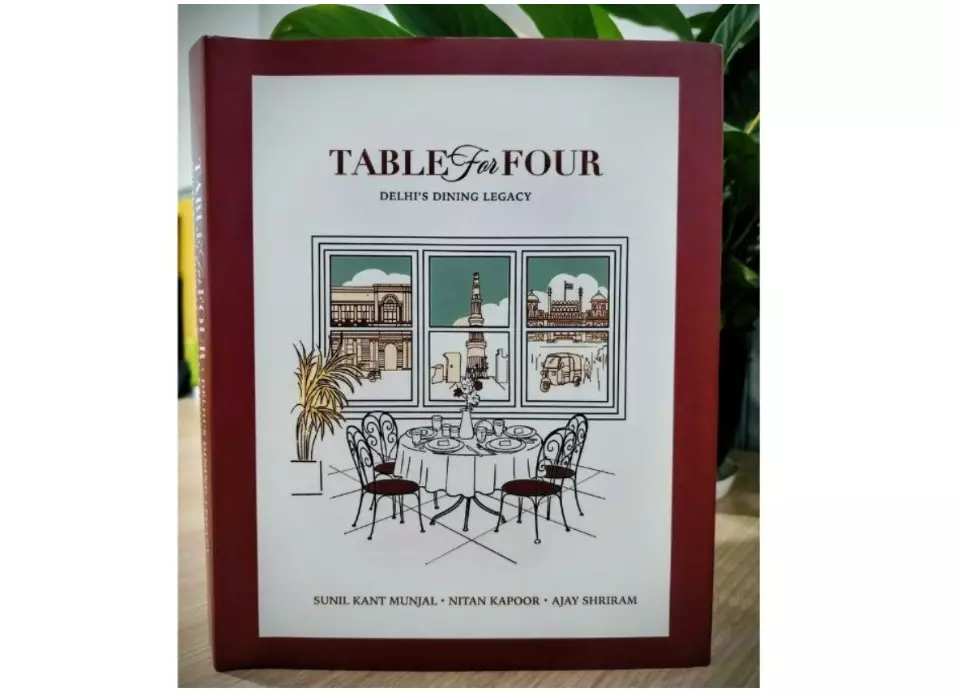
Halfway through reading Table for Four: Delhi’s Dining Legacy, I come to understand why food matters in friendships; coming from a boarding school myself, it isn’t tough to understand the “value” that food, literally, brings to the table. For many of us, “food anxiety” and / or “love for food” is a real thing, given that we have led years in a boarding school understanding rationing of food supplies, all the while sneaking in “tuck” (a rebel act), “midnight feasts” of Maggi topped with bhujiya and our own Parle-G biscuit cakes made for friends’ birthdays, left on the window sill overnight for it to “get set” (don’t ask).
The richly illustrated book, complete with brilliantly styled ‘dingbats’ is written by Sunil Kant Munjal, Nitan Kapoor, and Ajay Shriram, all of them from Doon School from batches 1973, 1966, and 1970 respectively. Table for Four is an ode not only to the rich and long-lasting friendship that they’ve shared, it’s also a reminder of friends showing up for one another despite their hectic schedules, and eating hearty meals in various culinary establishments in Delhi NCR. Dedicated to Deepak Nirula (he was from Batch 1968), one of the four friends and India’s pioneering restaurateurs who passed away before the book got published, this heartfelt book is a gamechanger, especially becoming one of the few – or perhaps, the only one – that’s an ode to Delhi’s culinary scene. What the reader has in her hands, then, is a rich documentation of Delhi’s leading restaurants (some shut shop over the years, and in that sense it becomes even more imperative to read about the reviews of these restaurants, a throwback to what it was like when many of these places were opened in Delhi). Packed with information, which doesn’t read laborious, the book’s gravitas is even more pronounced when you read the introductory essay, ‘Dining in Delhi: How Restaurants Evolved’ by noted author and food historian Anoothi Vishal. Beginning from the way people ate in Shahjahanadbad where Mughal ‘qahwahkhanas’ or coffee houses were perhaps the oldest forms of restaurants’ to how the ‘rise of internet and social media further changed the dining scene’, Vishal’s essay shows the path for how the dining culture in Delhi has continued to evolve with restaurants such as Moti Mahal, Kwality, Nirula’s, United Coffee House, besides the iconic restaurants within hotels such as ITC Maurya, Taj, Lalit, Imperial, The Ashok, along with some of the contemporary ones such as Olive, Indian Accent, Ikk Panjab, Big Chill, Divam Chor Bizarre, among others.
While the essay keeps the reader engaged, ‘Amuse-Bouche’, the chapter preceding Vishal’s essay, written by Munjal, Kapoor, Shriram, sets the tone for what’s to follow. The reading is heartfelt and immediately draws the reader in. It reveals to us how the four friends would ‘get together, enjoy a relaxed and leisurely afternoon to talk about the school, the DSOBS [The Doon School Old Boys’ Society] … and all subjects under the sun.’
The essay is a deep dive into how simple conversations over a shared love of food deepened the friendship but also steered the direction for a book that’s eventually regarded as serious study material for understanding Delhi’s restaurant scene across decades. What makes this book even more compelling are voices of leading restaurateurs and chefs, many of whom have not only tracked Delhi’s restaurants but also contributed to the culinary culture of Delhi.
It’s a reason why the book feels so personal, engaging and heartfelt. To discover that Munjal, Chairman of Hero Enterprise, was fond of baking as a child; to read that Nirula was fond of his “beer lunches and food” in his younger days; Kapoor’s nostalgia for the “milk bread from Standard Restaurant with its jukebox in Regal building” or the setting up of the restaurant Holy Cow in Europe in the 1970s (the rarity being that beef wasn’t served here) is bound to bring a smile on the face of readers. It’s also a reminder of how food allows many of us to build a lifetime of memories. To that effect, very rightly so, the book, as it’s mentioned in the initial pages, “stands out as India’s first – or perhaps only – comprehensive gourmet lexicon, mapping cooking terminology and ingredients across regional languages and even European peers…. [that] reflects both nostalgia and the rich linguistic diversity of Indian cuisine.”
The book’s very neatly divided into chapters that offer detailed reviews by the authors along with write-ups and interviews by and of leading voices of the F&B sector. Stalwarts such as Rohit Khattar, Dr Bina Modi, AD Singh, Priya Paul, Ritu Dalmia, Marut Sikka, Anahita Dhondy, Rahul Akrekar, Vineet Wadhwa, among several others have contributed to the book, all of them exploring their version of Delhi’s food scene through writing. Then there are recipes too, which, just like any hearty meal, make this book so wholesome.
Vir Sanghvi, co-founder and chairman, Culinary Culture, makes it a point to mention in the book's foreword that the four friends, despite having been well travelled individuals ‘approached each restaurant experience with an utter and complete lack of snobbery and no sense of we-know-everything-because-we-have-been-everywhere’.
For the four friends who've been meeting for over 16 years, documenting over 70-plus restaurants, it's the last few pages of the book that make you reach out for the tissue box given that the three of the friends make a moving promise; ‘...we have decided to still book a table for four for every lunch -- to keep a place for our missing fourth member [Deepak Nirula]...’ They call this book an ‘odyssey’ and once you read it, you really feel like you’ve been on one. Table for Four is a book you go back to; not just for the way Delhi's revealed to the reader, but for the manner in which human emotions are felt on every page of this book.
The review is written by Abhilasha Ojha

