More than a skill, craft education builds confidence and autonomy: Karishma Swali

How does a painted line become a thread, and how does an artisan move from executing an artist's vision to shaping an artwork? Karishma Swali discusses the collaborative process behind Cosmic Garden, the evolving role of embroidery in contemporary art and how Chanakya School is building a new generation of women practitioners.
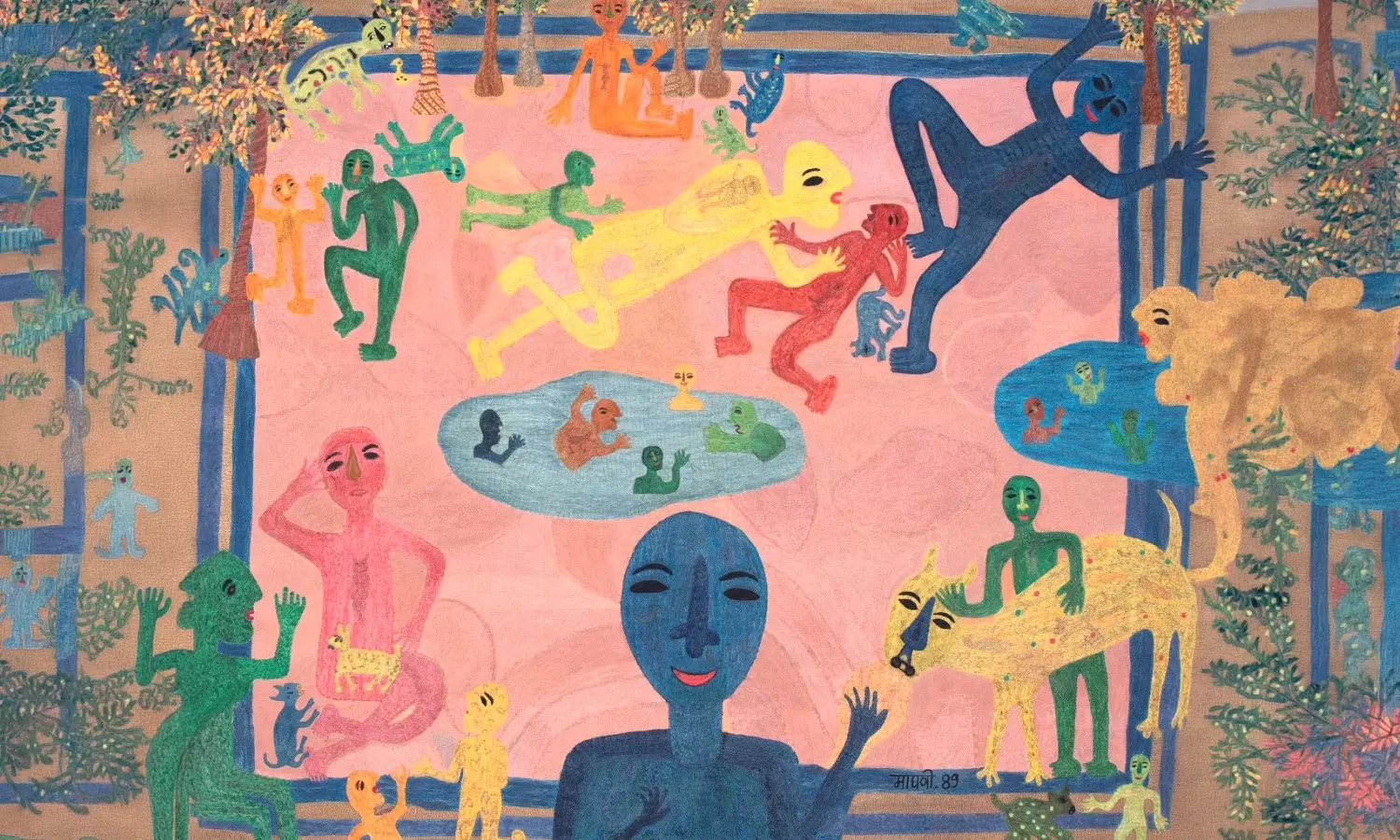
Cosmic Garden brings together the artistic worlds of Manu Parekh and Madhvi Parekh with the textile-based practices of Karishma Swali and Chanakya School, exploring the intersections of painting, sculpture and embroidery. Presented at Bihar Museum in collaboration with Chanakya Foundation, following its debut at the Venice Biennale, the exhibition examines how individual artistic visions can evolve through collective knowledge and the language of craft. For Karishma Swali, who leads the artistic direction of Chanakya School, it is also an opportunity to look at embroidery beyond its traditional associations with domestic work and recognise its place in contemporary art. In this conversation, she discusses the creative process behind the exhibition, the role of artisans as co-creators and how craft education is opening new possibilities for women.
Installation view of Cosmic Garden by Madhvi Parekh, Manu Parekh, Karishma Swali and Chanakya School, presented at the Bihar Museum, Patna, in 2026. Photo by Ranjit Kumar, courtesy of Chanakya Foundation.
What does bringing Cosmic Garden to Bihar Museum mean to you after its debut at the Venice Biennale?
First presented as a Collateral Event of the 60th International Art Exhibition – La Biennale di Venezia in 2024, Cosmic Garden now enters a new geographical and institutional context at Bihar Museum. For me, what is special about this exhibition is how the works continue to open themselves to new contexts and conversations. They carry the histories, techniques and relationships through which they were created, while allowing new connections to emerge between image and material, individual gesture and collective practice.
Manu And Madhvi Parekh With Karishma Swali Sahiba Chawdhary
How did you translate the visual languages of Manu and Madhvi Parekh into textile-based artworks?
Working with the visual languages of Manu and Madhvi Parekh was an enriching process of discovery. Madhvi's relationship with memory, mythology and vernacular traditions, and Manu's engagement with Indian cultural and esoteric traditions, offered us very different yet deeply connected worlds to explore. At Chanakya School, these encountered our own vocabulary of stitch, fibre, texture and scale. We began to see how line could become thread, how a painted surface could acquire dimension, and how their visual expressions could find a new language through textile.
How does embroidery become a form of artistic expression beyond its traditional associations with women’s domestic work?
For me, hand embroidery operates as a mode of drawing and material thinking. Every stitch carries a gesture, a rhythm and a sense of time. There is an extraordinary depth of knowledge within these practices that deserves to be recognised beyond their historical associations with domestic and gendered work. At Chanakya School, we explore embroidery as a vital mode of contemporary expression, bringing inherited textile knowledge into new artistic conversations.
How do the artisans of Chanakya School contribute to shaping the final artwork beyond executing an artist’s vision?
The works emerge through collective making and the accumulated knowledge of the hand. At Chanakya School, the artisans bring their own embodied knowledge, experience and understanding of material into the process. Drawing upon more than 300 embroidery and weaving traditions, we create a space where inherited techniques encounter new forms of artistic enquiry and material experimentation. Each interaction with stitch, fibre, texture and scale contributes to how the work develops. It is through this exchange between individual artistic vision and collective knowledge that a distinct artistic language emerges. The final artwork is therefore shaped by a shared and evolving practice, rather than by a singular act of authorship. For me, this collective process is central to how we approach making, where every contribution becomes part of the work's artistic language.
Karishma Swali Hashim Badani
With over 1,400 women trained at Chanakya School, how has craft education changed their relationship with art and livelihood?
Since its founding in 2016, more than 1,400 women have trained at Chanakya School. What has been most meaningful is seeing the different paths they have taken. Some graduates have joined the Chanakya ateliers, while others have gone on to establish independent practices or returned to the School as faculty, sharing their knowledge with new generations. As our first cohort graduated, the School's practice also evolved into an autonomous artist collective, bringing graduates together with master artisans. For me, this is what education through craft can make possible: not just learning a skill, but building confidence, autonomy and a lasting relationship with knowledge and making.
How do you see traditional Indian craft practices influencing the future of contemporary art?
I see traditional Indian craft practices as living knowledge systems that continue to evolve across generations. They hold an extraordinary understanding of material, process and the relationship between the hand and the imagination. At Chanakya School, we draw upon more than 300 embroidery and weaving traditions, bringing this inherited knowledge into contemporary artistic enquiry. I believe the future lies in allowing these practices to continue growing through dialogue with new materials, disciplines and artistic perspectives, without losing their connection to the knowledge systems from which they emerge.
