The Forgotten Roots of India’s Eco Feminism

7 March 2026 9:07 AM IST7 March 2026 9:07 AM IST
India’s environmental history holds a powerful story that rarely enters mainstream memory. In 1730, Amrita Devi Bishnoi and 362 others gave their lives protecting trees in Khejarli, centuries before the world would recognise the symbolism of women hugging trees during the Chipko movement.
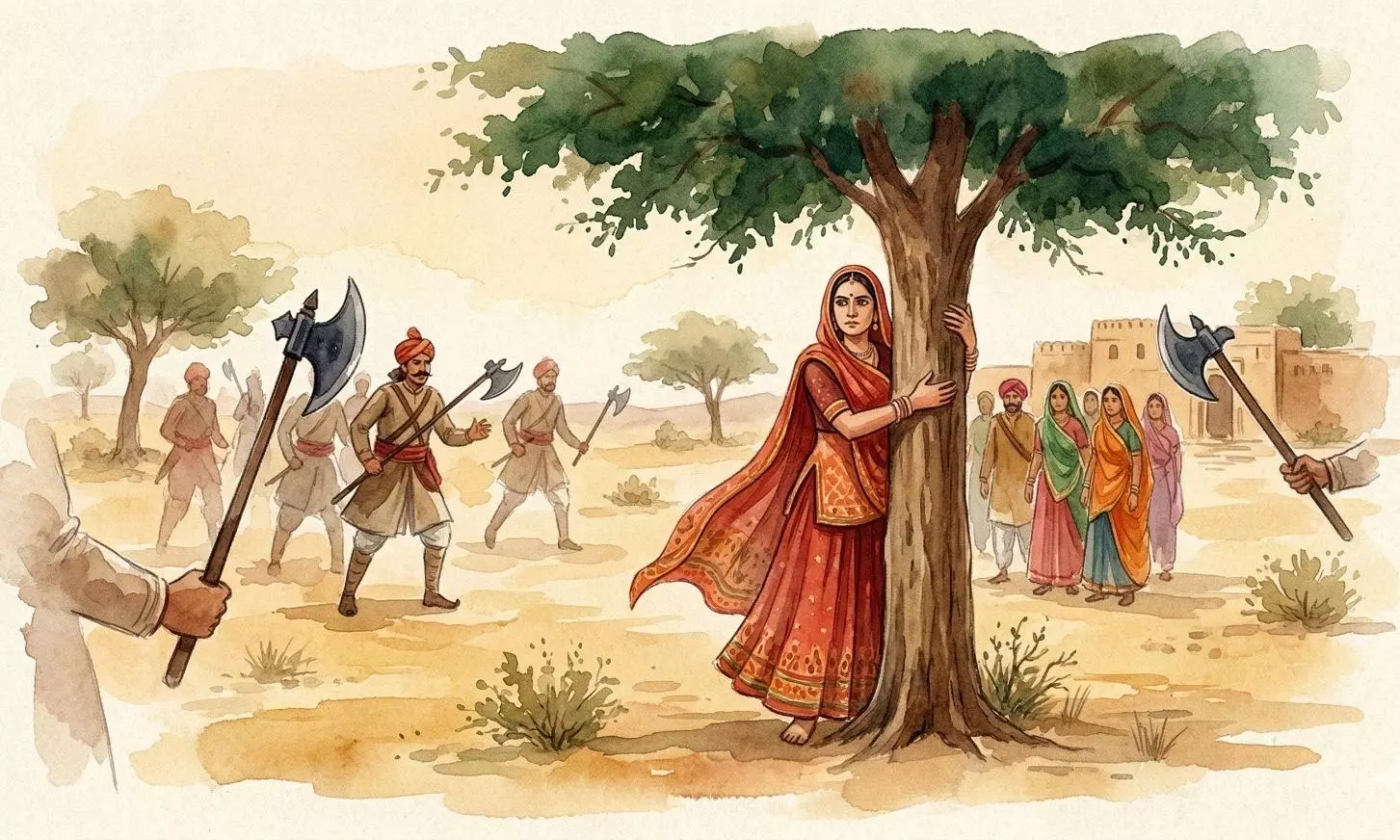
Representational Image
Every year on Women’s Day, we celebrate leadership, courage and the quiet revolutions women have sparked across generations. In India, when conversations turn to eco-feminism, they often begin with the Chipko movement of the 1970s. Rarely do they travel further back in time, to a desert village in Rajasthan in 1730, where a woman named Amrita Devi stood between an axe and a tree.
The story unfolds in Khejarli, a Bishnoi village in present-day Rajasthan. Maharaja Abhai Singh of Marwar (Jodhpur) had ordered his men to cut down the Khejri trees for wood to construct a new palace. For the Bishnoi community, founded on 29 principles that emphasise reverence for life, cutting a living tree was not a matter of administration. It was a violation of dharma.
Amrita Devi Bishnoi, a brave woman, did not draft a petition. She did not negotiate. She embraced the tree.
When warned that defiance would cost her life, she refused to step aside. The soldiers followed through on their threat. She was killed on the spot. Her three daughters, witnessing the violence, ran forward and met the same fate. As word spread, villagers gathered and did the same. By the time the massacre ended, 363 men, women and children had been killed protecting trees.
There were no cameras, no headlines, no global solidarity campaigns. News travelled slowly. By the time the king heard what had happened, he is said to have issued a decree prohibiting the cutting of trees in the Bishnoi villages.
The incident came to be known as the Khejarli massacre. It predates the Chipko movement by nearly 250 years. Yet it carries the same image that would later become iconic: women hugging trees, refusing to let them fall.
In a recent conversation, author Anu Lall, whose book Bishnois and the Blackbuck: Can Dharma Save the Environment? revisits this history, reflected on how easily this chapter has slipped from mainstream memory. “Examples of women leadership should be taught and these are eco-feminism leadership. Why is all this not in our textbooks? It is kind of sad,” she said.
Her words linger because they point to something larger than a forgotten event. They point to a forgotten lineage of women who did not see themselves as activists, but as custodians. Their resistance did not emerge from ideology imported from elsewhere. It grew from a lived ethic that placed protection of life at the centre of daily existence.
The Bishnoi way of life, shaped in the harsh ecology of the Thar desert, wove environmental stewardship into spiritual practice. The principle was simple: do not harm living trees; protect animals as you would protect your own kin. For women like Amrita Devi, this was not abstract philosophy. It was a way of being.
When the women of Reni village in the 1970s wrapped their arms around trees to stop commercial logging, the world took notice. The Chipko movement became a symbol of grassroots environmentalism and women’s leadership. But its moral echo can be heard in Khejarli. The gesture of embrace, the willingness to stand unarmed before force, the insistence that ecology is not separate from community life... these threads run through both moments in history.
On Women’s Day, the story of Khejarli invites us to widen the frame of eco-feminism in India. It reminds us that environmental leadership here was not born in seminar rooms or policy forums. It was born in villages, in the hands of women who understood that the destruction of trees meant the destruction of futures.
Their courage challenges the narrative that rural women of the past were only passive victims of patriarchy. In 1730, they confronted armed men and chose sacrifice over silence. They were not seeking recognition. They were defending balance.
Today, as climate anxieties intensify and cities grapple with vanishing green cover, the image of a woman holding a tree feels both ancient and urgent. It tells us that care is not a weakness. That protection is power. And that the roots of Indian eco-feminism run deep, nourished by women who refused to let the earth be wounded.
This Women’s Day, remembering Amrita Devi and the 362 others who stood with her is more than an act of historical correction. It is an acknowledgment that some of the earliest environmental defenders in this country were women who understood, instinctively, that safeguarding the earth was inseparable from safeguarding life itself.
( Source : Deccan Chronicle )

Next Story