The Real Challenge In Organic Farming Is Making It Work For More Farmers

After leaving a career in technology to return to farming, Akshayakalpa Organic founder and CEO Shashi Kumar set out to make organic agriculture a viable model for more farmers. But building the business brought its own lessons, including the importance of creating a market besides production. In this conversation, he discusses the economics of organic farming, farmer profitability, certification, consumer expectations, climate resilience and why India’s agricultural future may depend on returning to crop diversity.
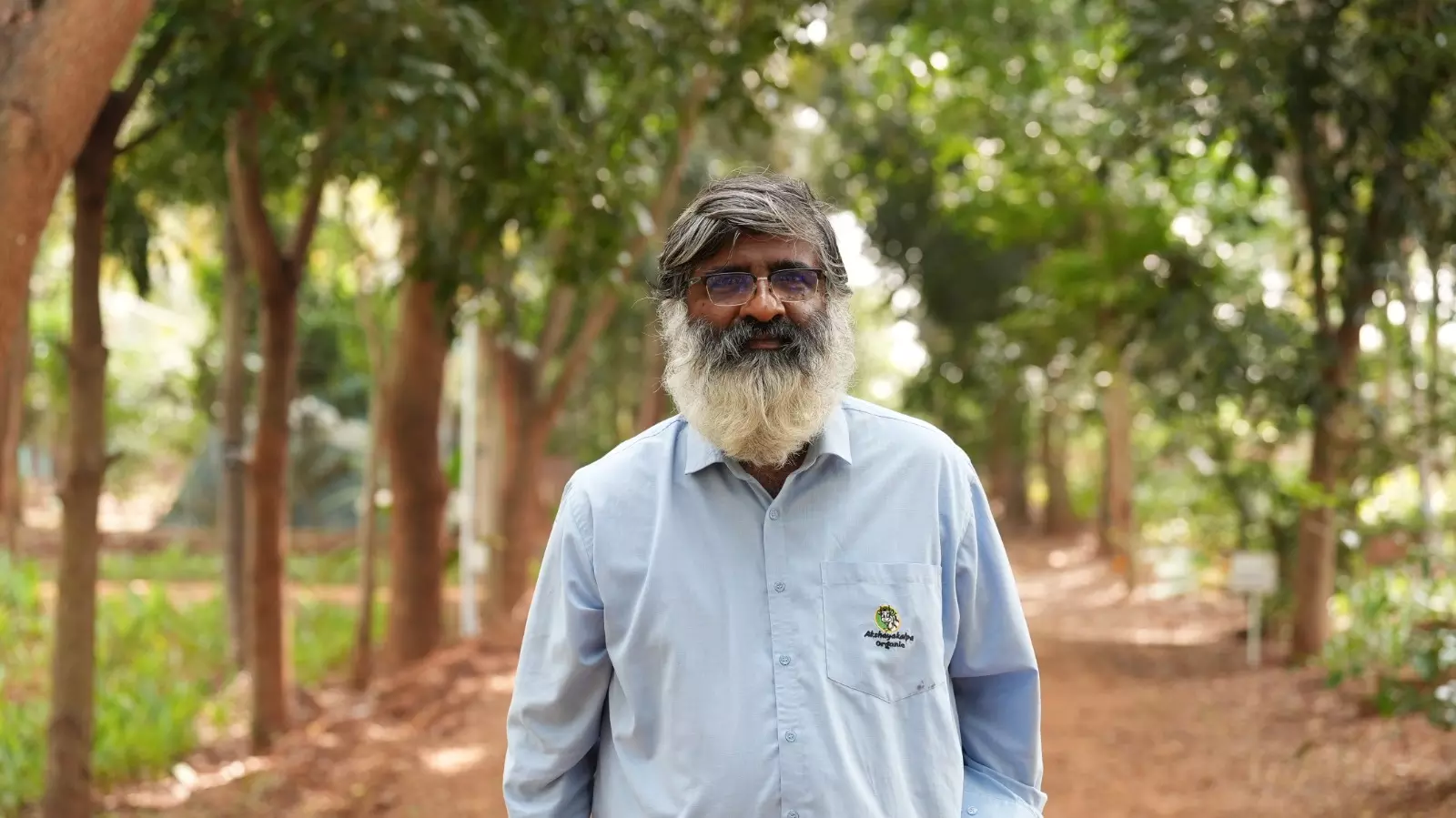
When Shashi Kumar left a career in technology to return to farming, he was not looking to simply replicate what his family had been doing for generations. He wanted to understand why organic farming, despite having several successful practitioners, had not become a model that more farmers could adopt. The problem, he felt, was not the absence of knowledge but the difficulty of making that knowledge transferable.
“There has been successful organic farming, no question about it. But the practices are often very specific to individual farmers. When others try to copy those practices, they face challenges,” says the founder and CEO of Akshayakalpa Organic, speaking at his farm in Tiptur, Karnataka.
For Shashi, the real question was how to make organic farming broad-based, with a set of rules and guidelines that more farmers could follow. Too often, he says, one farmer succeeds while others struggle to replicate the results, leading to the conclusion that organic farming does not work. That, he believes, is a misconception. The challenge is to create more successful examples that others can learn from and emulate.
This thinking also shaped the farming philosophy behind Akshayakalpa. Shashi points to the importance of integrating livestock into agriculture, an approach strongly advocated by his co-founder, Dr. G.N.S. Reddy, a veterinarian whose work over nearly three decades focused on livestock integration, watershed programmes and livelihoods.
“If you do not integrate livestock into farming, farming becomes unsustainable,” Shashi says. He explains how a farm growing millets, for instance, can use the crop residue as fodder for animals, while the dung returns to the soil. The idea is to create a closed-loop system rather than treat crop cultivation and dairy as separate businesses.
He also believes that building a successful model in every village could have a greater impact than attempting to work with thousands of farmers at once. A farmer who is able to make organic agriculture work commercially can become a local example for others. The difficulty, however, is that many villages do not have such role models.
The economics of organic farming remains one of its biggest challenges. Shashi is clear that it cannot be built around expectations of quick returns. The initial years require considerable investment, both in farming and in developing a market for the produce. In India, he estimates that only around 0.5 to 1 per cent of consumers buy organic products, while much of the organic market remains export-oriented. Building a domestic market is therefore as important as making farming profitable.
“It is a long process. It is not possible in a short time,” he says, adding that the first 10 to 15 years demand substantial effort and money. For entrepreneurs entering the sector, he puts the gestation period at a minimum of seven to 10 years. Scaling the business without diluting its principles is possible, he says, but requires patience and shareholders who understand the time involved.
His experience has also made him wary of the assumption that producing good food is enough to build a successful business. Akshayakalpa came close to bankruptcy multiple times because the company concentrated on farming and production without giving equal attention to selling its produce.
“The fundamental mistake was that we did not know how to sell,” Shashi says. “For the first nine years we just farmed. Farming and market have to go together.”
It was an expensive lesson in the importance of building demand together with supply. The challenge is not simply to grow food through responsible farming practices, but to find consumers who understand the product and are willing to buy it consistently.
The question of consumer expectations becomes even more complicated when it comes to organic produce. Shashi gives the example of bananas that the company stopped marketing because consumers rejected their natural spots. A local variety of chikoo also struggled because buyers preferred larger fruit. The market, he suggests, often has a fixed idea of what good produce should look like, leaving little room for natural variations.
He also questions the tendency to describe organic products as inherently premium. Premiumisation, he points out, is not exclusive to organic food. What matters more is whether consumers can establish the authenticity of what they buy.
Shashi believes India’s existing certification and labelling systems provide a framework for this. He refers to the Jaivik Bharat initiative and FSSAI regulations, and explains the role of farm-level certification, food safety certification and mass balance in verifying organic produce. A farm is audited for its production capacity, and the quantity certified must correspond with its annual sales. If the numbers do not match, the certificate can be withdrawn.
APEDA’s TraceNet system also records registered land and updates the produce details every year, allowing the supply to be traced back to the farm. For consumers, Shashi says, the Jaivik Bharat logo should be accompanied by the FSSAI organic certification. Both are important to provide assurance.
Beyond certification, he sees the future of agriculture as closely linked to the ability to make farming a viable career for younger people. With the average age of an Indian farmer at 55, against India’s median age of 30, the gap is becoming difficult to ignore. Young people are moving away from agriculture, and Shashi believes the only way to bring them back is to make farming profitable.
“People who have no other options continue farming. Most young people have moved out,” he says. The answer, in his view, lies in creating successful farmers in every village who can demonstrate that agriculture can provide a sustainable livelihood.
He also believes that aspiring farmers need more exposure to working farms rather than relying only on theoretical learning. Akshayakalpa has a nine-month fellowship programme for people aged 19 to 27, offering hands-on training. Shashi points to the diversity of crops on his own farm, where around 50 to 60 crops grow among the coconut trees, including lime and turmeric. Such diversity, he says, is central to the way the farm functions.
The same principle applies to the wider agricultural landscape. Farming practices cannot be transferred from one region to another without considering local conditions. What works in Punjab may not work in Tamil Nadu or Karnataka. Soil, water availability, rainfall patterns, local culture and the livestock available in a region all influence what can be cultivated successfully.
“You have to experiment locally,” he says. A farming model must emerge from the conditions of the place rather than be imposed on it. Where dairy is unsuitable, sheep or goats may be a better fit.
That regional approach also informs his views on climate resilience. Walking through the farm, Shashi explains the trenches and bunds that help retain water. Trees are integrated along the bunds, while crops grow between them. The system helps retain moisture in the soil and air, even if the resulting landscape does not resemble the neat, uniform appearance often associated with conventional farms.
He is critical of the preference for large monoculture plantations, partly because they make mechanisation easier. Growing the same crop across acres of land, however, can leave the soil more vulnerable.
Climate variability, including periods of deficient or excessive rainfall, is something farmers have to learn to work with, he says. Rather than treating every weather event as an exception, agriculture needs to draw on practices that have helped communities adapt to local conditions over generations.
“Diversification is the key,” Shashi says. He points to the ragi crop on the farm, which performed well under rainfed conditions despite limited rainfall. Millets such as ragi and bajra, he says, are hardy crops that can withstand conditions in which other crops may struggle. The knowledge to grow them already exists, but farmers and consumers need to place greater value on it.
He also makes a case for looking at food through the lens of agricultural resilience rather than only consumer trends. Ragi, once an inexpensive staple, is increasingly discussed as a health food, sometimes giving the impression that nutritious food has to be expensive. Shashi cites its minimum support price at around Rs 42 per kg and says consumers can buy it directly from farmers.
He points to Rangareddy and Mahabubnagar in Telangana, where farmers once cultivated ragi before shifting towards paddy after irrigation projects brought more water to the region. That transition, he suggests, has also changed their exposure to agricultural risk.
“We need to look at farming from a resilience angle, not only from a consumer angle,” he says. Resilient crops can be cheaper, but changing the food system also means changing what people are willing to eat. There is considerable discussion around millets, he observes, but that has not necessarily translated into everyday consumption.
For Shashi, the relationship people have with their food is ultimately connected to how much they know about where it comes from. He describes three levels of consumers: those who grow their own food, those who know who grew it, and those who eat without knowing how or where it was produced. The first, in his view, represents the strongest connection with food.
His own assessment of the agricultural enterprise he has built is notably unsentimental. Asked what he would do if he were starting again with limited capital, Shashi says he would not build Akshayakalpa in the same way. India, he feels, still lacks the support systems and structures needed to make farming enterprises easier to establish and sustain. Building a marketing organisation may be possible, but building an organisation around farming itself is considerably harder.
“If I were to restart Akshayakalpa today, I would not do Akshayakalpa,” he says. With limited resources, he would rather grow food for himself than take on the difficulties of growing for others.
It is a stark observation from someone who has spent years trying to make organic farming work at scale. But it also brings the conversation back to the central problem he identified when he entered agriculture: the gap between knowing how to grow food and creating a system in which farmers can make a living from it. For Shashi, the future of farming will depend not on one successful farm or one growing consumer market, but on making the entire system work for those who cultivate the land.
