Red, Layer by Layer: An Immersive Art House Opens in Fort Kochi

Set in the cultural heart of Kochi, Asian Paints Royale’s immersive art house explores red as emotion, material and memory.
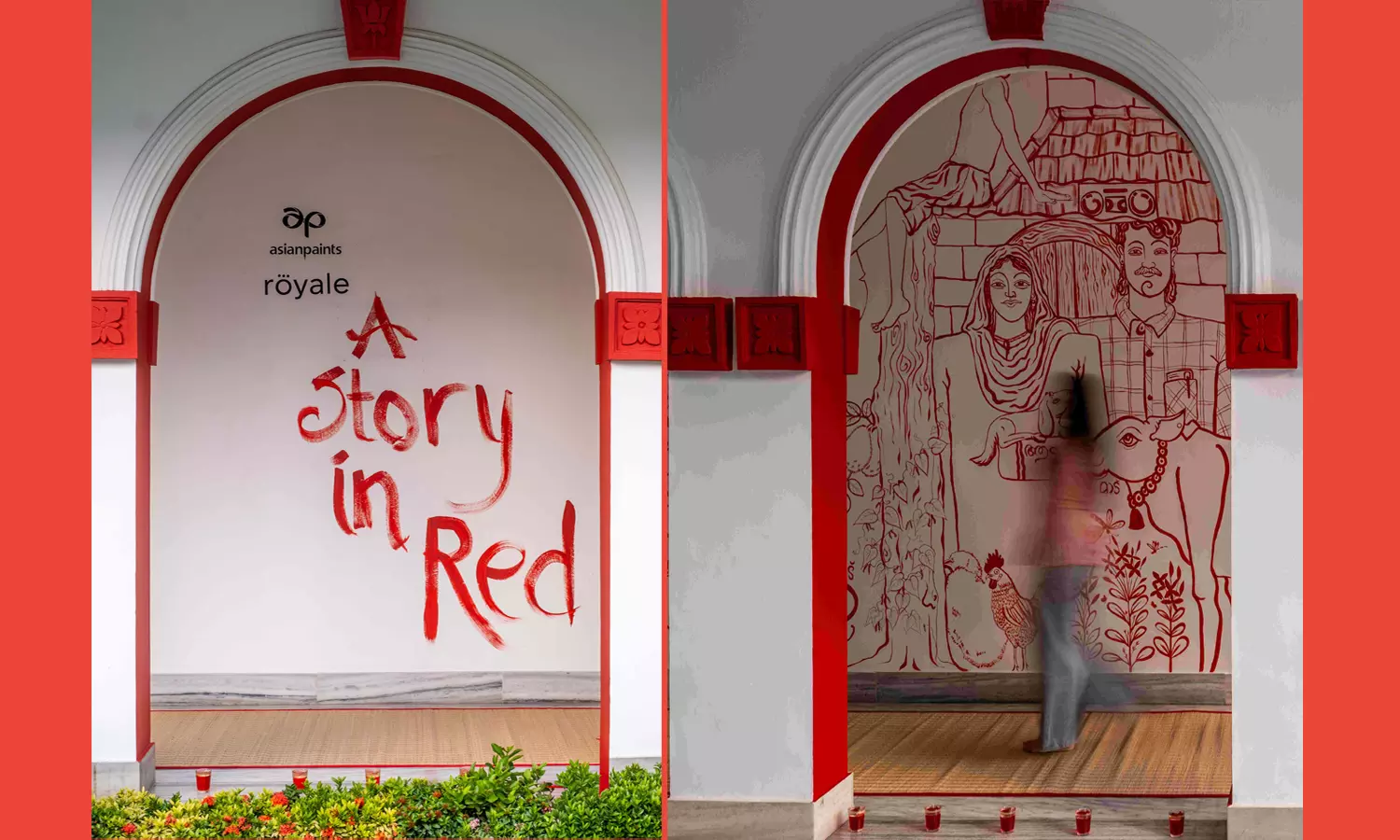
When you are asked to take your shoes off before you step inside. You wonder what’s in store. What waits beyond the threshold is not an exhibition you walk through quickly. It is a house you enter slowly, attentively, letting red guide you from room to room.
This is ‘A Story in Red’, Asian Paints Royale’s immersive Art House experience in Fort Kochi, unveiled at a moment when the city is already humming with creative energy. Set inside an old residence in the cultural heart of Kochi, the space does not announce itself loudly. Instead, it draws you in, letting colour, texture and objects do the talking.
“Welcome to this very interesting story in red,” says Amit Syngle, MD and CEO of Asian Paints Ltd., as he opens the walkthrough. “What you see and feel here is something invigorating. It’s a cultural juxtaposition. How colour, form and light come together to create something mesmerising, something very different.”
Red is the only constant, but it never repeats itself. Across rooms, the walls move between vermilion, rust, scarlet, burgundy and deeper, moodier tones. The finishes shift too, from silky and matte to lime-textured surfaces, absorbing light in some spaces and holding it softly in others. “We have used a very moody palette of Royale,” Syngle explains, adding, “It ranges from reds to oranges, and the textures move from silk-like finishes to very matte surfaces. That variation allows the objects to really intermingle with the space.”
Those objects, thirteen in all, are curated and in some cases created by Ranji Kelkar, a collector and creator known for his deep engagement with vintage textiles, jewellery and craft traditions. For Kelkar, the challenge was not simply to showcase red, but to let it speak through layers of everyday life, ritual and memory.
“When the thought of red was first told to us, I kept thinking, how do we put it together without overwhelming the space?” Kelkar says. “The idea was to use different reds in the same space and still make it look beautiful. So we played with ceilings, walls, textures and then added objects that tell stories. From day-to-day life to something luxurious, vintage, even antique.”
In one room, a ceremonial Okmus, traditionally worn during church celebrations in Goa, stands almost like a guardian, surrounded by layers of velvet, satin and lace. Designed by Savio Jon, it draws attention not just to form, but to surface. “Lace itself became a texture,” Kelkar points out, noting how fabric, wall finish and light echo each other quietly.
Elsewhere, a century-old Gujarati bandhani saree unfolds its history thread by thread. Its tiny dots, each tied with a mustard seed, speak of painstaking labour and a time when sarees were shorter, worn differently, adapted for daily life. “You figure out age through style,” Kelkar says simply. “The pallu, the weave, the length. These details tell you when something belongs.”
For Syngle, this layering of objects and surfaces reflects Asian Paints’ long-standing philosophy around interiors. “Royale has always created interiors that are strong environments to live in,” he says. “Spaces that breathe tradition but also invite people to enjoy them. What’s exciting here is how one colour tells a single story, but in a multi-volume manner. It unfolds differently in every room.”
The duality of red is never far from the surface. “Red carries warmth, energy and auspiciousness,” Syngle reflects. “But it also defines boundaries. It can signal caution, control. That duality fascinated us.” It is why the experience moves seamlessly between intimacy and drama, between a quiet textile detail and a room that feels almost theatrical in scale.
Craft traditions from across regions make appearances. Parsi patla bangles inspired by Czech glass work, velvet and leather slippers once embroidered at home, woven textiles where the artisan works blind to the final image until months later. “You are weaving the wrong side,” Kelkar explains of one such piece. “You don’t know how it will look when it’s done. That uncertainty is part of the beauty.”
Even the ceilings demand attention. Painted by a group of young artists working in rhythm, their patterns align with near-perfect precision. “It’s not one person. Five people working together, balancing each other out. That energy stays in the room,” reflects Kelkar.
Food, too, becomes an object of reflection. Red rice vessels, red bananas, old cooking pots arranged with the care of a ritual rather than a display. “When the first crop comes, you worship it,” Kelkar explains. “That’s where the light and agarbatti come in. It felt right, especially in Kochi.”
Why Kochi? Syngle answers without hesitation. “This is a cultural epicentre. With the Biennale happening, the city already speaks the language of art. We wanted this to feel like an art house, something that melts into the cultural interface of the city.”
While ‘A Story in Red’ will remain open for a limited period, it leaves behind a lingering thought. That a single colour, when explored deeply enough, can contain multitudes. “People say you can’t use just one colour. But this isn’t one colour. It’s a spectrum of hues, textures, and finishes. That’s where the magic lies,” he says.
As you step out, red stays with you… like a memory that refuses to fade.
