The Chromatic World Order - 1st Exclusive Excerpt

The Israeli–Palestinian conflict stands as one of the most enduring legacies of British imperial partition
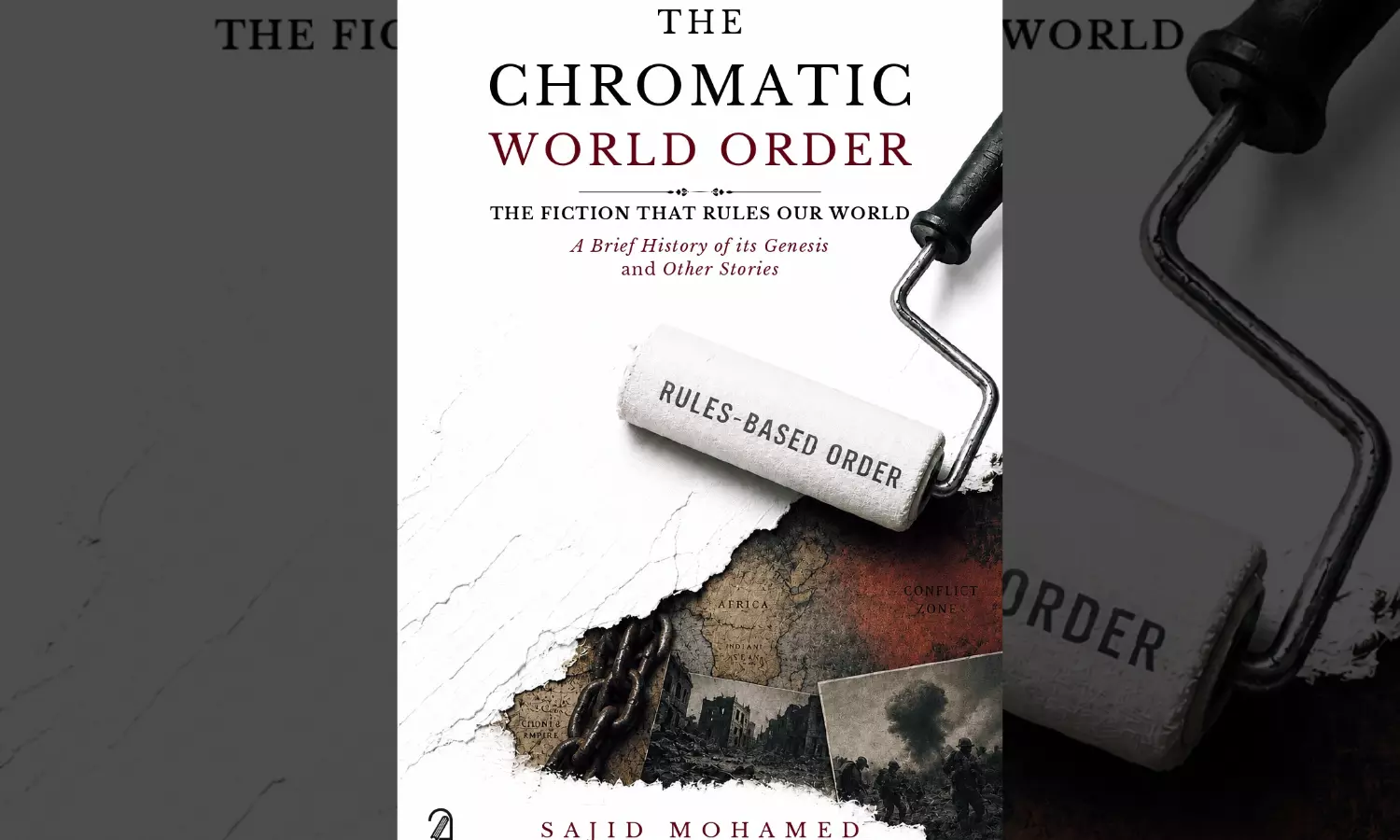
CHAPTER - 4 THE NEED
Book excerpt – Pg 216 to 219
In the Middle East, the post–World War I division of Ottoman territories through the secret 1916 Sykes–Picot Agreement ignored the sociopolitical realities of the region. British and French mandates – Syria and Lebanon under France; and Iraq, Palestine, and Transjordan under Britain – were crafted to maximize imperial control rather than reflect religious, tribal, or linguistic compositions.
The Israeli–Palestinian conflict stands as one of the most enduring legacies of British imperial partition. By promising the Arabs independence and, at the same time, endorsing a national home for the Jewish people, the 1917 Balfour Declaration laid the groundwork for an irresolvable contradiction. Britain’s withdrawal in 1948 without a viable political settlement precipitated the Nakba and inaugurated a conflict that is still drawing blood across the region. Likewise, the division of Pakistan from India generated unprecedented displacement and sectarian slaughter.
These political arrangements were reinforced by economic structures. Colonial administrations prioritized cash crops and mineral wealth – cotton, rubber, cocoa, gold – over food security, creating monocultures and fragile, externally oriented economies. In francophone Africa, the CFA franc system continues to tie monetary policy and financial sovereignty to France.
The Netherlands, a liberal democracy and ‘moral authority’
in global politics, owes its early modern wealth to one of the most systematically violent colonial regimes in history. Before we consider Dutch colonial history, a few submissions may be considered in respect of its ‘moral authority’ in the present world and why the essence of colonial lineage, of which we will figure in a moment, lies just beneath the surface of the ‘moral authority’. Here again, one would find that the universals are territorially bound, that the universal ethos, the Enlightenment principles, are for consumption within the territorial boundaries within the West, if not the Dutch boundaries, and stretching, if at all, maybe up to the Caribbean Netherlands, i.e., the ex-slave market and now Dutch municipalities – Bonaire, SintEustatius, and Saba.
The single most significant factor in projecting the ‘moral authority’ that is perceptibly associated with the Kingdom of the Netherlands is the city of The Hague itself. Its presence, as Joseph Nye Jr. claims in Soft Power, elevates the Netherlands beyond a typical developed nation and positions it as the legal and ethical centre of the world. The Hague hosts the principal judicial organ of the UN, the International Court of Justice (ICJ), and also the International Criminal Court (ICC), which prosecutes individuals for genocide and war crimes. Collectively, the presence of these two institutions in its territory signify that the Netherlands has voluntarily committed to serving as a neutral ground for resolving global legal disputes and seeking accountability for the most severe abuses of human rights. The Netherlands has been one of
the few developed nations to meet or exceed the UN target of spending 0.7% of its gross national income on development aid,35 which again bolsters its ethical standing in the world. Its domestic policies reflect a commitment to individual autonomy and tolerance, as in the legalization of same-sex marriage and euthanasia, and serve as a global benchmark for liberal and progressive values. The Netherlands also advocates forcefully for strong international climate action. So the Dutch soft power, the Dutch claim to moral authority, is built on a well-crafted modern legacy of seeking international justice, dedicating significant resources to global development, and the perceived consistent practice of progressive and liberal values at home and abroad.
However, its response to the two epochal horrors, the Jewish Holocaust and the genocide of the Gazans in the State of Palestine, shows that the ‘moral authority’ is a cover, and it is well crafted. As Jews fled Nazi Germany in the 1930s, the Netherlands maintained an immigration policy which is reflective of the larger crisis narrative of the present-day West. Before the Germans invaded, in May 1940, and afterwards, the Netherlands turned away Jewish refugees at the border, and the civilian administration and local police exhibited a high degree of obedience and administrative compliance with the German occupiers, leading to an exceptionally high rate of deportation. Frank Bovenkerk summarizes the complicity:
Of all the West European countries occupied by the Germans, the number of Jewish casualties was the highest in the Netherlands. Before the occupation there were approximately 140,000 Jews living in the Netherlands, and of that total at least 10),000 were murdered. When the war was over many war criminals and Nazi collaborators were punished. This did not include, however, Dutch civil servants and
many of the police and train conductors who were all part of the Holocaust machine. They were recruited from the large middle ground of a population of mainly bystanders. In addition, Dutch criminology has been conspicuously silent about the Holocaust.
Now, we come to the latest epochal horror, in the State of Palestine. Despite the overwhelming majority of humanity having recognized the State of Palestine, the Dutch parliament in August 2025, in a certain Dutch hubris, voted against a motion to recognize a Palestinian State while hosting the court where the legal process concerning the genocide is unfolding. To add, their direct complicity – be it the F35 case or general consent to genocide – is not different in substance than that of their conduct during the Jewish pogroms in Ukraine during the 1930s or the Holocaust in the 1940s.
When we look past the Holocaust and consider the Dutch colonial past, we witness that this curious Dutch duplicity has had a very long tenure, particularly pronounced given the country’s early modern identity as a merchant-governed society, where domestic liberalism coexisted with external violence and imperial domination.
