J&K: Amid Fear And Dread, Border-Dwellers Flee Homes

“These are difficult times. People here are worried. The LoC is only a few kilometres away and the thought of escalation in the hostilities (between India and Pakistan) gives us goosebumps,” he said, pleading, “Please, pray for us.
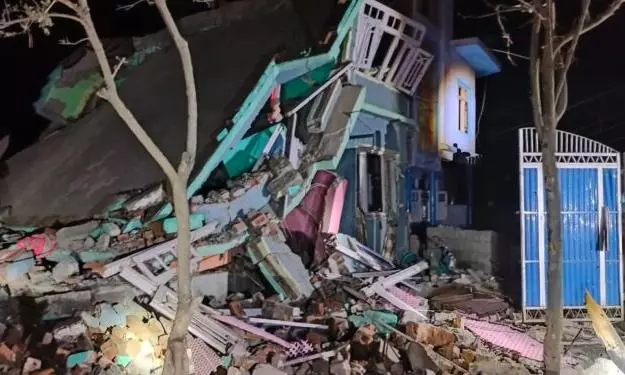
SRINAGAR: As dread returns to Jammu and Kashmir border areas following Pakistan raining artillery fire that killed and injured scores of civilians and left a trail of destruction over the hillside hamlets overnight, dozens of families have taken shelter in underground bunkers. Many more have fled to safer locations, living with either their relatives or friends now.
Amid the roar of a variety of howitzers and 81 mm and 120 mm mortars, the border-dwellers including women and children, were seen running out of their homes to evade death. Some of them reached by this newspaper through their mobile phones said that they witnessed artillery shells fired from across the Line of Control (LoC) falling and exploding in the middle of frightened civilian populations.
“Hell was let loose and the whole village was covered with smoke as a few houses and shrubs caught fire after being hit by shells,” said Muzaffar Ahmed, a resident of Karnah (Kupwara district). The villagers were being readied for evacuation to safer locations when reports last came in.
In areas falling in proximity of the LoC and the international border (IB), residents have taken refuge in the household-level shelters or moved in the village-shared shelters capable of accommodating multiple families. Often referred to as ‘bunkers’, these were constructed between zero to 3 km from the LoC and the IB or Jammu-Sialkot border when the facing armies would, prior to the two countries renewing the November 2003 ceasefire agreement in February 2021, routinely engage in skirmishes.
In the Uri sector of the neighbouring Baramulla district, several people were injured when their homes at Salamabad, Parantina, Basgran, Gingal, Dachi and Lagama were either deliberately pounded from across the de factor order or, as per their belief, the shells fired by the Pakistani troops to target Indian forward positions landed in their homes or exploded close to these.
When the shelling stopped at daybreak Wednesday, a few families fled to take shelter in the homes of their relatives or friends beyond the “danger zone”. A local reporter Irshad Ahmed Khawaja said, “You know there aren’t many individual or community bunkers here in the Uri sector and, therefore, most families have taken shelter in the basements of their houses or the rooms they consider safe or panic rooms. A few have gone to live with their relatives or friends down the hills like Baramulla (town) and Srinagar.”
Many families have fled their homes for safer locations in the Poonch city and neighbouring villages which were worst affected in the cross-LoC firing and shelling overnight, leaving at least 12 people dead and dozens injured and a trail of destruction. Ishrat Bhat, a resident, said, “Over the past few decades, hundreds of families have moved from villages to Poonch city. Most of these families have left for their native places. Those who are here now, mainly the original inhabitants, have chosen not to leave but have been reduced into a scared lot.”
“These are difficult times. People here are worried. The LoC is only a few kilometres away and the thought of escalation in the hostilities (between India and Pakistan) gives us goosebumps,” he said, pleading, “Please, pray for us. Please, pray better sense prevails upon them (India and Pakistan)”.
Moulana Sayeed Habib, the head of Jamia Zia Ul Uloom, Poonch’s oldest Islamic seminary which also runs a chain of contemporary schools said, “One of our teachers Muhammad Iqbal was hit by the shrapnel of a shell that landed on one of our campuses. Following his martyrdom, there is widespread feeling of insecurity among the students and the faculty. The loss of precious human lives in the shelling has shattered every single Poonchi.”
The border residents have suffered immensely due to unending military tensions and frequent bouts of skirmishes between the facing troops over the years. But they heaved a sigh of relief when India and Pakistan had in February 2021agreeed to strictly observe all agreements on ceasefire along the LoC and other sectors.
Though the two countries pushed on with the ceasefire agreement signed after months of tortuous negotiations, the facing armies and border guards have, following the Pahalgam terror attack, often clashed both along the LoC and IB, the 198-km stretch of the 2,912-km India-Pakistan border from Gujarat to Jammu and Kashmir called ‘Working Boundary’ by Islamabad as it passes through a “disputed region”.
