Paid GOAT? Accusations Plague Messi’s Argentina World Cup 2026 Journey

Accusations include favourable fixtures, questionable refereeing decisions that mostly helped Argentina that let them advance in multiple rounds of tournament
Lionel Messi, arguably the greatest footballer of all time, the GOAT, as fans call him, is having his last dance in Argentina colours at the 2026 edition of FIFA World Cup.
His Argentina team has reached the semifinals at the time of writing, and is on course to defend the World Cup trophy, and become the only team to do so in the last 64 years.
This is subject to the defending champions beating a star studded England squad in the semifinals and then defeat the European Champions Spain or the 2022 World Cup finalists France.
GOAT Debate a Thing of Past
Messi, who has eclipsed his eternal rival Cristiano Ronaldo in the race to be the greatest of all time, after winning the world cup in 2022, has practically nothing to prove in world football, as he has won everything he has played for, including multiple Ballon D’ors, UEFA Champions League, domestic titles in every clubs he has played for, Copa America Title and the World Cup for his nation, and many more individual records.
On the other hand Cristiano Ronaldo, Messi’s biggest rival in football greatness, could not take his team to a World Cup glory in what would be his last attempt at winning the prized trophy, and to achieve the personal greatness with it, that Messi has won in 2022. The rivalry, which started during the players’ time in the Spanish first division league, La Liga, where Messi played for Barcelona, and Ronaldo played for Real Madrid, has been the greatest personal competition in the game’s history.
Campaign Plagued By Conspiracy Theories
But this year, in the football world cup journey, Messi’s campaign with Argentina in the FIFA World Cup has become subject to criticism of a kind that has not happened ever in his playing career.
Argentina's journey in the World Cup has been marred with controversies, that includes accusations of favourable fixtures, questionable refereeing decisions that mostly helped Argentina and seemingly appear as a favour of luck that let them advance in multiple rounds of tournament.
Argentina’s journey to the semifinal had comparatively weaker opponents than other teams that have booked their place in the final four. In Group J, the defending champions played Jordan, Austria and Algeria. None of these three opponents were in the top 20 of the FIFA world rankings.
In the Round of 32, they played world cup debutants Cabo Verde, Egypt in a controversial match in Round of 16 and in the Quarterfinals, they played a Switzerland side that is 14th in the latest FIFA rankings. Switzerland is by far the highest ranked team Argentina has played so far in the tournament, and they are in the final four.
To compare, the Spain team had to face 20th ranked Uruguay in the group stages and then face Austria, Portugal, ranked 23rd, 7th and 8th in the knockouts.
Despite getting favourable fixtures to play, the Argentina team has struggled to register convincing victories in the early stages of each knockout games they have played in this world cup, and a recurring pattern of controversial decision from the referees that turn the ‘favour of luck’ to Argentina, before the champions press really hard to squeeze in a late narrow victory by the end of the game. This was the case evidently in the games against Cabo Verde, Egypt, and Switzerland.
To understand what the larger footballing community feels about all of this, one could go back to the highlights of the game between Argentina and Switzerland, and see the reaction of Swiss captain Granit Xhaka when a red card was given to their striker, Breel Embolo..
Smaller footballing nations, giving their best to prove themselves against behemoths at the biggest stage in the sport, only to feel treated unfairly. Followed by them losing their moral strength to display the fight and the larger and stronger team capitalising this chance to turn the game to their favour. Mentality monsters, the fans call them. Only their fans.
Politically Charged World Cup
The Argentina team are the defending champions of the World Cup title, as they won the 2022 title in the Qatar World Cup, defeating the then defending champions France in the final.
World football has undergone major changes in its power structures since then, with the power centres moving away from Europe and UEFA, and shifting into America.
The tournament, which happens to be played largely in the United States of America, a country that is actively engaged in a war with one of the participating nations. The stakes of the tournament have never been this politically charged, maybe after the Cold War Era.
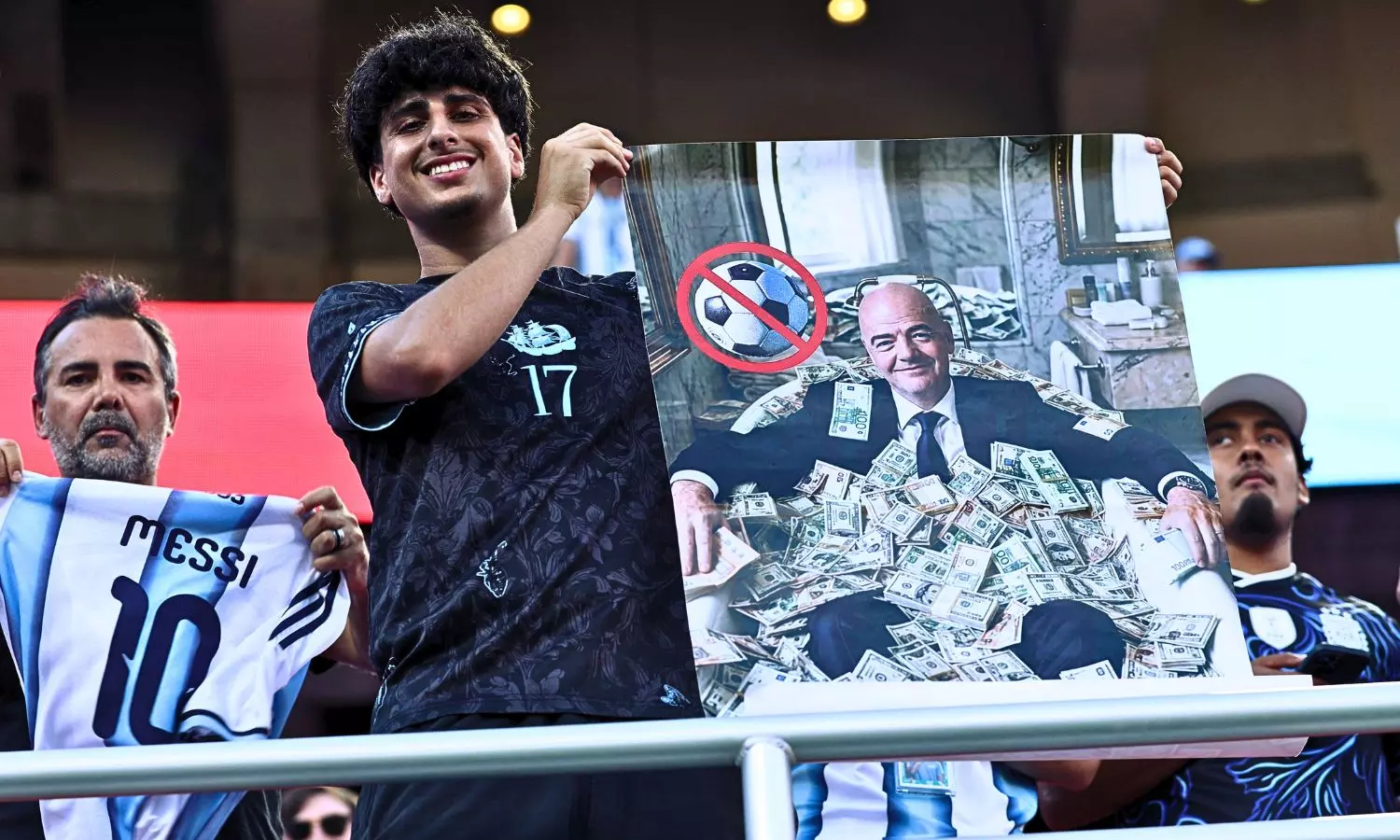
World football governing body, FIFA has been severely accused of colluding with the host nation’s political leadership throughout the tournament. This controversy intensified with America denying entry visa to multiple stakeholders of the world cup, including the Somalian Referee Omar Abdulkadir Artan, who was set to officiate multiple games.
Gianni Infantino, FIFA chief famously washed his hands off this incident, instead of pressurising the American leadership to give him entry to the world cup.
The account of Cabo Verde player Vozhinha sharing the ordeal of his mother getting denied a US Visa, DR Congo Super Fan Michel Kuka Mboladinga denied entry to multiple games, are other few cases of the similar kind.
Another incident of the US President calling Infantino to revoke the red card given to American striker Folarin Balogun, and the FIFA chief obliging him has only added fuel to the talks of this being a corrupt tournament with rules ‘more equal’ to some teams.
This world cup is setting itself up to go down as the most ‘anti people’ edition of the tournament, which has also become the most expensive and commercialised world cup to attend so far.
Why FIFA US Could Need Messi in Final
Messi, playing in USA’s MLS league for Inter Miami, is the flagbearer for the popularity of football in a land that calls the game ‘soccer’. With the tickets being heavily expensive in comparison to any world cup in recent years, coupled with visitors from multiple nations being denied entry visas, the world cup games in USA stadiums have had vacant seats in multiple games. This is a very uncommon scene, with world cup games historically being sold out, no matter the games.
The World Cup always gives the host nations a chance to attend the games at relative ease, rather than foreign spectators. With the USA being a nation with other sports being more popular than football, the footfall from the domestic audience is rather low for the tournament, in comparison to the earlier editions.
FIFA and the USA would need Messi here. The most popular face in ‘soccer’. He is perhaps the only footballer that can bring in American crowds into the stadium, and let America and FIFA milk the biggest sporting cash cow, the football world cup.