Tehseen Poonawalla on 26/11, Netflix Row, Patriotism and Pakistani Series Ban in India

In this exclusive conversation, he discusses his objections, the legal steps he is pursuing, patriotism, the significance of 26/11 and his ongoing efforts to prevent the show from streaming in India.
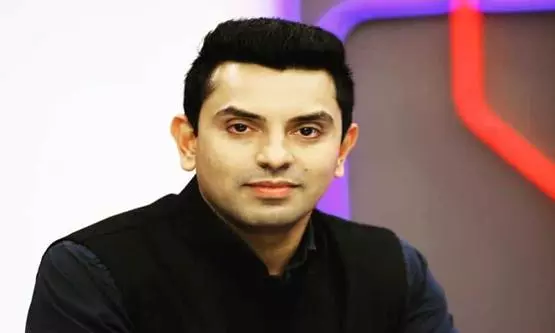
Political commentator and television personality Tehseen Poonawalla speaks candidly about the controversy surrounding the India release of Netflix’s Pakistani series "Jo Bachay Hain Sang Samait Lo," which is scheduled to premiere globally on December 4, 2026.
Poonawalla has publicly opposed the series’ release in India, questioning Netflix’s India strategy and raising concerns over remarks made by some of the show’s cast members. In this exclusive conversation, he discusses his objections, the legal steps he is pursuing, patriotism, the significance of 26/11 and his ongoing efforts to prevent the show from streaming in India.
Both you and your brother are known to be good orators. Do you think you inherited this quality from your parents?
I think it comes from both our parents. But one thing we have certainly inherited is our work ethic. Even though we may not always agree with each other, we try to put across our points of view in an articulate and respectful manner. That is how life should be. Two brothers or siblings can have differences of opinion, but society often makes a much bigger issue of them than necessary. Sometimes, you simply don't agree with another person, and that is okay.
Coming to the controversy, what exactly is your objection to the show? Are you taking legal action?
Yes, we are taking legal action, and we will do whatever it takes, within the law, to stop the show from being released in India. This is not just about me personally. There are certain issues that I believe cannot be ignored.
What is your biggest concern?
The first and most important issue is the statements made by actor Hamza Ali Abbasi, who has been on record speaking positively about Hafiz Saeed, describing him as a misunderstood and kind man who promotes religion.
Today is 26/11, and I have personally lost two friends in the attacks—Hemant Karkare sir and my civilian friend, Kaisar Kamran.
The 26/11 attacks were among the most brutal terrorist attacks on India, and Hafiz Saeed has been held responsible for the terror organisation associated with them. So my question is simple: How can somebody who speaks positively about a person associated with terrorism be allowed to have a show released in India?
I don't care whether someone calls me liberal or conservative. If somebody were to say that Hitler was misunderstood, you wouldn't expect such a series to be released in Germany. Similarly, if somebody called Osama Bin Laden a kind or misunderstood man, would the United States accept a show promoting that viewpoint? This is not acceptable to me, particularly on 26/11.
You have also raised objections to statements made by Fawad Khan and Mahira Khan regarding Operation Sindoor. What concerns you about their remarks?
Fawad Khan and Mahira Khan have referred to the operation as cowardly. I have read those statements. My point is very clear: If you call my armed forces cowardly, it becomes very difficult for us to have a conversation.
We must remember what led to Operation Sindoor. Terrorists entered India, and people were reportedly targeted on the basis of their religion. Their identities were checked, and they were asked about their religion before being killed. If you and I had been together in Pahalgam and the terrorists had decided to discriminate between us on the basis of religion, either of us could have been a victim.
So my question is: If you believe India and Pakistan cannot coexist, why come to India to work and earn money?
These actors are also major stars in Pakistan. Why do you specifically point to their popularity in India?
I am not saying they aren't big stars in Pakistan. But India gave them a huge platform and opportunities through major production houses in Mumbai. Mahira Khan gained international recognition through her work in India, and Fawad Khan also became enormously popular here.
At the same time, Indian films do not enjoy the same opportunities in Pakistan. Our films face restrictions there. So why should the relationship be one-sided? Why should I be expected to tolerate statements against my country and armed forces while simultaneously providing them with a platform and business opportunities here?
Do you think Netflix also bears responsibility for bringing this content to India?
Absolutely. That is precisely the question I am asking. Netflix has a huge Indian audience. There is so much incredible content being created across India—from West Bengal and the Northeast to Tamil Nadu, Kerala, Maharashtra and Gujarat. There is no shortage of Indian stories or talent.
So why is this particular content necessary in India? That is the question Netflix needs to answer.
Some would argue that Netflix is simply looking at the content creatively and giving creators a platform. What would you say to that?
If we are talking about creative freedom, the same standard should apply everywhere. Why are Indian films such as Dhurandhar or Ramayana not given the same space in Pakistan? If our content is restricted there, why should we have no concerns when content from Pakistan is brought here?
Creativity cannot become a one-way street. If one side is expected to accept everything in the name of creative freedom while the other faces restrictions, there is clearly a double standard.
You have said that the show will not be allowed to stream in India. How confident are you?
I am very clear about my position. We have already taken legal steps. I have filed a petition and also written to the Ministry of Information and Broadcasting, asking it to clarify its position.
If necessary, I will approach the court and take every legal step available to me. We will do whatever is required within the law to ensure that the show does not go on air in India.
Are you also planning protests outside Netflix India?
If necessary, yes. But I don't want to reveal the entire strategy because then it wouldn't really be a strategy. What I can say is that I will do whatever it takes, within the law, to stop this.
I believe in my Bhagwan Shri Krishna. Whatever it takes, I will do. My position is very clear—the show should not be released in India.
Have you been in touch with Netflix executives?
Yes. I have been receiving calls from their senior executives since morning. They have suggested meeting in Mumbai to discuss the matter.
I have nothing against dialogue, but I don't understand why such a discussion should happen behind closed doors. If they have a point to make, they can do so publicly, in front of the media. Why should we have a secret conversation?
So, if Netflix wants to meet you, are you willing to meet its representatives publicly?
Yes. They can come and talk. But I would prefer the conversation to happen in front of the media, live, where everybody can hear what is being said. Whatever points they have, they can put forward publicly.
What are you doing at the government and legal levels right now?
I am working on every possible front. I am in communication with the Ministry, and we are pursuing the legal case as well. The petition is ready, and we are taking all the necessary steps.
I want to approach this through every legal and institutional avenue available to me.
You are politically associated with the opposition. Do you expect support from the government?
This is not a BJP-versus-Congress issue for me. This is about India. India comes first.
I believe the Prime Minister is a good and kind man, and I have supported him when he has taken strong steps in the national interest. I believe he will not let Indians down. It is the government's responsibility to look into an issue like this.
I also believe the Chief Minister of Maharashtra is a good human being, and I hope the government takes the matter seriously.
How much support are you receiving from the public?
I am getting tremendous support from people across India. Just look at social media. Millions of people are commenting and expressing their views. My Instagram has completely blown up, and people from everywhere are reaching out.
For me, that is the biggest support.
What about your brother Shehzad? Is he joining hands with you in this fight?
There is no personal enmity between us. We simply have differences of opinion. I have spoken to him and made it clear that I have no personal issue with him.
I believe things will work out with time. When the time is right, we will find a way.
You were part of Rise and Fall, and your participation reportedly surprised him. Would you like him to come forward now?
Let's see. I will speak to him when the opportunity comes.
What message would you like to give people in India and Pakistani audiences, considering the financial implications of this controversy?
My position is 100 per cent clear. If the show is stopped, Netflix will obviously face financial implications, but I believe some things are bigger than money.
If Netflix chooses to go ahead despite the concerns being raised, it will have to take responsibility for the consequences of that decision.
You have spoken strongly about patriotism. What does patriotism mean to you?
For me, patriotism means putting your country first. This is the only country we have. We may have political differences, but when it comes to the nation, we have to stand together.
There are Indians who support Pakistani artists and their work. What would you say to them?
I would simply ask every Indian to think about where their loyalty lies. We can appreciate art, but we also have to understand the larger context.
My issue is not with every Pakistani citizen. My concern is with people who have made statements that are deeply hurtful to Indians or have defended individuals associated with terrorism. I don't believe such people should automatically be given a platform in our country.
Today is 26/11. You have personally experienced that day. What do you remember, and what would you like to say to those who lost their lives?
Today is an extremely emotional day. To everyone who lost their lives on 26/11, especially those who made the ultimate sacrifice in the line of duty, I salute their bravery and sacrifice for our motherland.
It is because of the courage and service of those officers that we are alive and able to live our lives today. We must never allow their sacrifice to go to waste.
You are also a strong orator and now have a larger public presence. Would you ever consider entering the entertainment industry or participating in another reality show?
This is my reality, and I love it. I don't think I need another reality show to define me. I enjoy the work I do with people like you, and for now, this is where I want to be.
Finally, if you had to give just one message to Indians today, what would it be?
India is ahead of Pakistan economically, technologically and militarily. But I believe Pakistan has been ahead in one area—propaganda.
I would tell every Indian to learn to be more united and aware. Look at how strongly people stand by their country. We should also learn to put our country first.
And on 26/11, what is your final message?
We will never forget 26/11. We will never forget the people who lost their lives or the officers who made the ultimate sacrifice. Their courage is part of the reason India stands strong today. We owe them our respect, gratitude and remembrance.