Panchayat 4: A heartfelt return into Phulera’s pulse

4 July 2025 7:48 PM IST4 July 2025 7:48 PM IST
They inhabit their roles. Jitendra Kumar’s half-smiles speak volumes, when Abhishek contemplates quitting or fighting on, you feel every doubt.
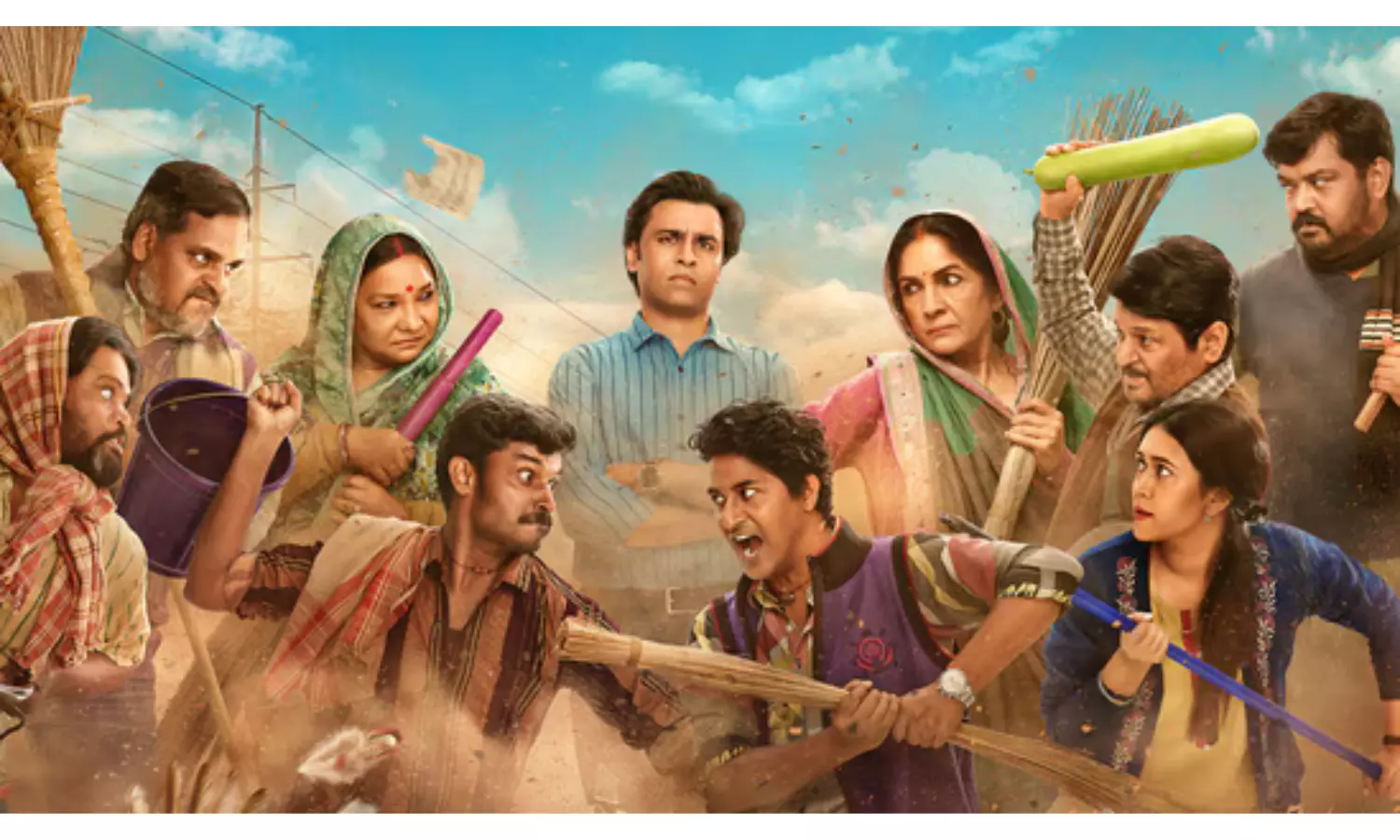
Panchayat 4 Poster
When Panchayat landed on our screens back in 2020, it was like stepping into a small-town bazaar: colourful, warm, a touch chaotic, and utterly irresistible. Four seasons later, Phulera still feels like home. And Season 4? It’s that old friend who’s grown richer in story, but still greets you with the same familiar grin.
Abhishek Tripathi (Jitendra Kumar) is no longer the wide-eyed city boy who trembled at the thought of village paperwork. He’s settled into his panchayat office, knows which house has the best chai at sunrise, Yet, beneath his calm, you sense the tug-of-war: Should he chase big-city dreams, or stay where his heart now resides?
Pradhan ji (Raghubir Yadav) still rules Phulera with a twinkle in his eye and a dozen half‐truths up his sleeve. Manju Devi (Neena Gupta), our ever-scheming matriarch, hasn’t lost her spark. When nominations come around, she quips,
“Is baar ghode ka lagaam hamko pakdaiga.”
And Pradhan ji, always ready, shoots back:
“Hamare rahte aapko lagaam kheenchne ki kya zaroorat?”
To which she grins,
“Ab to ham hi haath mein lagaam rakhenge… bahut din se to aap hi rakh rahe ho.”
That tiny exchange? It’s feminist firecracker wrapped in village humor. Because Panchayat isn’t just a comedy, it’s quietly turning the spotlight on who really holds power.
Shakti Pradarshan - When Things Shift
Shakti Pradarshan, the fourth episode of Panchayat 4, moves beyond its literal premise of a women’s empowerment event and dives headfirst into the deeper layers of power politics in Phulera. The staging ground is a self-defence workshop, but the real battle is for influence: between the Pradhan, the ever-watchful Chandrashekhar (MLA) through his opposition Bhushan, played by Durgesh Kumar, and the surprise entry of a new MP whose presence shakes things up.
When Manju Devi casually remarks, “Is baar ghode ka lagaam hamko pakdaiga,” Pradhan ji’s response is rooted in habit, but her retort lands like a political manifesto:
“Ab to ham hi haath mein lagaam rakhenge... bahut din se to aap hi rakh rahe ho.”
This moment, half joke, half declaration, brings gender, agency, and power into a single line. As nomination drama unfolds, loyalties shift, and alliances blur. Chandrashekhar’s silence speaks volumes, and the MP’s polite manoeuvring hints at battles beyond the ballot.
The episode ends not with a bang, but a quiet jolt—an unexpected election result that hints at the unpredictability of grassroots democracy. It’s not just a turning point in the season, it’s a quiet masterclass in how real power reveals itself: slowly, strategically, and often silently.
Turning point in the plot and Nana Ji’s entry
Enter Episode 5’s new star: Nana ji, a new role drifts into Phulera like a wandering bard. His parables, about honesty, service, even the odd moonlit dream—remind us that democracy isn’t loud; it’s in quiet promises kept.
And then—bang! The opposition candidate’s pressure cooker blows up during a live demo. Rice across the courtyard, lentils on Pradhan ji’s new kurta. The candidate, red-faced, tries to joke, “Yeh mera chunav nishaan hai” but the cooker clearly had other plans. Writer tried to put an unique narrative to tell us that if Cooker, representing the Bhushan Kumar, could’nt sustain, Bhushan’s political career can be on risk.
On the surface, comedy gold. But as a metaphor? Even the best-intentioned development schemes can detonate if you don’t mind the small print—or watch the safety valve. That pop echoes like a teaser for Season 5: watch closely, or you’ll miss the warning steam.
Crafting the Village in Celluloid
Writer Chandan Kumar weaves dialogue so natural you’d swear these folks exist off-camera. There’s no “As you know, Abhishek…” expositional clog. Instead, a single muttered line, “Hum gareeb hain, gaddar nahin”, tells you everything about Binod’s pride and grit.
Director Deepak Kumar Mishra frames Phulera like a living painting: the sun slipping behind mustard fields, the dusty lane where children play cricket, the mustard oil lamp flickering in Abhishek’s lonely office. No flashy cuts. Just the steady heartbeat of rural India.
And the actors? They inhabit their roles. Jitendra Kumar’s half-smiles speak volumes, when Abhishek contemplates quitting or fighting on, you feel every doubt. Raghubir Yadav, forever the prankster, lands each sly remark with pinpoint comic timing. Neena Gupta’s Manju Devi? A firecracker; part community leader, part satirical commentator, wholly unforgettable. And Faisal Malik’s Prahlad, taciturn, wounded, reminds us that grief and hope can share the same silent glance.
What It Says About Us
Underneath the laughter, Season 4 dips into deeper as political tensions flare when Abhishek arbitrates election disputes. Social media whispers more about Binod’s loyalty than the Abhishek and Rinki’s loe chemistry. Nana ji’s old-world ethics. Women claim center stage, and a political Shakti Pradarshan among all the leaders. And through it all, Panchayat asks: What does progress mean in a place that’s already rich in social and political wisdom? People indulging into politicl narratives showing the impact of opposition’s hardwork. It doesn’t sermonize. It shows.
Final Verdict
At roughly 300 minutes across eight episodes, Season 4 feels like a warm handshake you wish lasted longer. Every moment counts. There’s laughter, sure, but also a pang when Abhishek wonders if his interest lies with Phulera or the cities calling his name.
In today’s world of high-octane thrillers and endless twists, Panchayat remains a reminder: real drama hums in everyday moments. It’s in a woman’s fierce quip, an elder’s quiet counsel, a cooker’s noisy rebellion.
If you crave stories that breathe, where the spaces between words hold meaning, Panchayat 4 awaits. Sit back, pause the phone, and let Phulera unfold around you. By the end, you’ll find yourself agreeing with Binod’s last line:
“Jeet ke sach mein accha lagta hai, Prahlad Cha.”
And you’ll believe it, too.
The article has been authored by Uday Raj Singh, an intern at Deccan Chronicle.
( Source : Deccan Chronicle )

Next Story