Original Sholay Climax Surfaces: Here's Why it Was Cut?

11 Aug 2025 12:44 PM IST11 Aug 2025 12:44 PM IST
Released on August 15, 1975, Sholay is often dubbed as one of Indian cinema's greatest films
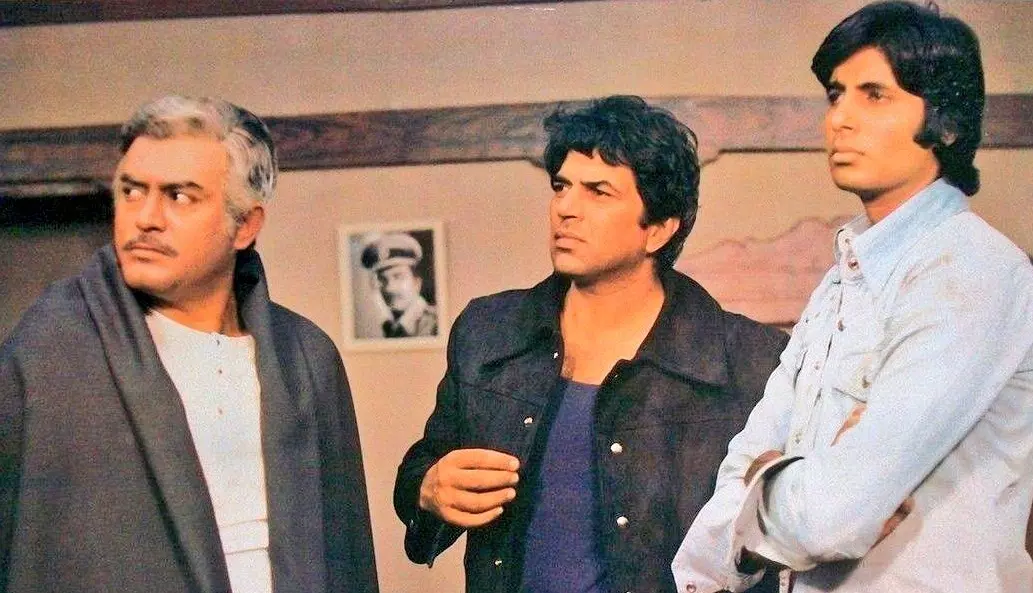
Sanjeev Kumar, Dharmendra and Amitabh Bachchan in Sholay (Photo: X)
As one of India's most iconic films, 'Sholay' is nearing its 50th anniversary, many cine-lovers would be surprised to know that the original climax of the film was edited.
Released on August 15, 1975, Sholay is often dubbed as one of Indian cinema's greatest films.
The action-packed drama, featuring Amitabh Bachchan, Dharmendra, Sanjeev Kumar, Hema Malini, Jaya Bachchan and Amjab Khan became a cultural phenomenon, (a 'cult movie' as netizens like to term it today) with its characters, dialogues and music remaining fresh in the audience's minds, even after decades.
However, much before the controversy of the AI edit of 'Raanjhanaa' starring Dhanush, Bollywood's OG blockbuster was engulfed in a similar row.
Storyline:
The film's story focuses on the fictitious Ramgarh village, where retired police chief Thakur Baldev Singh (Sanjeev Kumar) plans to defeat the notorious bandit, Gabbar Singh (Amjad Khan), with the help of Jai (Amitabh Bachchan) and Veeru (Dharmendra).
Upon arriving in the village, the duo realises the menace of Gabbar Singh and doubles down on the efforts to help Thakur. Jaya Bachchan and Hema Malini are seen playing Jai and Veeru's love interests as Basanti and Radha respectively.
The Climax:
In the version we grew up watching, Gabbar is beaten and handed over to the police. Justice is served - neatly, lawfully. But that's not what Ramesh Sippy and Salim-Javed had originally planned.
In the true climax, Thakur, seething with rage after losing his family and his hands, corners Gabbar and brutally kills him-with his spiked shoes. It was raw, violent, and emotionally satisfying. But the timing was unfortunate.
The original ending is now available on YouTube, where Thakur delivers flying kick to Gabbar, sending him onto a sharp spike behind him, killing him instantly.
Why the Change:
India was under Emergency, and the Censor Board, already jittery about violence and themes of vigilantism, demanded the ending be changed.
Criticism:
Farhan Akhtar recently opened up about this buried truth. He shared how his father, Javed Akhtar, and Salim Khan were deeply frustrated about the forced rewrite.
They even joked that by the time the new ending was finished-with villagers, police, and what felt like a crowd scene-only the postman was missing.
Director Ramesh Sippy echoed that frustration years later. confirming that the original version was more powerful, more cathartic-but deemed "too violent" for the times. Hema Malini too criticized the move, saying it was without the knowledge and consent of the director, which is not ethical.
( Source : Deccan Chronicle )

Next Story