Sowcar Janaki Got Her Name From Telugu Debut With NTR in Shavukaru

It was a remarkable beginning for an actress who would go on to become one of the most versatile performers in South Indian cinema.
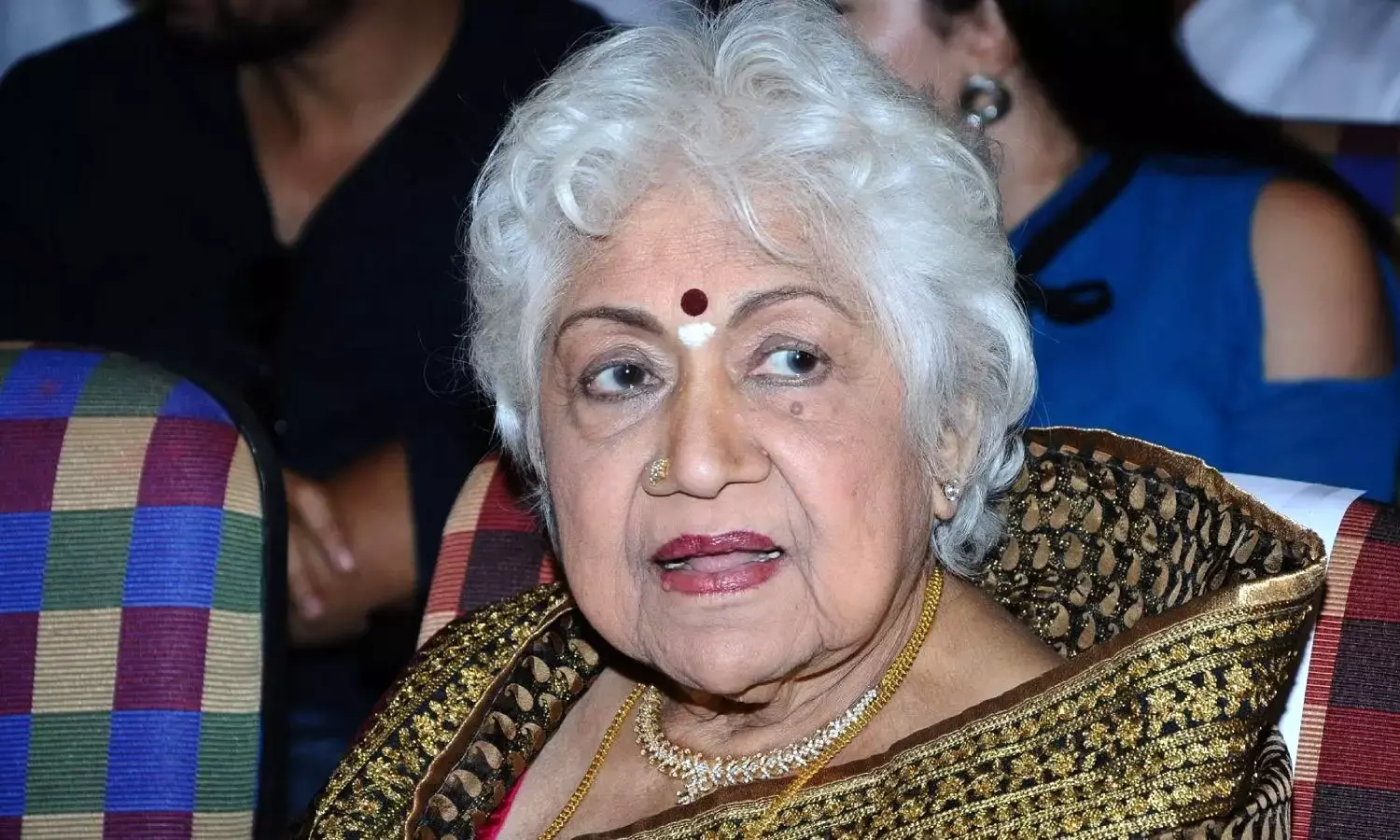
Sowcar Janaki, one of the most enduring actresses of Indian cinema, died on Friday at the age of 94, bringing to a close a career that stretched across more than seven decades and nearly 400 films. She passed away at 1.59 pm, leaving behind a body of work that crossed languages, generations and the changing grammar of Indian cinema.
But for Telugu audiences, there was always something especially personal about Janaki. Telugu cinema did not merely mark the beginning of her extraordinary journey. It gave her the name by which generations came to know her.
Born Sankaramanchi Janaki, she made her screen debut in the Telugu film Shavukaru in 1950, directed by L. V. Prasad and starring N. T. Rama Rao. The film became the turning point of her career, with the title eventually becoming inseparable from her own name. She was no longer simply Janaki. She was Sowcar Janaki.
It was a remarkable beginning for an actress who would go on to become one of the most versatile performers in South Indian cinema.
Her Telugu film journey included some of the most significant films of the era. In Rojulu Marayi, she was part of a landmark film that ran for more than 25 weeks and went on to become a silver jubilee success. The film also introduced Waheeda Rehman to cinema.
Then came films such as Charanadasi, Edi Nijam, Bhagya Rekha and Doctor Chakravarthy, each adding another dimension to her repertoire. Doctor Chakravarthy, starring Akkineni Nageswara Rao, became an industry hit and was the first recipient of the Nandi Award for Best Feature Film. Janaki's portrayal of Nirmala remains among the performances that established her as an actress capable of handling emotionally demanding roles with considerable restraint.
What made Janaki special was that she never appeared trapped by the expectations of a heroine. She could be warm, vulnerable, sharp, humorous or deeply dramatic, often within the same film. As the years passed, she moved naturally from leading roles into character parts without allowing the transition to diminish her presence.
That quality was particularly evident in her later Telugu work. In Samsaram Oka Chadarangam, she played Chittamma, a role that won considerable appreciation. The film itself went on to win three Nandi Awards.
Her Telugu filmography continued well beyond the era in which she had been a leading lady. She appeared in films including Bezwada Bebbuli, Tayaramma Bangaraya and Samsaram Oka Chadarangam, while continuing to take on character roles that gave her opportunities to work with successive generations of actors and filmmakers.
Yet it would be difficult to define Sowcar Janaki through any one language. Her career moved effortlessly between Telugu, Tamil, Kannada and Malayalam cinema. In Tamil, she created some of her most celebrated work, particularly in films such as Puthiya Paravai, Iru Kodugal, Bama Vijayam, Ethir Neechal and Thillu Mullu. Her performance in Puthiya Paravai, in which she played dual roles, remains one of the most remembered performances of her career.
Her association with filmmaker K. Balachander produced another important chapter in her career. Their collaboration, which began in theatre, later resulted in films that allowed Janaki to explore characters far removed from the conventional heroine. In Kaviya Thalaivi, she played the challenging dual role of mother and daughter, while Bama Vijayam, Ethir Neechal and Thillu Mullu brought out her instinct for comedy, drama and character-driven performance.
That ability to reinvent herself was perhaps her greatest strength.
Janaki belonged to the generation that helped build South Indian cinema, but she never became merely a relic of its golden age. She continued acting across decades, moving from heroine to character artiste without losing either her dignity or her screen presence. Her later films included Vetri Vizha, Puthu Puthu Arthangal, Hey Ram and Kaanche, among others.
There was also a life beyond cinema. Janaki was associated with theatre and radio and performed extensively on stage. Her career earned her several honours, including the Filmfare Lifetime Achievement Award – South and, most significantly, the Padma Shri in 2022 for her contribution to Indian cinema.
For Telugu audiences, however, her legacy will always return to that first screen appearance in Shavukaru. The film gave an 18-year-old Janaki a screen identity that stayed with her for the rest of her life.
More than seven decades later, the name still carries the same resonance.
Sowcar Janaki was part of an era when actresses were expected to fit neatly into the role assigned to them. She quietly refused to do that. She was a heroine, a character artiste, a comedienne, a dramatic performer and a theatre artiste. She could share the screen with giants and still leave behind a distinct impression of her own.
For Telugu cinema, she was not simply an actress who happened to begin her career here. She was one of its early stars, and the industry gave her a name that became synonymous with her artistry.
Sowcar Janaki leaves behind much more than a filmography. She leaves behind characters that audiences grew up watching, performances that continue to be discussed and a reminder of a time when acting was as much about presence and craft as it was about stardom.
The name Sowcar Janaki began with a Telugu film.
It became a legacy across Indian cinema.
