I wanted the world to know who these two extraordinary people were: Juhi Babbar Soni

What began as a daughter’s tribute to her mother eventually became a theatrical account of two remarkable lives set against the Progressive Writers’ Movement and India’s freedom struggle. As ‘Ek Lamhaa Zindagi’ completes 50 shows, actor and director Juhi Babbar Soni talks about the unexpected journey of bringing her grandparents, Razia Sajjad Zaheer and Syed Sajjad Zaheer, to the stage, her inheritance from her parents and why she believes live theatre is ready for better days.
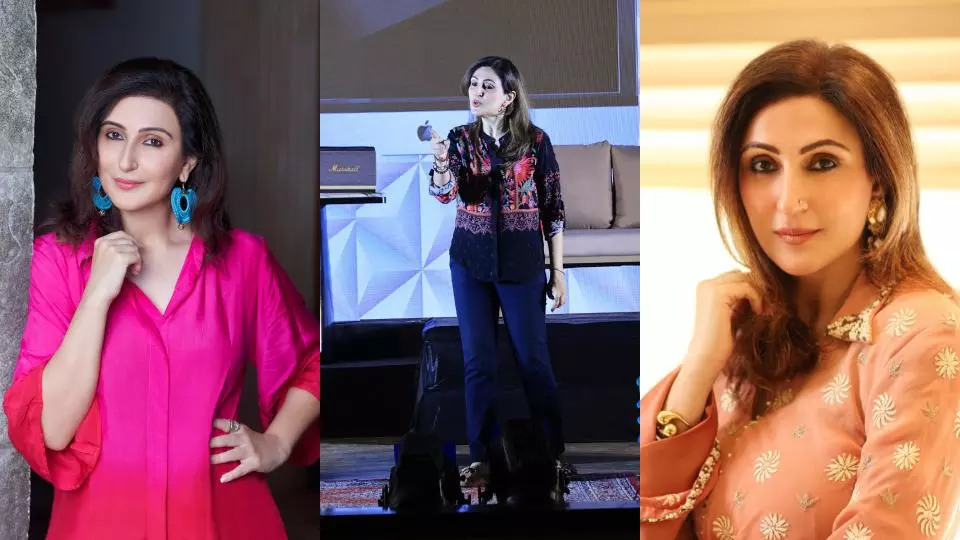
What began as a daughter’s tribute to her mother eventually became a much larger story about love, history and India’s freedom struggle. Actor and director Juhi Babbar Soni recently brought ‘Ek Lamhaa Zindagi – A Love Story’ (1938–1979) to Hyderabad for the Azad Literary Fest at Maulana Azad National Urdu University. The performance marked the play’s 50th show. Written, compiled and performed by Juhi, the monologue traces the lives of her maternal grandparents, Razia Sajjad Zaheer and Syed Sajjad Zaheer, prominent figures in the Progressive Writers’ Movement. In DC Conversations, Juhi talks about the unexpected journey of bringing their story to the stage, her inheritance from her parents and her enduring relationship with theatre.
“I have grown up listening to stories about my grandparents. I would meet someone and realise that this person was such a legend, and then hear them speak about my grandparents almost as though they were Gods. As a child, my reaction would be, ‘Wow! This is what people think of them.’ We had celebrated my grandfather’s 100th birth anniversary in Mumbai 21 years ago. Many people who had known him were still around and came to speak about him. I was very intrigued and would have wanted to listen to every single person speaking about them.”
The idea for the play came from an earlier work by her mother, actor and director Nadira Babbar, who had written a poem about her own mother, Razia Sajjad Zaheer, titled ‘Meri Maa Ke Haath’. She later adapted it into a play directed by Makarand Deshpande.
“Last year, when I was invited to do something for the 25th edition of the Kala Ghoda Arts Festival, the theatre curator suggested I perform something written by my mother. I started looking through her work and thought, what could be better than this? It was written by my mother, about my grandmother, and I would be performing it,” she says.
However, an eye procedure shortly before the scheduled performance meant Juhi could not prepare in the usual way. She suggested a dramatised reading instead, with the script in her hand. What happened on stage took her by surprise.
“Five or seven minutes into the reading, I suddenly got up and started performing. I was using the entire stage, going to the platform, coming back to the writing desk and moving downstage. My light technician was wondering what had happened because I was not supposed to move! He finally put on the full lights because he had no idea where I would go next. I had been in theatre for almost 30 years, but I was genuinely surprised by what had happened. I kept asking myself, how did I do that?”
Although the audience had enjoyed the performance, Juhi felt something was missing. She realised that the story could not remain just a daughter’s account of her mother and grandmother.
“The audience was happy with what I had given them, but I felt there was something else I needed to do with the script. I kept thinking about it and eventually realised that this could not just be a story of a daughter looking at her mother. It was much larger than that. These were two extraordinary individuals whom the world needed to know about. Indian history also needed to acknowledge them much more than it had.”
She began researching their lives, gathering material from people who knew them, online archives and the University of Texas. Her aunt Noor Zaheer’s book on Razia also became an important resource. But the research soon presented another challenge.
“If I tried to include everything, the play would run for more than 10 hours. I had to start cutting and editing, and that was extremely difficult. When you are personally connected to a story, it is not easy to decide what stays and what goes. These are not just characters for you. One is your grandmother, the other is your grandfather, and then there is your mother and your aunt. I also felt a responsibility as an artist. The Progressive Writers’ Movement is such an important part of this story, and the people associated with it deserve to be remembered. As a citizen of this country, I felt there was so much history here, so many names and dates that needed to be revisited from a different perspective.”
With barely a week left for the premiere, Juhi approached Makarand Deshpande to help shape the new production. Between them, they cut the script from eight-and-a-half hours to an hour-and-a-half, rehearsing and editing repeatedly. The version that premiered at Prithvi Theatre on March 1 was itself being performed for the first time.
“The making of this play has been a story in itself. Although the play revolves around my grandfather, everything that was happening with him was also reflecting on and affecting my grandmother. The story is told through her eyes. I play my grandmother, but it is about my grandfather, the Progressive Writers’ Movement, India’s independence and everything that was happening during those years,” she notes.
The monologue format was a natural choice for Juhi, who had already found considerable success with ‘With Love Aap ki Saiyaara’. After taking a long break from work following the birth of her son, it was his wish to see her perform more that encouraged her to return to the stage.
“I have already done 138 shows of ‘With Love Aap ki Saiyaara’. We have travelled to 61 cities across India and done five shows in London. To perform a Hindi monologue for so many shows has been a wonderful experience. It put me back on track, made people notice me and gave me artistic satisfaction I had not experienced before.
“When ‘Ek Lamhaa Zindagi’ happened, moving into the monologue format felt very natural. I was already confident about it, and the transformation of the script was happening so quickly that I don’t think I even considered bringing in other actors. Everything fell into place.”
For her, the biggest compliment is not that audiences do not miss having other actors on stage, but that they can actually imagine all the characters.
“I belong to the school of writing, direction and acting that I have learnt from my mother. I have watched her closely and worked with her for years. If somebody tells me that watching my performance was like watching Nadira Babbar, I consider it a huge compliment. I don’t have to consciously imitate her gestures or mannerisms. I am her flesh and blood. I have inherited so much of that naturally,” says Juhi.
While her mother has been her artistic influence, her father, actor and politician Raj Babbar, remains her ideal.
“If there is anything good in me, it is because I am Nadira Babbar and Raj Babbar’s daughter. I have grown up in awe of my father. For me, he has always been the ideal and the idol. I think I am like my mother, but I want to be like my father. I admire his discipline, sincerity and the hard work he continues to put in even today. He has also always been a people’s person, and I think that ability to connect with people has been important in his long journey in politics.”
Despite doing screen projects such as the very recent ‘The Great Shamsuddin Family’ and ‘Faraaz’, Juhi says theatre remains her deepest calling.
“Theatre is my absolute inner calling. People ask me how I don’t get tired of doing it, but what happens after the performance gives me my energy. That is my vitamin. The blessings, appreciation and applause from the audience are what I go back for every time. Theatre has always been a struggle, the poor cousin of cinema and perhaps now of OTT as well. But I believe live arts are going to see better days. The more we move towards artificial intelligence and screen-based experiences, the more people will naturally want to see something live and real, ” she signs off.
