Beyond Mini: Anushree Shukla on Her Journey and Ambitions Across Film Industries

19 Nov 2026 11:18 PM IST19 Nov 2026 11:18 PM IST
The actor talks about her Hyderabad connection, being part of the popular franchise, working with Shanaya Kapoor and exploring different creative avenues, including voice artistry and dance.
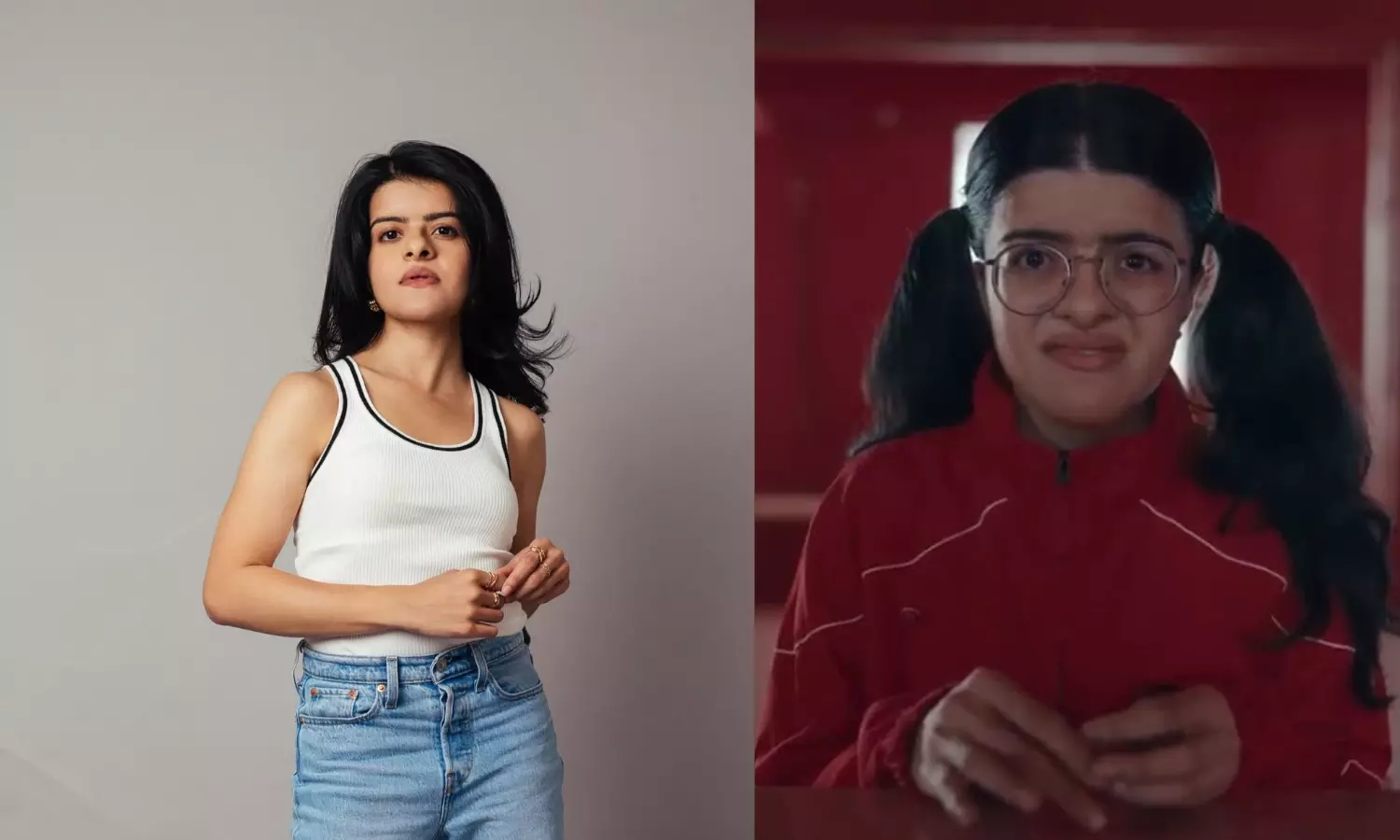
Anushree Shukla in the frame (Photo by arrangement)
What does it take to find your place in an industry where thousands aspire to become actors?
For Anushree Shukla, the journey has involved moving away from an engineering career, overcoming self-doubt and continuing to audition until opportunities came her way.
Currently seen as Mini in "Student of the Year: After Dark," Shukla has explored different creative avenues, including acting, voice artistry and dance. With a background in theatre and short films, she believes in constantly training herself and preparing for the opportunities ahead.
In an exclusive conversation with Deccan Chronicle, the actor speaks about her journey, her experience of being part of the popular franchise, working with Shanaya Kapoor and her aspirations of exploring different film industries.
The conversation began on a familiar note, with Shukla expressing her fondness for Deccan Chronicle and revealing her connection to Hyderabad. Her family moved to the city in the 2000s, and she completed her schooling at Oakridge International School. She also shared that several aspects of her experiences growing up in Hyderabad influenced what audiences see in Student of the Year: After Dark.
Excerpts from the interview:
You have explored different creative avenues, including acting, voice artistry and dance. Before we get into your latest project, can you tell us about your acting journey? How did it begin, and was acting always something you wanted to pursue?
Honestly, acting was always in my blood. My grandfather was an actor, and it was something I naturally loved doing. During school, I was always part of plays and was often cast as the princess or the lead. I was also inclined towards dance and the performing arts.
However, my father comes from an IIT background and always believed that education was important. He wanted me to have a degree and be well educated. I eventually went to the US for college and studied informatics engineering and human-centred design engineering.
Acting was never really part of the plan. But midway through college, I came to Bombay and decided that I wanted to become an actor. Everyone around me thought I was making a crazy decision. They would ask why I was leaving a good career opportunity to enter an industry where thousands of people come to Mumbai hoping to become actors.
Initially, I had a lot of anxiety because it is not an easy field. But I am happy that I continued auditioning and kept going. I think that was the real game changer for me.
When did you start working in the industry?
I started a few years ago with short films and theatre. I actually did my first play with Vijay Singh Konda when he was still struggling in the industry. I was quite young then. We performed Les Misérables at Ravindra Bharathi in Hyderabad.
That was during my high school years, when I was very active in the arts. I lost touch with it during college because I became more focused on being a student. But I always felt that I needed to return to it.
You are currently seen as Mini in "Student of the Year: After Dark." What drew you to this character, and how would you describe her personality and journey?
Mini is very different from me. I am quite social, love talking and enjoy being the most energetic person in a room. Mini, on the other hand, is quiet. She is an observer who likes listening to people.
She wants to be part of friend circles but does not know how to navigate them. She struggles with conversations, and I think even communicating is a skill.
I spent time thinking about her backstory, what makes her interesting and even who her crushes might have been. In my version of Mini's backstory, she was obsessed with Sid Saraiya, the most popular boy in school, but could never tell him that she liked him.
I wanted Mini to be a little invisible. We all know those quiet, nerdy people in school who often go unnoticed, and that is what I wanted to bring out in her.
Being part of a franchise like "Student of the Year" comes with its own expectations, especially given its popularity. Did you feel any pressure, and how was your experience being part of this world?
I did not feel pressure. I was just extremely excited. I would listen to Dharma songs every day. It was such a joy to be part of the Dharma universe, something I had dreamt about for so long.
I think the pressure was more on the primary cast because they had a larger part to play. I just wanted to make sure that my character was authentic and that whenever I appeared on screen, I created some sort of impact.
I was also aware that I was playing a secondary character. But I wanted to be prepared for the day when I eventually get to play a primary character. I wanted to make sure that when that opportunity comes, I am ready for it.
How was your experience working with Shanaya Kapoor and the rest of the cast?
Shanaya is fabulous. I really admire her work ethic and the energy she brings to the set. She comes prepared and has a certain ease in her body language. She never makes you feel that there is a hierarchy when you are working with her.
I remember having a lovely conversation with her at the Dharma office when we had just started rehearsals. We were sitting together and chatting, and she spoke about how difficult it had been to get launched. Many of our peers were getting launched at the time, while several of her projects kept getting shelved.
I found her very real in that moment. There is a different kind of struggle that people in her position also go through, and I could see how much she wanted to make this project work.
Even today, when I see her promotions and the way she is working, I feel she is here to stay. I am very excited for her.
What was the overall dynamic on the sets? Were there any memorable moments from the shoot?
There were so many moments. Tara, Baby Doll and I were often together, partly because of the way the schedules were organised. We travelled together in a bus from Nainital to Dehradun and Kanatal, listening to music and having fun.
The team was wonderful. The heads of departments, including Harshveer, Arpit and Vanshika from the camera team, did a fantastic job. Our art director Reema was also brilliant. Everything on the sets and even within the frames looked beautiful. We just had to come in our costumes and act.
I would also give a lot of credit to Dharma Productions. They treated the cast and crew very well. We were well fed, taken care of and given our schedules and notes on time.
One particularly funny incident happened during what was supposed to be our first shoot together. It was a funeral scene, so everyone had arrived wearing white clothes and was preparing emotionally for the scene. The entire cast, including Sid, Baby Doll, Tara and Rehan, had gathered together.
There were around 200 extras waiting for the scene, and we were all ready. But suddenly, the power went out. We were also stuck in traffic in Nainital, where a wedding procession had apparently caused delays. We ended up losing the entire day, and that particular shot did not even make it into the show.
It was one of those moments when everyone was wondering what would happen next. But that is filmmaking. So many things happen on a set, and sometimes things are simply beyond anyone's control.
Apart from acting, you are also a voice artist. How has working with your voice helped you as a performer?
Definitely, I do a lot of accents and impressions, and I constantly try to train myself in different accents. I think it is very important to train your tongue.
I also learnt Marathi for a play in which I played Gauri. Every language and accent has its own sur. Recognising that sound is very important, along with learning the language.
I may have forgotten some of it, but with a good voice coach, I am very trainable. My goal now is to do a Telugu film. I would love to do an entire film in Telugu.
You are also a dancer. How important has dance been in shaping your confidence, expression and overall approach to performing in front of the camera?
I am currently learning Kathak and preparing for my Madhyama Pratham examination, which is my fourth-year exam. I have also learnt Bhangra and performed it during college. We travelled extensively across the country for it.
Apart from that, I have learnt swing dancing, which involves partner movement. You have to develop a rhythm with another person's body, and that teaches you a lot about personal space, chemistry and creating organic moments.
Kathak is also helping me understand abhinay, which is something that develops gradually. Dance is a skill that requires training. Talent is important, but so is the ability to train your expressions and movements.
I think voice artistry, dance and acting are all interconnected. For instance, in dance, we have vilambit laya, madhya laya and drut laya, which represent slow, medium and fast tempos.
Even in a conversation, the pace at which you speak changes the energy. If I speak slowly, you experience the conversation differently. If I speak very quickly, the tone and energy change completely. Understanding rhythm and knowing how to express yourself are important for an actor.
From voice artistry and dance to acting in a major streaming project, you have explored different creative avenues. What has this journey taught you about yourself as an artist?
It has taught me that I really want to stay in this industry. I have had a lot of self-doubt, but I want to allow myself to say, congratulations, Anushree, you have made it this far.
This is only my debut, and there is an entire life ahead of me. There is so much more to do. I want to be a working actor and explore opportunities in India and abroad, including Telugu and Marathi cinema. I want to try different kinds of roles, even item numbers. I want to do everything.
What kind of roles and opportunities are you looking forward to exploring next?
I really want to work on stories about the Indian diaspora. There are people living in Australia, the US and the UK who have Indian roots, but we are not telling enough of their stories.
There is so much potential in these narratives, but they are not getting the funding or opportunities they deserve. I work with the Tasveer Film Festival and Market as a producer, and I want to contribute towards taking these stories forward.
I am also interested in working across industries. The world of storytelling is changing, and I feel India is becoming an important part of that conversation.
Look at projects like Ramayana. I feel very proud that India is now taking centre stage in storytelling. I would love to be part of such projects and work with filmmakers who have strong visions.
I would love to be part of Karan Johar's next directorial, Gurinder Chadha's next project or something by Mira Nair. I want to work with directors who have interesting stories to tell.
As you look ahead, what is one thing you hope audiences take away from watching you on screen? What would you like them to remember you for as an actor?
Authenticity. I have done around seven to ten short films in lead roles, and whenever I take up a character, it is important for me to feel that character completely.
If I do not know the accent, I will learn it. If I do not understand the dialect or the way people dress, I will make an effort to understand their lives. I have even lived in a chawl for 15 days to understand a character.
For an adaptation of A Streetcar Named Desire, my director Kashyap Shangari chose me to play the Marathi-English and Marathi-Hindi roles rather than the English-speaking characters. I kept asking him why he had chosen me for those roles because I had to work so hard on the language.
He taught me Marathi, and I am very grateful to him for pushing me to another level.
That experience made me realise that the art is just as important as the final product. If you focus on getting the small details right and truly embody the character, the result will reflect that effort.
Can you tell us about your upcoming projects? Is there anything in the pipeline?
I recently won the Best Actress award at the Kullu Manali Film Festival for our short film Tripti, in which I played the lead. It is a wonderful story, and we are now working on a series.
I have also started my own production house called Zingaat Productions. I am looking at financing different short films that can eventually be developed into feature films. We are working backwards from distribution.
There are also several opportunities coming my way after Student of the Year: After Dark. People have been reaching out with scripts and material, and I am looking forward to what comes next. I am excited to be in a cinema near you.
( Source : Deccan Chronicle )


Next Story