Batwara 1947 Review: When Humanity Comes Before Religion in a Partition Story

15 Aug 2026 11:07 PM IST15 Aug 2026 11:07 PM IST
The film avoids making the story simply about Hindus versus Muslims. Instead, director Rajkumar Santoshi focuses on humanity, motherhood and grief.
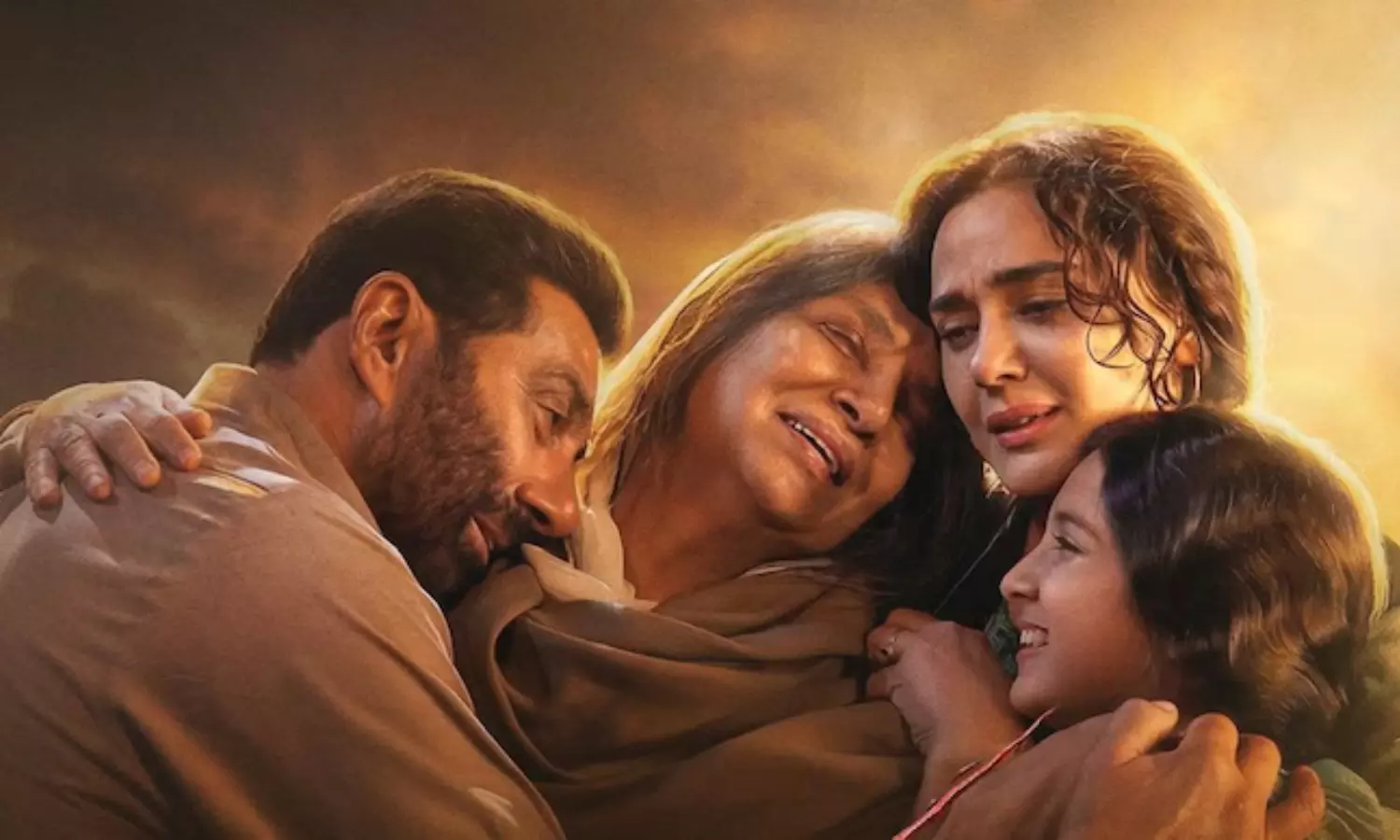
Batwara 1947 Poster
Cast: Shabana Azmi, Sunny Deol, Abhimanyu Singh, Preity Zinta, Ali Fazal, Karan Deol and others
Director: Rajkumar Santoshi
Rating: 3/5
Story
Set during the Partition of 1947, Batwara 1947 follows Sikander Mirza, played by Sunny Deol, who moves to Lahore with his family and gets a large house to live in.
But there is already someone living there, Durga, played by Shabana Azmi, an elderly Hindu woman whose son was killed during the riots.
Sikander's family initially wants Durga to leave. Sikander also agrees with them. But as the story progresses, Durga slowly becomes part of the family.
This becomes the emotional centre of the film.
The film avoids making the story simply about Hindus versus Muslims. Instead, director Rajkumar Santoshi focuses on humanity, motherhood and grief.
Several scenes underline this idea. A Muslim family celebrates Diwali. A Muslim man lights a diya near the Krishna Tulsi plant. The film also shows Muslims performing Hindu last rites.
The central idea is captured in the line:
“Maa ko mazhab mein mat baato, Maa khud ek mazhab hai.”
Performances
Shabana Azmi is the emotional backbone of the film. Much of the film's emotional weight comes through her character.
Sunny Deol plays Sikander in a much more restrained way than the angry, explosive characters audiences may associate with him. His scenes with Yakub, played by Abhimanyu Singh, provide the film with some of its commercial energy.
Singh is particularly effective as Yakub and brings intensity to the conflict.
Preity Zinta is sincere in her role, while Ali Fazal makes an impression despite having limited scope. But Karan Deol needs more confidence in his performance.
Rajkumar Santoshi and Sunny Deol reunion
The Santoshi-Sunny Deol combination is interesting because the two were known for their anger-driven films in the 1990s.
However, their approach is different in this movie. With no Ghayal-style rage at the centre of the film, the film's primary weapon is emotion.
Santoshi also uses symbolism, particularly around religion, family, Diwali and the final rites to reinforce the film's message.
Where the film works
The second half is stronger than the first.
The police station sequence and Durga's final rites provide the emotional punch the film has been building towards.
The final portion, especially the last 20 minutes, is where the film's central message comes through most strongly.
Where the film struggles
The first half is slow and feels stretched, and the songs also interrupt the flow. At the same time, some scenes become overly melodramatic and loud, while certain moments feel too preachy.
Technically, the production design and colour palette occasionally resemble an old television serial. The editing could have been tighter, and the sound mixing is uneven, particularly during Sunny Deol's louder moments.
Verdict
Batwara 1947 is slow, occasionally preachy and technically uneven. But its central idea vividly revolves around grief having no religion, and a mother having no border.
The film is less interested in showing Partition only as a story of Hindu-Muslim conflict and more interested in asking what happens when people choose humanity over identity.
Rating: 3/5
( Source : Deccan Chronicle )

Next Story