Amrita Bagchi on Operation Safed Sagar and the Human Cost of War

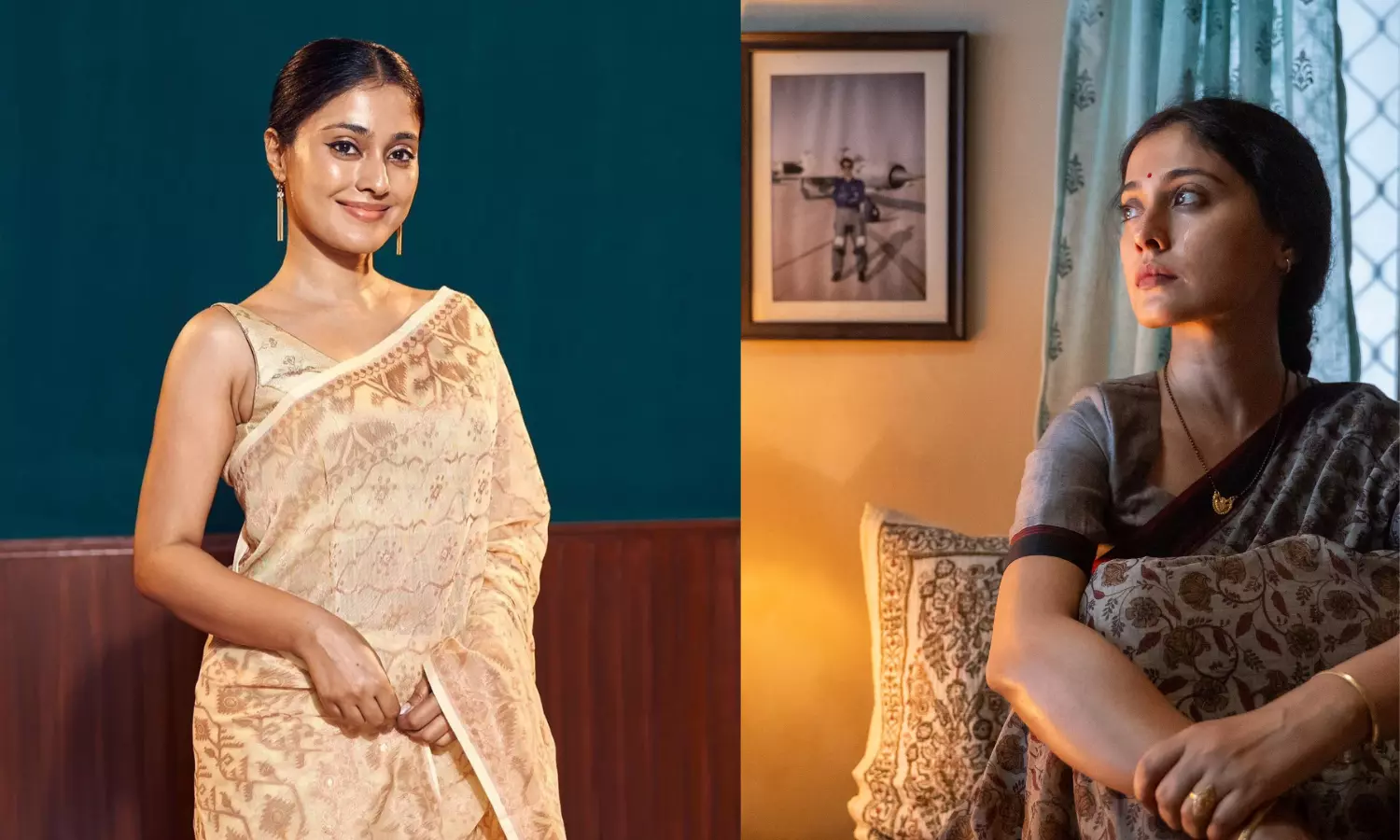
Actor Amrita Bagchi portrays Alka in the series. A multidisciplinary artist with a background spanning theatre, filmmaking, illustration and music, Amrita brings a deeply personal perspective to the character.
Can you tell us a little about your character Alka in Operation Safed Sagar?
Alka Ahuja is based on a real person. She is the wife of late Squadron Leader Ajay Ahuja, who we lost during the Kargil War in 1999.
Ajay ji was part of the Golden Arrows, which was part of the Indian Air Force and was exclusively a photo-reconnaissance squadron. So, they had to go and take photos where the army could not reach and get information about infiltration on the LOC.
Ajay ji was following his orders and getting information when he went back to rescue a colleague who had also ejected, whose jet had malfunctioned. In doing so, the colleague got rescued, but Ajay ji ended up ejecting and going into enemy territory. He was then tortured and his body was sent back. Alka ji was his wife.
They have a son together, Ankur, who was around 6-7 years old at the time. They were a really equal couple. They were best friends, completely in love with each other, very anchored home, very anchored togetherness.
This sudden loss is something that Alka ji faced at a very young age. She was 32 years at the time. And that's the person I'm portraying.
At that time, the country did not know the role of the Air Force in the Kargil War. People outside the defence forces didn't really know much about it.
Alka ji went on to run a petrol pump and she has been doing that for 25 years without acknowledgement, without the country knowing about Ajay ji. So, now, when she's in her mid-fifties, this show is kind of doing justice to Ajay ji, to Alka ji's sacrifice and the loss that she faced.
There's so much resilience to her that she didn't lose faith. She didn't lose faith in the country. She didn't lose faith in good things.
So, that's my character in a nutshell. And I think it starts at a very delicate time of love and joy in their life. And the arc kind of moves into tragedy and strength.
Amrita Bagchi and Siddharth with Alka Ahuja.
Since the characters are based on real-life people, was it challenging to put it on screen?
We had tremendous support from the Indian Air Force. We had Verlin Panwar, who used to be a squadron leader with the Air Force and she's now retired. She's helping filmmakers and storytellers tell Air Force stories and get the technicalities right.
I also spent a lot of time with Alka ji. I sat with her. She told me so many stories and shared photos of Ajay ji.
So, it's a huge responsibility for sure. I was definitely anxious about getting it right. But with the kind of support I got from her and the kind of access I had to her, I must say they made it very easy.
Did playing Alka change your own understanding of what resilience can look like?
It absolutely changed.
When I see the women from the Air Force, whether they are spouses or whether they're active parts of the defence forces, they have this very unreal amount of optimism.
It's very difficult to be the family of a martyr, to not be acknowledged for almost a quarter of a decade and to continue smiling after that. Of course, we can say that we don't have a choice and you have to move on. But to not be a bitter person is very difficult.
I feel that after playing this character, especially after studying people like Alka ji and the other people of the Air Force, you really realise your place in the universe.
As citizens of the country, our forces are doing what they can to make sure we sleep well. So as citizens, it is our responsibility to participate in the country, to participate in bettering the nation.
If they're protecting us, it is also our job to protect the thing that they are protecting. These two have been major takeaways.
Do you think stories about war often overlook the emotional lives of families waiting at home?
Yes, they do. And I feel that's where Operation Safed Sagar has really succeeded, because it kind of is a story about war that tells you that war is not necessary.
When you don't show the human cost, when you don't show the families, you end up glamorising the war. You end up glamorising the action.
But the moment you show the human cost, the moment you show the sacrifices made by people who are not actively in combat, you're immediately saying that this war is not necessary.
We had to do it. We were pushed into it. But is it really that the way? Is violence really the way?
So I think a good show or film on war should actually be about the unnecessariness, essentially, if I know that's not a word, but that it should be about peace.
A good film about war should talk about the lack of need of war.
What has this role taught you about portraying grief without making it overly dramatic?
I think these are very directorial calls. We had Oni Sen who was directing us, Abhijeet Parmar and Kushal Srivastava, who were the creators. They were very clear about the volume of the performance, because I think that's where the tone is set. As an actor, I have to be very mouldable. My job is to deliver the director's vision based on what they want.
The volume and tone was set from very early on that you play real life. You don't do anything over. You don't do melodrama.
The second thing I feel is that we all take from our own emotional pools of grief. It's not like I can go and copy it. I can't mimic grief.
I have to delve into my emotional pool and find grief that aligns with whatever the emotion that I'm trying to encapsulate.
In doing that, I realise that a little distance from my personal grief is needed. If it's a recent grief that I'm pulling into, then I will not be able to stop when the director says cut. It's not a tap. I can't turn it off.
But if you have distance from your grief, like I did, then I feel it allows you to control the amount, when to start, when to stop.
So, tonality is set by the director and the process to achieve that tonality comes from your own emotional experiences and how recent or how far back they are.
Is it true that the cast members of the series didn't use phones on sets?
It's hundred percent true. We were shooting in real Air Force bases. We shot in NAL Air Force Base in Bikaner, we shot in the Murr Island Air Force Base, and the boys shot in Air Force bases across North India, up in the Himalayas.
Air Force bases do not allow phones. They don't allow anything with GPS trackers. Our IDs and phones would have to be submitted at the gate in these sealed pouches.
Not just phones, smart watches, iPads, laptops, anything with GPS trackers.
So we didn't have phones on set. And for me personally, I really enjoyed it. I think it made us bond more.
How did it help you in bonding with other cast and crew members?
It really massively helped.
Everyone's a really great person. It's one of those shows where a lot of good people have come together. All the actors, directors, creators, everyone was so good.
When the phones were taken away, it went into Dhamshiraj and Antakshari.
The women of the Air Force were so graceful because we were shooting in their houses, on their streets. They opened their homes up to us in the middle of the night.
Parathas used to come, cakes used to come. And then we would see sunrise, see sunset. We would actually go plant a tree.
So, I personally, it really felt like being back in the 90s and it felt super healthy.
How much of Alka ji stayed with you, or how much of the character Alka stayed with you after the shoot?
I wouldn't say Alka ji, because she's a person. She's around and she's far more resilient and far bigger than who I am.
I would say there is definitely something I have learned from her strength and from her grace.
You can't really exit out of a character like this because it's such an extension of our day-to-day lives.
But I think what has stayed mostly about Alka ji is a certain lightness of being. She doesn't walk around a heavy person.
She doesn't walk around asking for self-pity or asking everybody to sympathise with her. She's such a light person. She's smiling, laughing all the time.
And she keeps saying that that's what she owes to Ajay ji, that he was a very fun-loving guy. The last thing he would want to see is me crying after 25 years.
So I think that lightness, if we can find a way to become like that, is something I would definitely like to hold on to.
How was it working with Siddharth and Oni Sen?
Incredible. Both of them.
Siddharth is such a generous co-actor. He really believes in equality, truly fundamentally believes in that.
Building with him is very easy because he's not thinking, “Ki, mera shot kitna hoga, ya main kitna focus mein rahunga.”
His priority is always the scene and the plot point that we are talking about. He will do anything to create and collaborate on creating an equal relationship, whether it's with his co-actors or with the creators.
And he's also very funny. Especially with dealing with such heavy things, that beautiful wonder that he brought in was wonderful.
Oni Sen is also somebody who is my super, super senior from college. When I was in my first or second year, he would come to teach there. He was a visiting faculty there.
For me, doing the series with him was such a special experience because he's so collected. He's so calm.
If you've seen the series, you know there are lots of challenging circumstances in which they've shot. It's a very heavy series that's been shot over a period of a year and a half.
His energy is so calming that when he enters a set, you don't get rattled. You don't get scared.
It is so easy to surrender to Oni as a director because he will not take a wrong decision. It was so easy to surrender to him.
You came to acting through graphic design, illustration, theatre, music and filmmaking. Do you think being multidisciplinary makes you a different kind of actor, or does it sometimes make it harder for you to choose where your creative energy should go?
Filmmaking is where all the kind of arts kind of collide. You would say there's also a lot of science that comes into filmmaking if you really get into lensing and light, and the technicality that a DOP gets into or a VFX person gets into, artistically, of course.
So I feel it's an amalgamation. Having experience in some of those areas definitely helps me in understanding scene work better or understanding angles better and things like that, storytelling overall.
But whether it makes me a different kind of actor, I don't know if that's something I can say. Maybe the directors who worked with me are more qualified to answer that.
I don't have any formal training and I have learned on the go. So I think if there is one thing that I would like to continue having in my journey as an actor is the flexibility and the openness to keep learning.
Whichever set I go to, there's always some actors that I'm learning from, that I'm picking things up from. And I hope that continues because that really helps me grow.
Since you have done theatre and now you are doing cinema as well, what is something that theatre can give you but cinema cannot?
There are so many perks to it. I feel like theatre gives you immediate audience response.
You play a part and then, based on audience response, you can keep tweaking it. You get like 40, 50, 100 chances depending on the number of shows you do to kind of keep honing that part.
I had done a play with Kalki, and Kalki is really into preparation and she's very sincere and her method and process is very intense. She kept telling me that theatre is like gym for acting.
It's where you really get to build your acting muscles because your volume, your projection, your presence, your focus. Like this line needs to deliver to this particular audience. This is to my co-actor. This is for the light.
This kind of clarity and rigor that theatre has, that is, I think, super, super helpful.
Whereas on a screen, you kind of only get one chance, like multiple takes. But once it's in the film, you don't get to change it based on audience reaction. You can only hope to change it in your next film.
But in theatre, you can keep evolving and you can keep changing your performance till you perfect it.
And of course, the immediate human interaction, the immediate thing of seeing something funny on stage and the audience laughs. Whereas in film, it's a more isolated experience.
You're constantly trying a different way and you don't know, did it land? Did it not land?
So it's of course an incredible medium, but it's a different medium.
Can you tell us about your future projects?
In my future, there are two films. One is a Gujarati independent film that I've done called Rooj. It's directed by Himajeev Verma and it's gearing up for a theatrical release in Gujarat. Maybe end of this year or sometime next year.
There is also another English-Hindi independent feature film I've done set in Bangalore. It's called How to Not Have Sex.
Basically, there's a film by Richard Linklater called Tape, which was made in the early 2000s. So it's the Indian adaptation of Richard Linklater's film. This adaptation is called How to Not Have Sex.
Richard Linklater and his writer themselves have come on board as executive producers.
So it's just on its festival journey. We played in Austin. We played in Seattle. We played in New York. And now it's going to play at Melbourne.