India, NZ Strike FTA Deal, Aim to Double Trade Flow

Indian youth to get longer post-study visas in Auckland
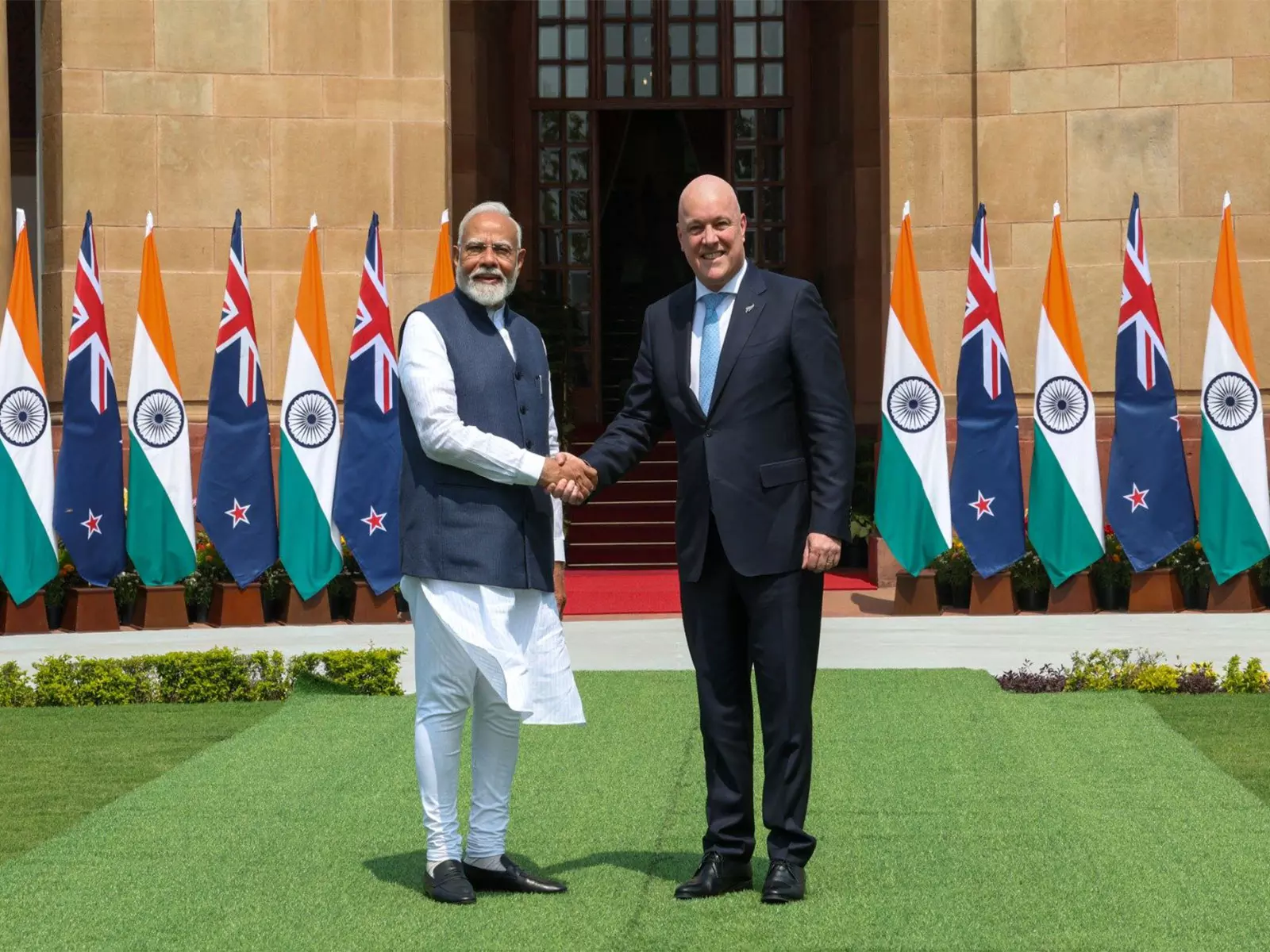
New Delhi: Prime Minister Narendra Modi and his New Zealand counterpart Christopher Luxon spoke on Monday and jointly announced the successful conclusion of a “historic, ambitious and mutually beneficial” Free Trade Agreement (FTA) between the two countries. Both leaders expressed confidence that the agreement would help double bilateral trade over the next five years and lead to investments of about $20 billion from New Zealand into India over the next 15 years. These investments are expected to support manufacturing, infrastructure, services, innovation and employment in line with India’s Make in India vision.
India described the pact as a “new-generation trade agreement” built around tariffs, agricultural productivity, investment and talent, forming part of a people-centric, jobs-driven strategic partnership aimed at Viksit Bharat 2047.
Under the agreement, India will eliminate or reduce tariffs on 95 per cent of imports from New Zealand. About 57 per cent of New Zealand’s exports to India will become duty-free from day one, rising to 82 per cent once the agreement is fully implemented. The remaining 13 per cent will be subject to significant tariff reductions. As a result, the average tariff applied to New Zealand imports will fall sharply to about 3 per cent.
Tariffs on sheep meat, wool, coal and forestry products will be removed immediately.
Duties on kiwifruit, apples, cherries, avocados, blueberries, manuka honey, fish, seafood, and iron and steel will be reduced or eliminated in a phased manner.
The FTA will give duty-free access to a range of domestic goods, particularly from labour-intensive sectors. The agreement is expected to help double bilateral trade in goods and services to $5 billion in five years.
The commerce ministry said the FTA provides zero-duty market access for all Indian exports to New Zealand, including textiles, pharmaceuticals, leather, engineering goods and agricultural products. To protect the interests of domestic farmers and MSMEs, India will not give any duty concessions in the politically sensitive dairy sector, like milk, cream, whey, yoghurt, and cheese. The other products which will not be covered under the pact include vegetable products (onions, chana, peas, corn, almonds), sugar, artificial honey, animal, vegetable or microbial fats and oils, arms and ammunition, gems and jewellery, copper and its products, and aluminium and articles.
The agreement also includes significant mobility provisions. Indian students will be eligible for post-study work rights of up to three years for STEM undergraduate and master’s programmes, and up to four years for doctoral scholars. A dedicated quota of 5,000 temporary employment entry visas and 1,000 work and holiday visas has also been created. The professional visa category covers AYUSH practitioners, yoga instructors, Indian chefs, music teachers and professionals in high-demand sectors such as IT, engineering, healthcare, education and construction.
The ministry said the FTA was concluded after five formal negotiation rounds and multiple in-person and virtual intersession meetings, describing it as a comprehensive, balanced and forward-looking pact. This is the third FTA concluded by India this year, following agreements with the United Kingdom and Oman, and comes amid ongoing negotiations with the European Union and the United States.
New Zealand announced the pact would be inked in the first half of next year, but according to a Reuters report, there could be trouble brewing. While the New Zealand Prime Minister announced that “the gains are wide-ranging and significant”, his coalition partner, New Zealand First, announced it would oppose the pact in Parliament. NZ First leader Winston Peters was quoted by Reuters as stating that the deal “gives too much away, especially on immigration, and does not get enough in return for New Zealanders, including on dairy”.
The commerce ministry said New Zealand has offered its “best-ever” market access and services commitments to India, covering 118 services sectors and Most-Favoured Nation treatment in 139 sub-sectors. These include IT, professional services, audio-visual, telecommunications, construction, tourism and travel-related services.
Agricultural cooperation under the FTA includes restricted market access for apples, kiwifruit and honey, linked to quotas and minimum import prices. The pact also provides duty-free access to key inputs such as wooden logs, coking coal and metal waste and scrap, and establishes Centres of Excellence for apples, kiwifruit and honey to improve productivity and farmer incomes.
Further under the pact, New Zealand will set up a dedicated Agri-Technology Action Plan on kiwifruit, apples and honey with a view to helping Indian farmers enhance productivity and quality. The cooperation includes the establishment of Centres of Excellence, improved planting material, capacity building for growers and technical support for the orchard management, post-harvest practices, supply chain performance, and food safety.
Commitment has been extended by New Zealand on Geographical Indications (GIs), including the amendment of its law to facilitate the registration of India’s wines and spirits.
“Cooperation has been agreed in AYUSH, culture, fisheries, audiovisual tourism, forestry, horticulture and traditional knowledge systems,” the commerce ministry said.
Apart from tariff liberalisation, the pact includes provisions to address non-tariff barriers through enhanced regulatory cooperation, and streamlined customs, sanitary and phyto-sanitary measures and technical barriers to trade disciplines.
The pharma and medical devices sector will get a boost through faster regulatory access in New Zealand by enabling acceptance of GMP (Good Manufacturing Practice) and GCP (Good Clinical Practice) inspection reports from comparable regulators, including approvals by the US FDA, EU’s EMA, UK’s MHRA.
The FTA negotiations were formally launched on March 16 this year during the meeting between Union commerce and industry minister Piyush Goyal and New Zealand trade and investment minister Todd McClay.
Commerce and industry minister Piyush Goyal said that this is the seventh agreement finalised by the NDA government. It includes the UAE, Australia, the UK, EFTA bloc, Oman and Mauritius. He said that the India-New Zealand pact is the first pact in which all the main officials from the Indian side involved in the negotiations were women. India’s chief negotiator is joint secretary in the ministry, Petal Dhillon.
He also said that India has so far finalised FTAs with three members of the Five Eyes (FVEY) alliance — Australia, the UK and New Zealand.
