This Election, Tamil Nadu’s Water Future Is at Stake

28 March 2026 8:22 PM IST28 March 2026 8:22 PM IST
For a state with just 2.5% of India’s water resources, water security may be the defining electoral outcome, one that AIADMK says it can deliver
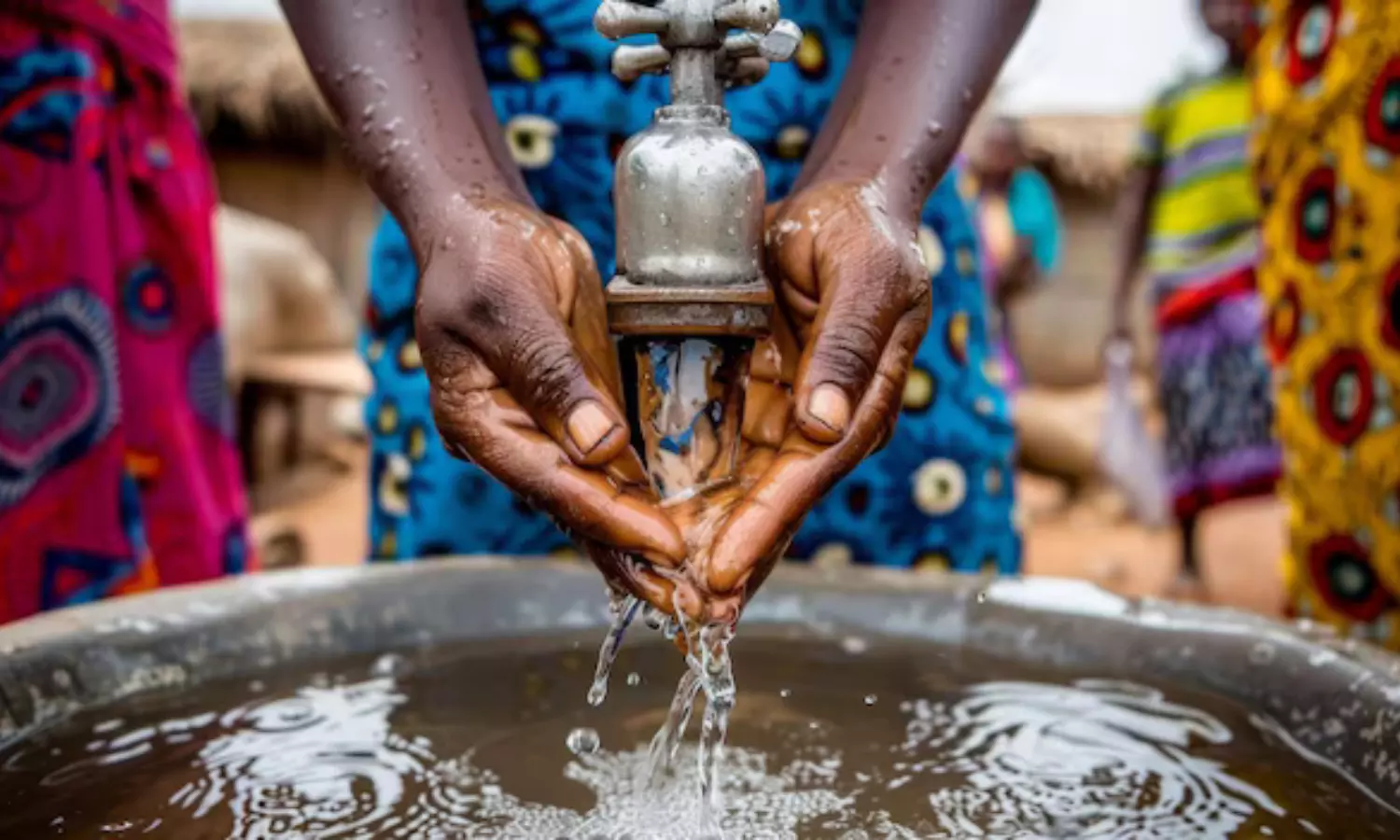
Representational Image/Freepik
In many parts of Tamil Nadu, a good monsoon is no longer enough.
What matters just as much is what happens after the rain, whether tanks hold, canals carry, and water stays long enough to make a difference. Across districts, the signs of strain are often visible in small ways: a lake that fills but does not last the season, a borewell that needs to go deeper each year, and fields that depend a little more on uncertainty than they once did.
The pressure can be illustrated by the fact that the state holds barely 2.5% of India’s water resources but supports nearly 7% of its population. Per capita water availability in Tamil Nadu is estimated to be in the range of 750 to 900 cubic metres, much lower than the national average, which is nearly double that.
Demand has steadily outpaced availability, not just in cities but across rural and agricultural belts as well. This points to a deeper reality: water management here is not only about supply, but also about planning, maintenance and, crucially, continuity.
Despite this structural constraint, Tamil Nadu’s dependence on monsoons, coupled with recurring drought cycles, has historically made water security a central public concern. The consequences of mismanagement are immediate and visible, including distressed agriculture, depleting groundwater and, at times, a scramble for drinking water.
It is in this context that water policy in the state has often oscillated between long-term planning and short-term response.
During his tenure as Chief Minister, Edappadi K. Palaniswami placed visible emphasis on irrigation and water conservation infrastructure. Schemes such as Kudimaramathu sought to revive a traditional model of community-led maintenance of water bodies, focusing on desilting and restoration, and ensuring that tanks and lakes retained their capacity to capture monsoon flows.
Similarly, projects like the Athikadavu-Avinashi scheme were designed to address regional imbalances by diverting surplus water to drought-prone districts. While the project itself had earlier origins, its execution phase gained traction during this period, reflecting a broader administrative push toward infrastructure-led solutions. At a more localised level, initiatives such as the restoration of multiple lakes across western Tamil Nadu pointed to an approach that combined scale with regional targeting.
These efforts were complemented by welfare-linked administrative measures during periods of stress, including drought years and the Covid-19 pandemic, when the focus extended to ensuring continuity in farm operations and rural livelihoods.
This brings the focus, inevitably, to the question of administrative continuity.
Yet, as with most policy domains, the effectiveness of such interventions depends not only on their design, but also on their continuity.
In recent years, questions have emerged around whether this focus on water-related infrastructure has been maintained. Some initiatives associated with earlier frameworks appear to have slowed or been reconfigured. The suspension of programmes like Kudimaramathu, for instance, has been flagged by sections of farmers and local stakeholders, particularly in the context of missed opportunities for rainwater harvesting during erratic monsoon cycles.
Alka S. Yadav is a Doctoral Scholar at CHRIST (Deemed to be University)
Concerns have also been raised around water quality and maintenance practices. In Madurai, for instance, reports of pollution in the Vaigai river, which continues to serve as a source for multiple drinking water schemes, have drawn attention to gaps in water treatment and monitoring systems. More broadly, allegations of inadequate desilting, sewage mismanagement and neglect of irrigation infrastructure have added to a perception challenge around implementation.
As Tamil Nadu heads into an election, this lived experience is being directly addressed in political messaging. The AIADMK’s manifesto places water infrastructure at the centre of its pitch, calling for the revival of desilting programmes, expansion of irrigation through river-linking projects and faster completion of pending works. At its core is an argument for continuity over disruption. In a state where water stress is structural, the electoral test may well rest on which vision convinces voters it can deliver consistent, year-round water security.
Proposals such as reviving large-scale desilting initiatives, expanding irrigation through new phases of river-linking projects and addressing longstanding inter-state water issues are being positioned within this broader framework. The underlying idea is straightforward: in a water-stressed state, disruption in policy execution can carry costs that are both immediate and cumulative.
For voters, however, the choice is unlikely to be framed in technical terms alone. It will rest on lived experience, whether water reaches their fields, whether groundwater levels hold, and whether supply systems function reliably through the year.
In that sense, the debate over water in Tamil Nadu is no longer just about scarcity. It is about governance, how policies are implemented, how consistently they are pursued and whether the state can sustain a long-term approach to one of its most critical challenges.
The article is authored by Alka S. Yadav is a Doctoral Scholar at CHRIST (Deemed to be University), researching multiculturalism and Public Policy.
( Source : Guest Post )

Next Story