IBC Needs Reforms as Recoveries Remain Low, Resolution Delays Persist

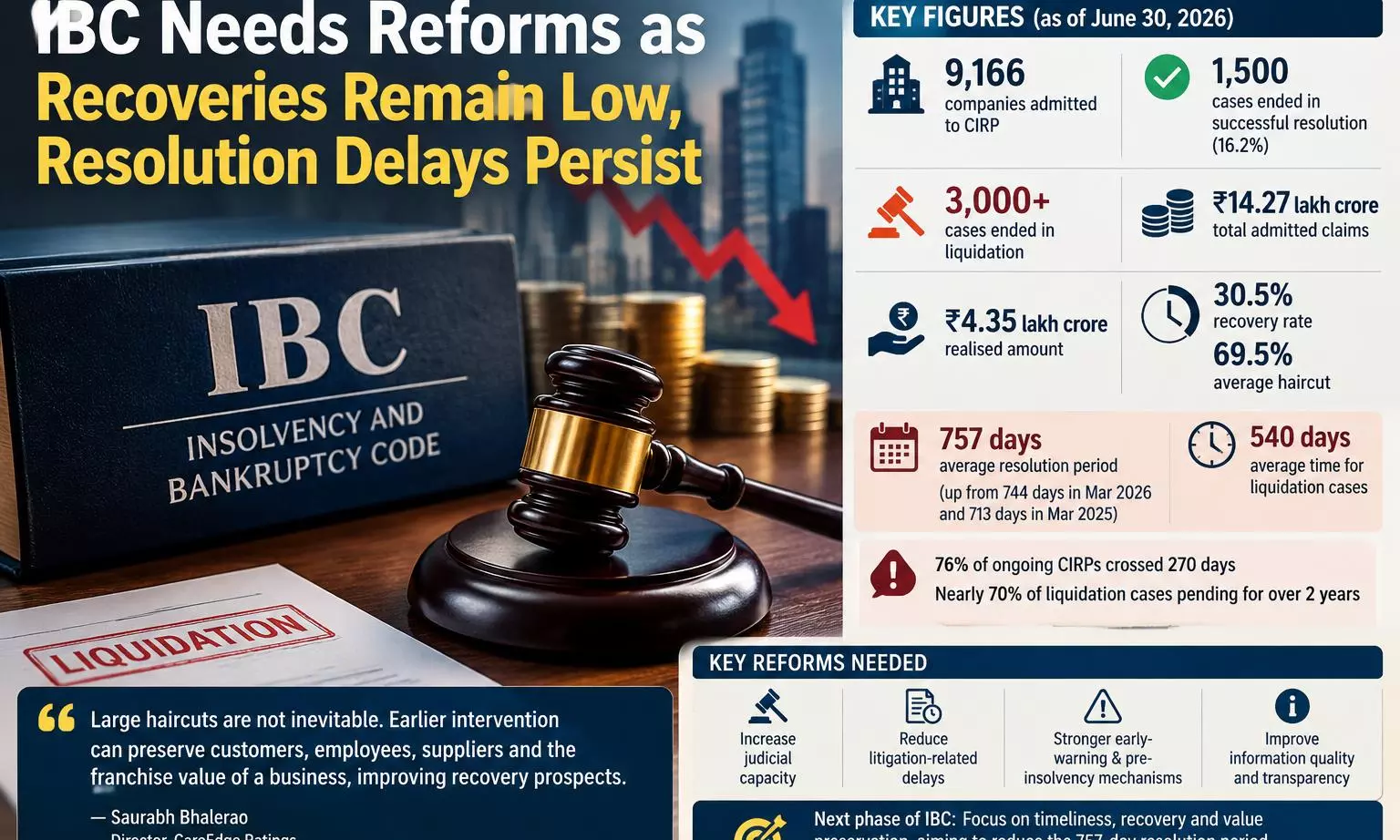
As of June 30, 2026, a total of 9,166 companies had been admitted to the Corporate Insolvency Resolution Process (CIRP)
Chennai: The latest controversy involving Essel Group Chairman Subhash Chandra has highlighted discrepancies in the Insolvency and Bankruptcy Code (IBC). Creditors have had to take a nearly 70 per cent haircut on their claims, while insolvency proceedings often extend to more than twice the prescribed timeline. By then, many distressed companies lose significant value.
Saurabh Bhalerao, Director at CareEdge Ratings, said the IBC needs reforms, including increased judicial capacity, reduced litigation-related delays, stronger early-warning and pre-insolvency restructuring mechanisms, and improved information quality and transparency.
As of June 30, 2026, a total of 9,166 companies had been admitted to the Corporate Insolvency Resolution Process (CIRP), of which around 1,500 cases, or 16.2 per cent, had ended in successful resolution. More than 3,000 cases had ended in liquidation, while others were closed through appeals, reviews, settlements or withdrawals.
Cumulative admitted claims stood at Rs 14.27 lakh crore, against which around Rs 4.35 lakh crore had been realised. This translates into a recovery rate of 30.5 per cent and an average haircut of 69.5 per cent.
Prolonged timelines remain a major concern. The average resolution period increased to 757 days in June 2026 from 744 days in March 2026 and 713 days in March 2025. Liquidation cases took roughly 540 days on average.
Around 76 per cent of ongoing CIRPs had already crossed 270 days, while nearly 70 per cent of ongoing liquidation cases had remained pending for more than two years.
According to Bhalerao, litigation and procedural delays, valuation disputes, difficulties in achieving stakeholder consensus, challenges in attracting credible resolution applicants, and the increasing complexity of stressed assets are among the key reasons for the delays.
He also pointed to a structural problem: companies often enter the insolvency process only after significant deterioration in their financial and operational condition. This reduces both their chances of revival and the pool of potential resolution applicants.
Large haircuts, therefore, are not necessarily inevitable, he said. Earlier intervention can help preserve customers, employees, suppliers and the franchise value of a business, thereby improving recovery prospects.
The cost of weak recoveries is borne directly by banks through provisions, capital and profitability. Depositors are affected indirectly through wider credit spreads and more conservative lending. There can also be a fiscal impact when public sector banks require government capital support.
Bhalerao called for greater judicial capacity, reduced litigation-related delays, stronger early-warning and pre-insolvency restructuring mechanisms, and improved information quality and transparency.
The next phase of the IBC should focus on timeliness, recovery and value preservation, with the aim of reducing the 757-day average resolution period and improving recoveries beyond the current 30.5 per cent.
