Sensex, Nifty Rebound, Rupee Marginally Up From Record Low on RBI Intervention

Dollar selling, equity recovery lift markets despite Middle East tensions
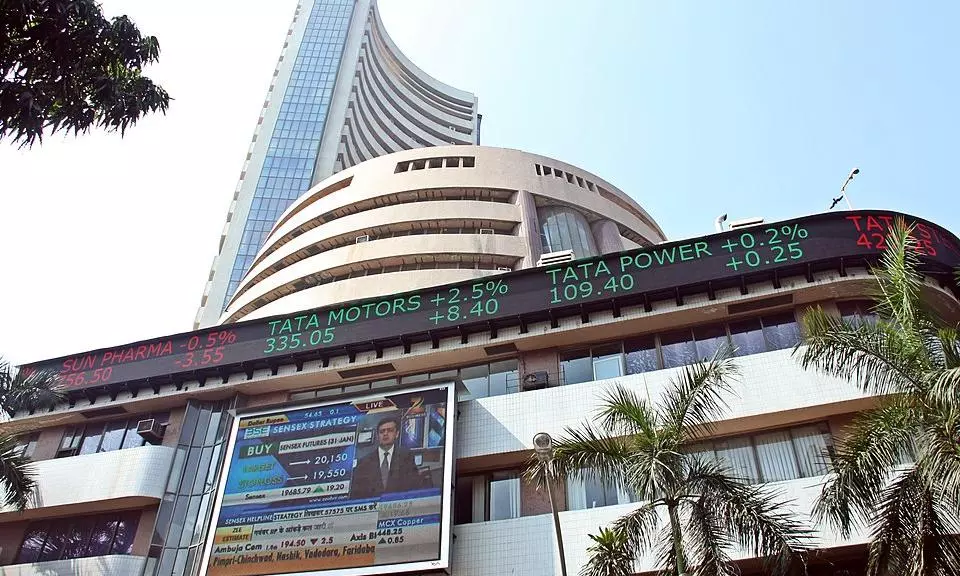
Mumbai: The Indian rupee began the week on a constructive note on the back of dollar selling by the central bank through state-run banks, a recovery in domestic equities and a softening of the US Dollar against major global peers. The Sensex surged 939 points, or 1.26 per cent, to close at 75,502.85, while the Nifty 50 gained 258 points, or 1.11 per cent, to settle at 23,408.80 after briefly touching a session low of 22,955 as value buying emerged from lower levels amid assurance from the Trump administration on safe transit for ships through the Strait of Hormuz.
Among sectors, auto and financial indices rallied over one percent, whereas oil and gas and realty indices lost the most, shedding over 1.5 percent.
At the interbank foreign exchange market, the rupee opened at Rs 92.44 and touched its lowest-ever intra-day level of Rs 92.47 against the greenback during the session. It finally ended at Rs 92.40, down 10 paise from the previous close.
The Indian Rupee (INR) and the equity markets endured turbulence last week as the country’s heavy reliance on energy imports came into sharp focus. Higher oil costs are a "double whammy" for the Indian economy as they widen the current account deficit and fuel domestic inflationary pressures. A sustained 25 per cent rise in oil prices could increase India’s import bill by about $15 billion, widen its current account deficit by around 0.3 per cent of GDP, increase inflation by roughly 0.7 per cent and reduce GDP growth by approximately 0.2 per cent. Higher oil prices would also weaken the rupee, increase fiscal pressures, and potentially delay monetary easing by the RBI. Remittances from the Gulf, worth $40–50 billion annually, and the large Indian diaspora in the region also face indirect risks. Sentiment in India remains cautious. Domestic equity markets tanked more than 5 per cent last week, while the rupee depreciated roughly 0.8 per cent. Foreign investors pulled back from both Indian equities and debt, seeking the safety of the USD.
Market breadth on the BSE was more cautious. Of 4,537 stocks traded, only 1,509 advanced while 2,860 declined, and 907 stocks hit fresh 52-week lows against just 81 at 52-week highs.
Among Nifty gainers, UltraTech Cement led the pack, surging 4.46 per cent to Rs 11,090, followed by Grasim Industries at 3.44 per cent to Rs 2,656.90, Mahindra & Mahindra at 3.34 per cent to Rs 3,029, Eternal at 3.16 per cent to Rs 222.50 and Trent at 2.68 per cent to Rs 3,581.20. On the losing side, Bharat Electronics fell 2.48 per cent to Rs 428.50, Max Healthcare dropped 2.32 per cent to Rs 967, Wipro declined 1.79 per cent to Rs 194.05, Coal India shed 1.71 per cent to Rs 459, and ONGC slipped 1.51 per cent to Rs 260.10. Auto and financial stocks carried the recovery, while oil & gas and realty remained under pressure.
India VIX cooled 4.47 per cent to settle at 21.63, offering some relief, though it remains elevated above 20.
Ponmudi R, CEO of Enrich Money, a SEBI - registered online trading and wealth tech firm said, “While the market has shown encouraging signs of recovery, the broader trend is likely to remain range-bound and consolidation-driven in the near term. The next directional move will largely depend on developments in the Middle East conflict, movements in crude oil prices, currency stability, and institutional fund flows.”
According to Dilip Parmar, senior research analyst, HDFC Securities, said, “While possible intervention by the Reserve Bank of India (RBI) has provided a critical floor for the local currency, the Rupee remains tethered near historic lows. This persistent pressure stems from sustained dollar demand among importers and the ongoing trend of foreign fund outflows. For the upcoming sessions, one should be eyes on a spot USD-INR with immediate resistance at 92.60 and a key support at 92.05.”
The war in the Middle East and its impact on energy supply will continue to dictate global markets and will play a key part in a series of rate decisions from major monetary authorities. The Federal Reserve will headline such decisions in Chair Powell's second-to-last meeting in his term. Policy setting is also featured for G10 monetary authorities in the European Central Bank, Bank of Japan, Bank of England, Swiss National Bank, Reserve Bank of Australia, Bank of China, and the Swedish Riksbank, in addition to central banks in China, Brazil and Russia,” said Mecklai Financial Services.
