Finance Minister Nirmala Sitharaman presented the Union Budget 2026–27 with a clear focus on sustaining economic growth, strengthening infrastructure, boosting manufacturing and maintaining fiscal discipline, while continuing support for key social sectors
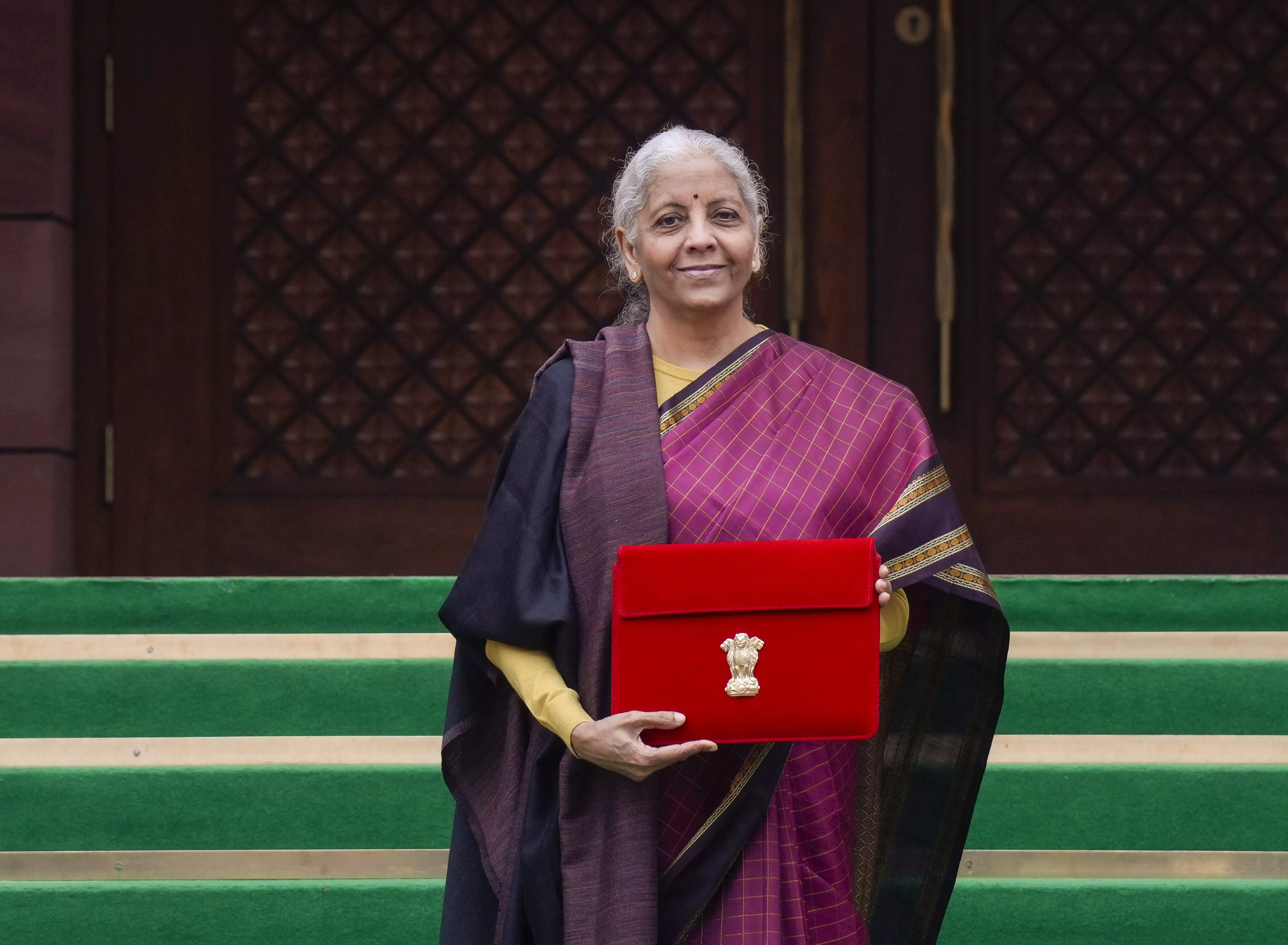
New Delhi: Choosing “reforms over populism”, the government on Sunday opted for a Union Budget 2026-27 with a long-term focus on infrastructure creation, manufacturing, skilling and job creation to insulate the country from global turbulence. Presenting her ninth Budget in a row, the country’s longest serving finance minister Nirmala Sitharaman, refused to play Santa by cutting down income-tax rates for the common man though relief came in other forms.
Keeping in mind India’s strategic needs, the turbulent global geopolitical situation and the shaky world economy, the government, as the minister said, has chosen “action over ambivalence”, “reform over rhetoric” and “people over populism”. She added the government has pursued far-reaching structural reforms, fiscal prudence and monetary stability whilst maintaining a strong thrust on public investment.
“The Reform Express is well on its way and will maintain its momentum to help us fulfil our kartavya”, Sitharaman said in her Budget speech adding this was the first Budget of the second quarter of the century.
The minister said the Budget was prepared with a vision of India at 2047 in mind and was inspired by three “kartavyas” (duties) of the government. These are: to accelerate and sustain economic growth by enhancing productivity, competitiveness and building resilience to volatile global dynamics; to fulfil the aspirations of people and build their capacity; and to provide equity in access to resources, amenities and opportunities. Accordingly, the Budget lays emphasis on scaling up manufacturing in seven strategic and frontier sectors. These are biopharma, semi-conductors, electronics components manufacturing, rare earth minerals, chemical parks, textiles and manufacturing of containers, construction and infrastructure equipment.
While trying to insulate the nation from two major geopolitical uncertainties -- trade tariffs and trade barriers, Ms Sitharaman underlined that while facing an external environment in which trade and multilateralism are imperilled and access to resources and supply chains are disrupted, as a growing economy with expanding trade and capital needs, India must also remain deeply integrated with global markets, exporting more and attracting stable long-term investment.
Giving a major push to infrastructure creation and upgradation of assets, the finance minister announced a major increase in public capital expenditure -- from Rs 2 lakh crores in FY2014-15 to an allocation of Rs 12.2 lakh crores in FY2026-27. The minister underlined that this capex of Rs 12.2 lakh crores is 4.4 per cent of GDP.
This, the minister explained, will take care of dedicated freight corridors, 20 new waterways passing through critical mineral-rich states, coastal cargo movement and city economic rejuvenation, for which Rs 5,000 crore in five will be given to cities. To support mineral-rich states of Odisha, Kerala, Andhra Pradesh and Tamil Nadu, dedicated rare earth corridors will be established to promote mining, processing, research and manufacturing to reduce dependency on foreign countries. In a bid to reduce exports of medicines and promote home-grown industry, Ms Sitharaman has given a big boost to the bio-pharma sector in the country.
“Seven strategic and frontier sectors like bio-pharma is a big change in the way we are looking at R&D, for which Rs 10,000 crores is being given. Semi-conductors are important for electronic component manufacturing and to become self-sufficient, rare earth mineral corridors will help India meet its own requirements and our dependency on external sources will be lesser. This will have multiple decadal impact on our economy and our dependence on magnets and rare earths will come down,” the minister said.
To strengthen capital goods capability, the government plans to set up hi-tech tool rooms that will manufacture high-precision components at large scale and at lower cost. A scheme for the enhancement of construction and infrastructure equipment (CIE) will be introduced, to strengthen domestic manufacturing of high-value and technologically-advanced CIE. A scheme for container manufacturing too was announced while another scheme for coastal cargo promotion will be launched for incentivising a modal shift from rail and road, to increase the share of inland waterways and coastal shipping. The minister said incentives will be provided to indigenise the manufacturing of seaplanes and enhance last-mile and remote connectivity, and promote tourism.
Some other features of the Budget are that Individual Persons Resident Outside India (PROIs) will be permitted to invest in equity instruments of listed Indian companies through the Portfolio Investment Scheme (PIS). Interest awarded by the motor accident claim tribunal will be exempt from I-T. There will be reduction in Tax Collected at Source (TCS) rate on sale of overseas tour programme packages from 5 per cent and 20 per cent to 2 per cent without any stipulation of amount.
The Budget also proposes to reduce TCS for pursuing education and for medical purposes under the Liberalised Remittance Scheme (LRS) from 5 per cent to 2 per cent. TDS on the supply of manpower services is proposed to be at the rate of either 1 per cent or 2 per cent.
The time available for revising I-T returns is extended from December 31 to up to March 31 with the payment of a nominal fee. Individuals with ITR-1 and ITR-2 returns will continue to file till July 31, and non-audit business cases or trusts are proposed to be allowed time till August 31.
The TDS on the sale of immovable property by a non-resident to be deducted and deposited through resident buyer’s PAN instead of TAN. The government is introducing a one-time six-month foreign asset disclosure scheme below a certain size for small taxpayers. Taxpayers can update their returns even after reassessment proceedings have been initiated at an additional 10 per cent tax rate over and above the rate applicable for the relevant year.
There will be an exemption on import duty on 17 drugs for cancer, along with medicines and food for special medical needs for seven rare diseases and drugs and medicines imported for personal use. There will be exemption from basic customs duty on specified parts used in microwave ovens that will bring down its cost.
The stock market fell after the minister announced hikes in the Securities Transaction Tax (STT) on futures and options (F&O) trades.
----------------------
Finance Minister Nirmala Sitharaman presented the Union Budget 2026–27 with a clear focus on sustaining economic growth, strengthening infrastructure, boosting manufacturing and maintaining fiscal discipline, while continuing support for key social sectors.
A major highlight of the Budget was the strong push for infrastructure. The government announced a record capital expenditure outlay of around Rs 12.2 lakh crore for the coming financial year, signalling continued emphasis on roads, railways, logistics, urban infrastructure and connectivity. This capex-led approach is aimed at crowding in private investment and creating jobs.
The Budget reinforced India’s growth-oriented strategy in a challenging global environment. The government reiterated its commitment to long-term economic stability through calibrated fiscal consolidation, while ensuring sufficient spending to support growth, employment and domestic demand.
Manufacturing and strategic industries received focused attention. New measures were announced to strengthen domestic manufacturing capabilities, including initiatives linked to electronics, semiconductors, rare earth minerals and biopharmaceuticals. These steps are intended to reduce import dependence and position India as a competitive global manufacturing hub.
Support for MSMEs and small businesses featured prominently. A dedicated growth fund for SMEs was announced to help high-potential enterprises access capital, scale up operations and generate employment. Measures to improve credit flow and ease of doing business for smaller firms were also highlighted.
The transport sector saw renewed emphasis, particularly railways. The Budget proposed new high-speed and semi-high-speed rail corridors to improve connectivity between major economic centres, reduce travel time and promote more sustainable transport options.
On the social sector front, the Budget continued to focus on welfare and inclusion. Initiatives were announced to strengthen healthcare infrastructure, expand trauma care facilities and enhance social security coverage, including for gig and platform workers. Agriculture and rural development remained key priorities, with targeted programmes aimed at improving farmer incomes and rural livelihoods.
In taxation, the Budget largely prioritised stability and simplification over major rate changes. The government underlined efforts to rationalise compliance, improve transparency and enhance ease of doing business, while continuing discussions around providing relief to the middle class within a fiscally responsible framework.
Overall, the Union Budget 2026–27 reflects a balancing act between growth and prudence. With a strong infrastructure push, targeted support for manufacturing and MSMEs, and sustained focus on welfare, the Budget seeks to lay the foundation for long-term economic resilience while addressing immediate development needs.