Headline Retail Inflation Rises To Two-year High Of 5.54 pc In September

This marks the sixth consecutive monthly rise in the annual inflation rate since March. The spike also took inflation further above the Reserve Bank of India's 4 percent target, although it remained within the central bank's tolerance band of 2–6 pc
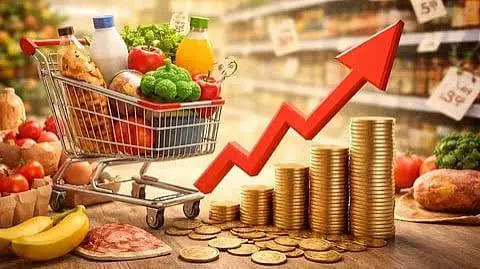
New Delhi: Headline retail inflation rose to an almost nearly two-year high of 5.54 per cent in September, crossing the 5 percent mark for the first time in the new Consumer Price Index (CPI) series. The September inflation, however, saw a sharp acceleration in food prices that pushed up household costs, the government said on Monday.
As per the data released by ministry of statistics & programme implementation, inflation increased to 5.54 per cent in September from 4.83 percent in August, marking the sixth consecutive monthly rise in the annual inflation rate since March. The spike also took inflation further above the Reserve Bank of India's 4 percent target, although it remained within the central bank's tolerance band of 2–6 percent.
The further highlighted that food inflation climbed to 7.74 per cent during the month, against 5.97 per cent in August. However, experts said that the main reason for the spike could be pressures stemming from weak monsoons, regional supply disruptions, and energy and crude price volatility linked to geopolitical tensions in the Middle East.
“Among major states, Tamil Nadu recorded the highest headline inflation at 6.81 percent, followed by Odisha at 6.70 percent, Madhya Pradesh at 6.68 percent, Telangana at 6.64 percent and Andhra Pradesh at 6.29 percent,” the ministry data showed.
Despite the increase of key food articles, the data also showed that onions recorded the steepest price increase among the major items, with inflation reaching 108.09 percent, compared with 48.78 percent in August. “Similarly, garlic prices accelerated to 54.62 percent from 43.60 percent, while lemon prices rose 36.41 percent compared with 15.15 percent in the previous month,” it showed.
However, the ministry data said that some vegetables continued to provide relief. “Potato prices declined 11.50 percent year-on-year, while tomato prices fell 8.62 percent. Besides, silver jewellery inflation remained exceptionally elevated at 87.80 percent, although it moderated from 106.81 percent in August,” it showed.
“The increase in inflation was more pronounced in rural India, where retail inflation rose to 6.08 percent in September from 5.24 percent in August. Urban inflation too increased to 4.88 percent from 4.31 percent,” it said.
Commenting on the data, Radhika Rao, senior economist and executive director, DBS Bank said that food inflation continued to quicken, driven by a broader set of sub-segments amid below-normal rainfall, imported price pressures and derivative fuel impacts. “Fourth-quarter 2026 pressures will be under watch, as a low base, along with higher food, fuel and services inflation, is set to lift headline prints, tracking closer to 6 per cent,” Rao said.
On evolving food and core price pressures and the RBI’s approach to managing rupee volatility, she also said that a gradual rise in the core gauge aligns with the central bank’s view that price risks are no longer benign. “In the face of higher headline prints, we expect the RBI to keep the door open for another rate hike in December 2026,” she added.
However, Nirav Karkera, head of research and fund manager, W by Groww said that inflation has climbed steadily over the past two quarters, and recent prints show no loss of momentum. Food and supply pressures are the main drivers. “Onion, which carries meaningful weight in the basket, has seen a steep rise in prices. This accounts for a meaningful share of headline inflation,” he said.
“Freight and eating-out costs are picking up pace. These are the key channels through which a supply shock spreads to the broader basket, though most services remain contained for now. Rural households are carrying a heavier burden. That raises concerns for consumption, especially with a weak monsoon and El Nino threatening the rabi harvest,” he added.
