Adobe CEO to Step Down in Face of Investor Concerns Over AI

13 March 2026 12:31 PM IST13 March 2026 12:31 PM IST
Narayen, who served as CEO for 18 years, will remain in the position until a successor has been appointed, Adobe said in a statement
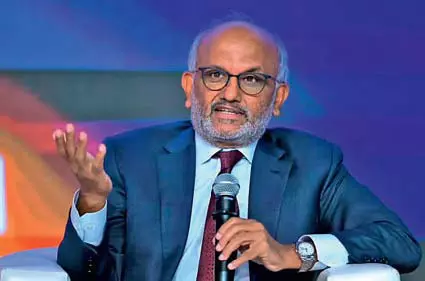
Adobe CEO Shantanu Narayen. (DC File Photo)
Adobe Chief Executive Officer Shantanu Narayen will resign from his position atop the creative software giant amid deep skepticism about the company’s ability to thrive in the AI era.
Narayen, who served as CEO for 18 years, will remain in the position until a successor has been appointed, Adobe said Thursday in a statement. The 62-year-old will stay on as board chairman.
The CEO change “adds questions around strategic continuity, capital allocation priorities and pace of innovation,” Grace Harmon, an analyst at Emarketer, said in an email. “Investors will likely focus on whether incoming leadership maintains a balance between disciplined execution and aggressive AI investment, especially as competition in creative and enterprise AI intensifies.”
The shares fell about 7% in extended trading after closing at $269.78 in New York. The stock has declined about 23% in 2026, putting it near its lowest level in three years.
The maker of Photoshop and other products for creative arts professionals is among a group of application software companies, including Salesforce Inc. and Atlassian Corp., seen as struggling to win new customers in the face of AI upstarts. Adobe has worked to weave artificial intelligence tools through its creative and marketing software — and offers its own range of AI models meant to generate imagery that doesn’t carry copyright risks — in an effort to keep its massive market share.
Narayen oversaw a period of huge growth at the company. Adobe’s annual revenue has multiplied almost six times to about $24 billion since he took over at the end of 2007, and the workforce has grown from about 7,000 to more than 30,000. He is often credited with steering one of the first successful transitions in software to a business model in which customers bought recurring subscriptions to bundles of products, rather than one-time purchases of individual applications.
Narayen had “a legendary run at Adobe,” Microsoft CEO Satya Nadella wrote on social network X. Dylan Field, the chief executive officer of Figma Inc., which Adobe tried to acquire in 2022, wrote that Narayen is “thoughtful, kind and relentless in pursuit of Adobe’s vision.”
Still, Narayen’s direction has been increasingly questioned by investors in recent years. Generative AI has made it easier to create visual media without Adobe’s expensive products. Many of the most popular new AI creative tools, such as Google’s Veo 3 AI models, are built by competitors.
“We are focused on selecting the right leader for this next exciting chapter of the company’s growth and are grateful for Shantanu’s continued leadership as CEO to ensure a smooth transition,” said Frank Calderoni, the board’s lead independent director, who will oversee the search for Narayen’s successor.
Annual recurring revenue for the company’s AI-first products such as Firefly more than tripled in the fiscal first quarter compared with the same period last year, Narayen said on a conference call after Adobe released results. In September, the company said sales from these products exceeded $250 million.
Also on Thursday, Adobe projected revenue will be $6.43 billion to $6.48 billion in the period ending in May. Analysts, on average, estimated $6.43 billion, according to data compiled by Bloomberg. Profit, excluding some items, will be $5.80 to $5.85 a share, compared with an average projection of $5.70.
In the fiscal first quarter, sales increased 12% to $6.4 billion, compared with analysts’ average estimate of $6.28 billion. Adjusted earnings were $6.06 a share in the period, which ended Feb. 27. The average projection was $5.88 a share.
Creative and marketing professionals generated $4.39 billion in subscription revenue, while business professionals and consumers produced $1.78 billion.
The departure of Narayen overshadowed what were otherwise steady results, wrote Anurag Rana, an analyst at Bloomberg Intelligence. “Adobe’s financial metrics have shown little noticeable change since early last year, yet the stock is down almost 40% — likely a key reason for the planned CEO transition.”
( Source : Bloomberg )

Next Story