A Himalayan Wake-Up Call For Disaster Insurance

The need for climate insurance is becoming harder to ignore.
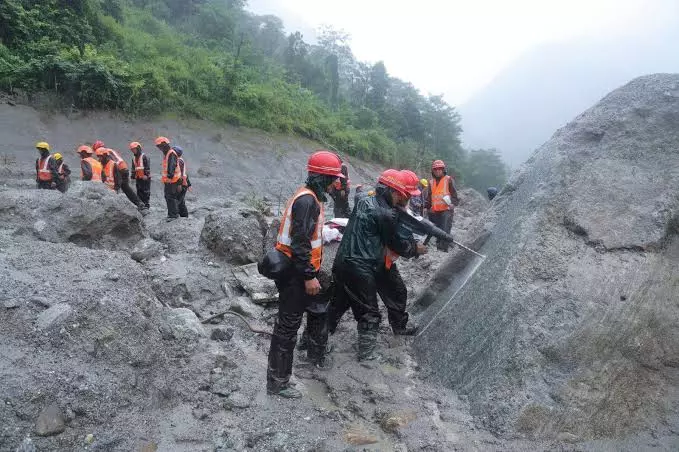
Nepal, Nepal flood, Trishuli River, flash floods, Betrawati Bazaar, Rasuwa district,The Nepal-Tibet disaster
The Nepal-Tibet disaster of last week will leave scars long after the floodwaters recede. It is also a stark reminder of a gap policymakers have yet to fill: how to protect households, businesses and governments from mounting climate risks. That's our focus this week.
INSURING AGAINST DISASTERS
The human tragedy in the Himalayas is still unfold
A glacier collapse last week unleashed a flash flood that has killed more than 900 people, and nearly 5,000 are still missing. Read here for the latest update.
The disaster swept away roads, bridges and hydropower facilities, leaving Nepal with a reconstruction bill estimated at $4 billion to $5 billion, or roughly a tenth of its economy.
The country has sought foreign technical help to rebuild.
While catastrophes of the scale seen in Nepal may be difficult to model, the growing economic toll of climate-linked disasters is renewing calls for more structured insurance protection.
Swiss Re Institute, a research wing of the reinsurer, estimated natural catastrophes caused $100 billion in losses globally in the first half of 2026, according to its report published on August 11. Around 42% of those losses were insured, largely because many events occurred in heavily insured markets such as the U.S.
In India, insurance coverage against disaster-related losses remains sparse, with estimates suggesting only about 5% of losses are insured, according to a paper by New Delhi-based think-tank Social Policy Research Foundation.
A nationwide disaster insurance programme has been under discussion for several years. Ashwin Manikandan of Reuters reported last year that policymakers were examining a model that could include a small levy on utility bills to fund premiums. Read more on the proposed model here.
The proposal is yet to be implemented.
Without a national framework, government support after climate-related disasters remains largely ad hoc, said Shailaja Lall, partner and head of the insurance practice at law firm Shardul Amarchand Mangaldas & Co.
"States may provide relief, but there is nothing structured," she said, adding that a government-backed scheme could provide at least a basic level of mandatory protection.
GROWING CLIMATE RISKS
The need for climate insurance is becoming harder to ignore.
Across India, during the ongoing annual monsoon, there have been bouts of torrential rain. In the southern states, 14 people were killed, while 26 died in the north-eastern state of Assam and six in the country's financial capital Mumbai.
Beyond the human cost, heatwaves and floods are disrupting agriculture and businesses. Germanwatch, an environmental think-tank which publishes the Global Climate Risk Index, ranks India among the countries most affected by climate risk, estimating inflation-adjusted economic losses of about $170 billion over the past three decades until 2024.
One potential solution is parametric insurance, under which payouts are triggered automatically when predefined thresholds, such as rainfall levels, temperatures or cyclone intensity, are breached.
Although some Indian states have experimented with such programmes, adoption remains limited.
“In India, Nagaland has pioneered a state-level parametric disaster insurance programme, although the model is yet to be adopted more widely," said Pankaj Tomar, India and Southeast Asia head at insurance provider AXA Climate.
"Scaling such programmes requires a sustainable mechanism for funding insurance premiums and structured coordination among the stakeholders involved."
For businesses, traditional insurance works better, but parametric cover may help if conventional cover is unavailable or expensive, Tomar said.
"It may be particularly useful in hazard-prone locations such as parts of the Himalayas, where conventional insurance coverage or capacity can sometimes be difficult to obtain."
That is where Nepal's Upper Trishuli-1 hydropower project could become a test case. The project, damaged in the recent floods, is insured through a parametric policy according to publicly available information, making its recovery a closely watched example of how such products perform when disaster strikes.